What Is the CASHFLOW Quadrant?
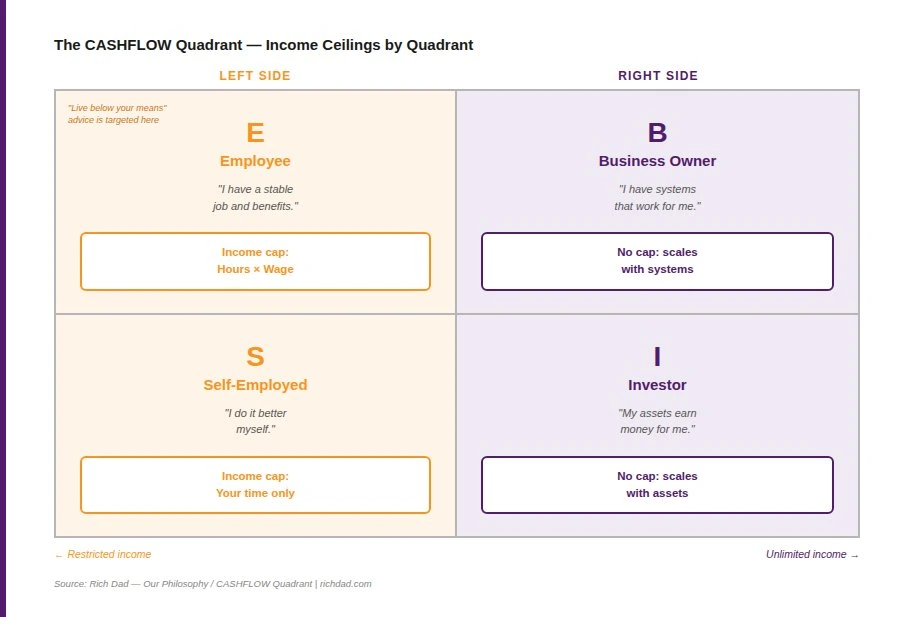
The CASHFLOW Quadrant, often searched as the cash flow quadrant or the ESBI quadrant, is a framework from Robert Kiyosaki’s book Rich Dad’s CASHFLOW Quadrant. It divides everyone who earns money into four groups: Employee, Self-Employed, Business Owner, and Investor. Each letter describes a source of income, and Rich Dad teaches that the source matters more than the amount.
The distinction surprises many readers because the quadrant is not a list of careers. A surgeon who draws a paycheck from a hospital earns as an E. The same surgeon running a private practice earns as an S. If that surgeon opens clinics that run without daily involvement and invests the profits in rental property, income now arrives from the B and I quadrants as well. Every person who generates income lives in at least one quadrant, and many live in several at once. Where you are is determined by where your cash comes from.
The Four CASHFLOW Quadrants Explained
Each quadrant carries its own mindset about money, risk, and education. Understanding all four is the first step toward choosing which one you want to build.
E Quadrant: The Employee
For employees, the most important thing is security. Robert Kiyosaki’s poor dad was an employee his entire life and wanted little more than a stable job with good benefits. He never understood why his son would want to become a business owner and investor, because to him nothing seemed riskier.
Because employees tend to avoid risk, they rarely see a reason to study money itself. For them, education means learning the skills that qualify them for a steady, high-paying job. When an employee needs more money, the usual move is to look for a higher-paying job. Income is capped at hours times wage, and it stops the day the paycheck does.
S Quadrant: The Self-Employed
People in the S quadrant tend to make poor employees and often believe no one can do the work better than they can. They tolerate more risk than employees and value control over their own future. Doctors, lawyers, dentists, accountants, consultants, and other service professionals typically live here.
Because of their high standards, self-employed people struggle to delegate, so they earn only while they work. In Rich Dad’s phrase, they do not own a business; they own a job. When an S needs more money, the usual answer is to bill more hours, which runs into a hard limit: the number of hours in a week.
B Quadrant: The Business Owner
Business owners own a system or a product that earns money whether or not they are in the room. Because they know they cannot succeed alone, they hire people with skills they lack, often people more talented than themselves, and delegate as much of the work as possible. The best business owners could leave for a year, come back, and find the company still profitable.
Business owners are often called risk takers, but Rich Dad points out that an employee has no say in a layoff, while an owner decides how the business responds when the economy turns. When a B needs more money, the answer is a new product or a new system that produces it. For a starting point, see how to start a business.
I Quadrant: The Investor
Investors have the strongest financial education in the quadrant. They look for assets that produce steady cash flow, and they often use other people’s money (OPM) to acquire them. They then reinvest the income to buy more assets, a cycle Rich Dad calls the velocity of money. Investors do not have to manage employees, and they do not have to work at all if they choose not to.
Rich Dad teaches that the largest fortunes are built on owning businesses and assets rather than drawing wages. When an investor needs more money, the answer is to acquire another asset that produces more passive income.
Left Side vs. Right Side of the CASHFLOW Quadrant
The dividing line between many who struggle financially and many who prosper runs between the two sides of the quadrant. Employees and the self-employed sit on the left, where income depends on their own time. Business owners and investors sit on the right, where income comes from systems and assets.
Left Side vs. Right Side of the CASHFLOW Quadrant
Where your income comes from decides what happens when you stop working.
| Quadrant | Income comes from | When you stop working | How each earns more |
|---|---|---|---|
| EmployeeLeft side | A paycheck from an employer | Income stops with the paycheck | Looks for a higher-paying job |
| Self-EmployedLeft side | Profit from your own work or practice | Income stops when you stop billing | Bills more hours |
| Business OwnerRight side | A business system or product | Income can continue without daily involvement | Creates a new product or system |
| InvestorRight side | Assets that produce cash flow | Income continues from the assets | Acquires another cash-flowing asset |
Source: Rich Dad — CASHFLOW Quadrant framework | richdad.com
Financial freedom can be found in all four quadrants, as Rich Dad’s guide to defining financial freedom explains, but the skills of a B or an I tend to get you there faster. In Rich Dad’s view, the more left-side earners make, the more they tend to send out in taxes and in payments on debt for liabilities, which is the cycle Rich Dad calls the Rat Race. Cash flow patterns show how that cycle differs for the poor, the middle class, and the rich.
How the Tax Code Treats Each Quadrant
How much you make does not make you rich. How much you keep does. That is why Rich Dad pays close attention to taxes, and why the quadrant matters. Left-side income is earned income, the kind the tax code taxes most heavily, while right-side income more often comes from assets.
For 2026, a single filer’s wages are taxed at ordinary income rates from 10% to 37%, and employees also pay 7.65% in Social Security and Medicare tax while their employer pays a matching 7.65%. The self-employed pay the same ordinary rates plus 15.3% self-employment tax on 92.35% of net earnings, and half of that tax is deductible. Business profit passes through to the owner at ordinary rates, or in a C-corporation is taxed at a flat 21% corporate rate. Investors who sell assets held more than a year pay long-term capital gains rates of 0%, 15%, or 20%, with a 3.8% net investment income tax added above $200,000 of income for single filers.
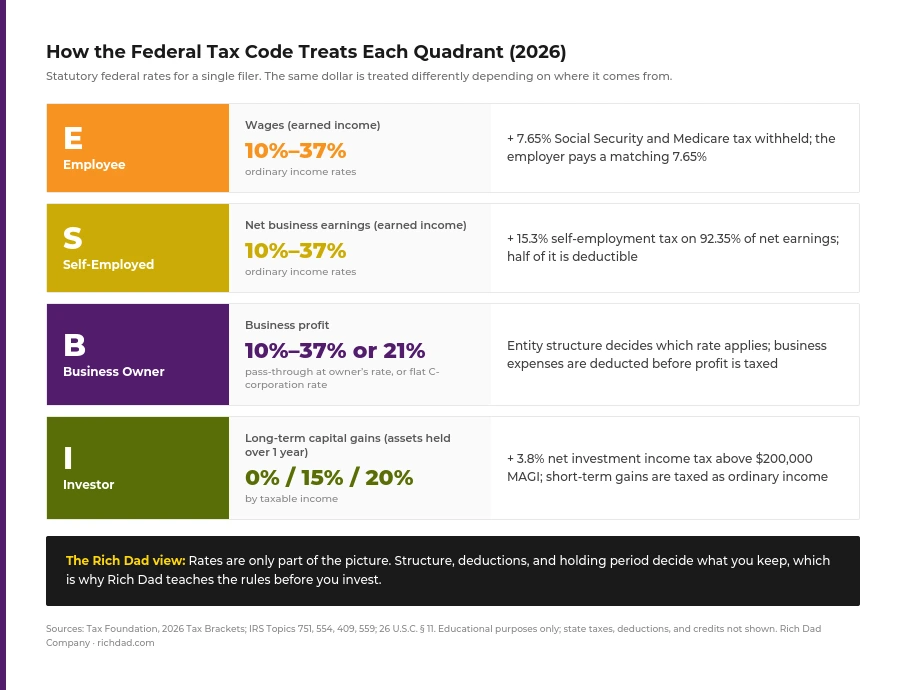
Rates are only part of the story. Deductions, entity structure, and holding periods decide what a business owner or investor actually keeps, which is why Rich Dad teaches the rules before you invest. Individual results vary with deductions, state taxes, and structure.
The Real Risks on Each Side of the CASHFLOW Quadrant
Rich Dad does not claim the right side is risk-free, and the data shows why education has to come first. Business ownership is hard. According to the Bureau of Labor Statistics, of private-sector business establishments that opened in March 2013, 79.6% were still operating after one year, 50.6% after five years, and 34.7% after ten.
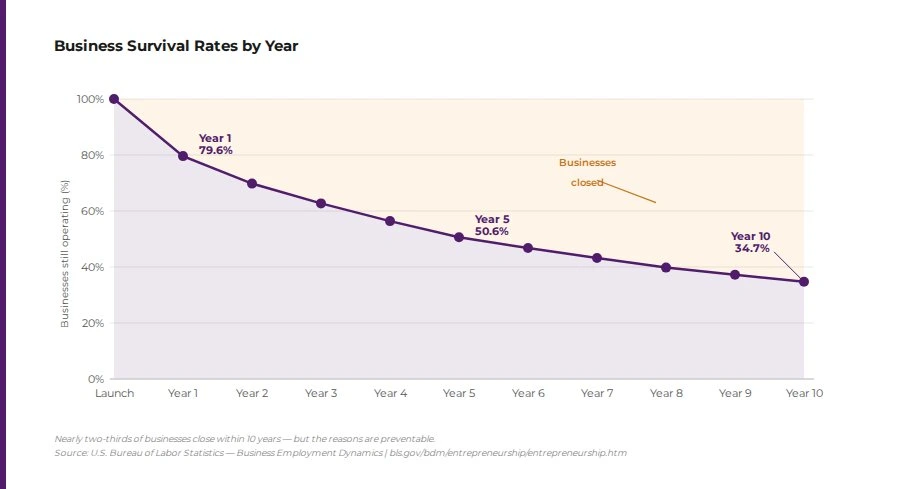
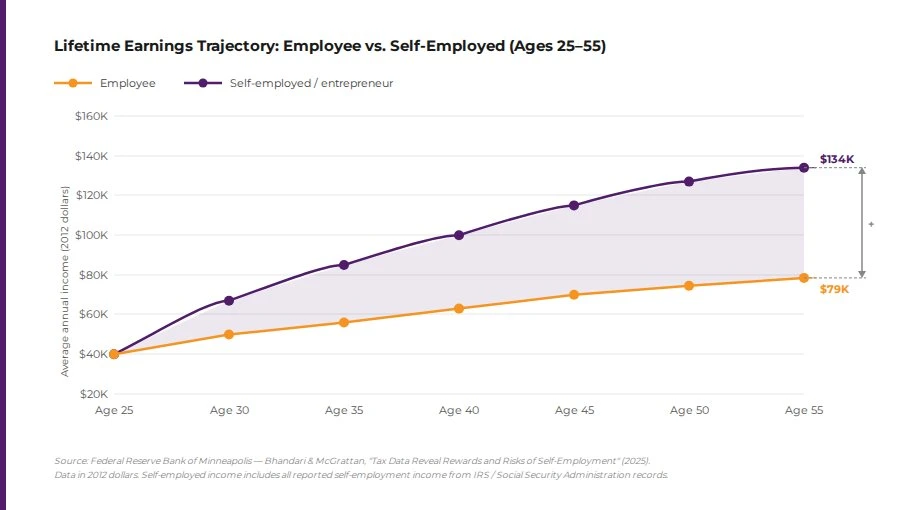
Self-employment shows the same pattern of high reward and high variance. A Minneapolis Fed analysis of IRS and Social Security records found that by age 55, workers who had tried self-employment averaged about $134,000 a year, compared with about $79,000 for paid employees (in 2012 dollars). The same research found that the gap between high and low self-employed earners widens two and a half to three times faster than it does among employees, and that once education and skills are accounted for, most self-employed workers report less income than comparable paid peers. When the 2008 downturn hit, self-employed incomes fell about 10% below their prior average.
Rich Dad’s answer is not to stay put. Staying an employee carries its own risk, because an employee cannot control a layoff. The answer is to treat risk as an education problem: the more you know about business, taxes, and investing, the more of the risk you can manage instead of merely endure.
The Mindset Behind Each Side of the CASHFLOW Quadrant
Most people are taught the mindset of the left side. In his book Why “A” Students Work for “C” Students, Robert Kiyosaki writes that every child has a genius, the one thing that lights up their life, and that school often fails to recognize it. Schools teach one path: get good grades, get a degree, get a good job. That path leads to the E or S quadrant, because careers like doctor, lawyer, and teacher live there.
The Rat Race follows. College debt demands a high-paying job. A house adds more debt, so the paycheck has to keep coming. Children, health care, and other expenses close the circle, and the dreams of youth give way to work that does not feed the soul. If any of these sound familiar, it may be time to rethink the path:
- “I love what I do, but I wish I could make more money.”
- “I can’t wait for the weekend.”
- “I want to do my own thing.”
- “Is it quitting time yet?”
Rich Dad teaches three habits for shifting toward the right side: keep a long-term vision and plan, practice delayed gratification, and put compounding to work in your favor instead of letting it work against you through debt. Start small, be patient, and watch wealth build over time.
Rich Dad’s New Rules of Money and the Quadrant
The quadrant is one half of how Rich Dad explains modern money. The other half is the 8 new rules of money from Robert Kiyosaki’s book Conspiracy of the Rich: money is knowledge; learn how to use debt; learn how to control cash flow; prepare for bad times and you will only know good times; the need for speed; learn the language of money; life is a team sport, so choose your team carefully; and since money is becoming worth less and less, learn to print your own. Both ideas point in the same direction. Advice built for earlier generations assumes a world that has changed, and doing things the way your parents did them is no longer a reliable plan.
How to Move From the Left Side to the Right Side of the CASHFLOW Quadrant
Moving quadrants is a process, not a leap. Rich Dad suggests these steps:
- Audit your income. Add up last month’s income and sort each dollar into earned, portfolio, or passive income. Most people find nearly all of it is earned.
- Name your next step. An employee might start a side business or begin investing. A self-employed professional might document processes and delegate pieces of the work so the business can run without them.
- Start small with assets that pay. Look at real estate and other cash-flowing options covered in investing for passive income.
- Learn how debt and OPM work before using either. Good debt can build wealth, and bad debt can end it, which is why education comes first.
- Reinvest the income. Use the cash flow from one asset to acquire the next, keeping your capital in motion.
- Keep learning by doing. Play the CASHFLOW game to practice the concepts, and take the CASHFLOW Quadrant course to go deeper.
No degree program teaches how to operate on the B and I side. Reading Rich Dad’s CASHFLOW Quadrant and studying the skills it describes costs far less than a traditional education, and the return on that study can be much larger.
Choosing Your Side of the CASHFLOW Quadrant
The CASHFLOW Quadrant does not tell anyone to quit a job tomorrow. It gives a way to see where income comes from, how it is taxed, and how much control it provides. Those who understand the four quadrants can make deliberate choices instead of drifting along the path school and habit prescribed.
Rich Dad’s advice is to begin with education, then act on a small scale and build from there. Start with the book, the CASHFLOW game, or the course, and put the quadrant to work on your own numbers.
FAQs
The CASHFLOW Quadrant is a framework from Robert Kiyosaki that sorts all income into four types: Employee (E), Self-Employed (S), Business Owner (B), and Investor (I). It classifies you by where your income comes from, not by your job title.
ESBI stands for Employee, Self-Employed, Business Owner, and Investor. E and S make up the left side of the quadrant, and B and I make up the right side.
Rich Dad teaches that financial freedom can be found in all four quadrants, but the skills of the B and I quadrants tend to get you there faster because income there does not depend on your own hours.
Yes. Every person who earns income lives in at least one quadrant, and many live in several. An employee who owns rental property earns in both E and I, for example.
Start by auditing where your income comes from, then build income that does not depend on your hours: a business system, or assets that produce cash flow. Rich Dad recommends starting small and learning as you go.
Robert Kiyosaki introduced the CASHFLOW Quadrant in his book Rich Dad’s CASHFLOW Quadrant. You can learn more about Robert Kiyosaki and his philosophy on the Rich Dad site.
The official book is sold at the Rich Dad store. The CASHFLOW Quadrant course covers the same ideas in a course format.
No. The quadrant is a framework from a book, while CASHFLOW is a board game that lets you practice investing and escaping the Rat Race. The two teach related ideas.