What passive income really means
Most people equate investing with watching a number go up — a stock price, a 401(k) balance, a home’s estimated value. Rich Dad calls this capital gains investing, and it’s really a form of speculation: an investor buys an asset, hopes the market values it higher later, and only gets paid if they sell at the right time. Passive income investing is a different game entirely. It asks a single question of every dollar deployed: does this asset put cash in my pocket this month, regardless of what the market does tomorrow?
That distinction matters because it changes how an investor evaluates risk. A capital-gains investor loses sleep over price swings because a paper loss becomes a real loss the moment they need the money. A passive-income investor collects rent, dividends, or profit distributions on a set schedule and can ride out volatility because the income never depended on selling in the first place.The three different types of cash flow patterns
The three cash flow patterns: Poor, middle class, and rich
Rich Dad’s foundational teaching starts with three simple diagrams of where money goes each month. The poor live paycheck to paycheck: income arrives, expenses consume it, and if the math doesn’t work, debt fills the gap. The middle class looks wealthier on paper — bigger homes, nicer cars — but the pattern is nearly identical. Income still comes from a job, and it still flows straight out to liabilities dressed up as rewards: a larger mortgage, a car payment, a growing pile of consumer debt. When income stops, so does the ability to keep up.

The rich operate a third pattern entirely. Their income originates from assets — real estate, business systems, dividend-paying holdings — and that income covers their expenses without a paycheck ever entering the picture. This is the pattern passive income investing is designed to build.
The CASHFLOW Quadrant: Why passive income requires a mindset shift
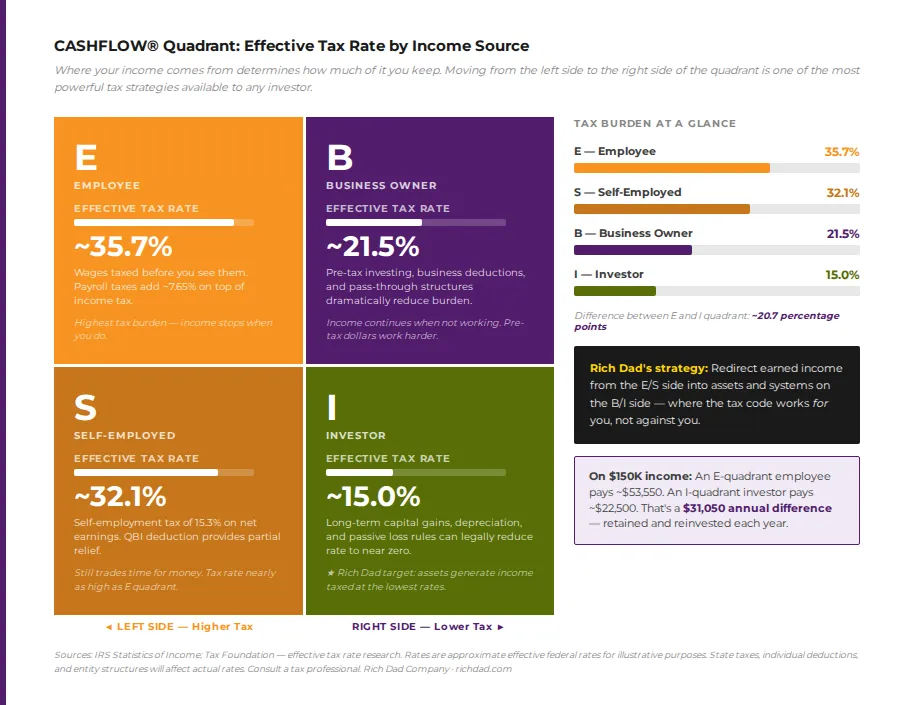
Rich Dad’s CASHFLOW Quadrant sorts every income source into four positions: Employee (E) and Self-Employed (S) on the left, Business Owner (B) and Investor (I) on the right. Es and Ss trade time for money — their income is capped by hours worked and stops the moment they stop working. Bs and Is are on the other side of the ledger: their income comes from systems and assets that keep producing whether they personally show up or not.
This is why passive income investing is really an I-quadrant skill. It isn’t about working harder inside a job or a solo practice — it’s about redirecting capital into assets that generate cash flow independently of the investor’s daily labor. The goal isn’t to escape work altogether; it’s to reach the point where work becomes optional because the assets already cover the bills.
Passive income vs. capital gains: Why cash flow wins over time
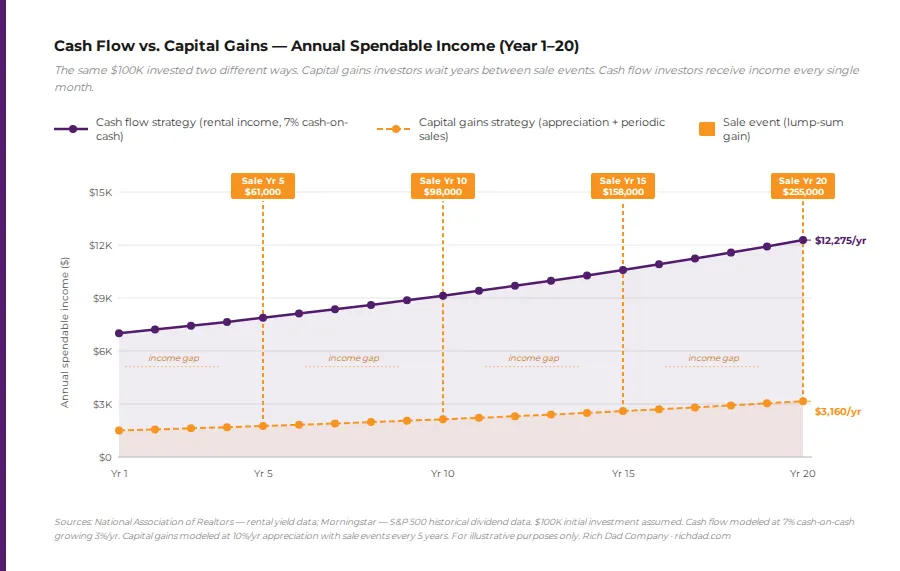
The clearest way to see the difference between these two approaches is to compare their payout schedules. A capital-gains strategy pays an investor only when they sell — meaning long stretches with no income at all, followed by a lump sum that’s taxed and then has to be reinvested from scratch. A cash-flow strategy pays every single month, and because that income compounds and grows with the underlying asset, the gap between the two approaches widens every year an investor holds on.The CASHFLOW Quadrant: Why passive income requires a mindset shift
The tax advantage built into passive income
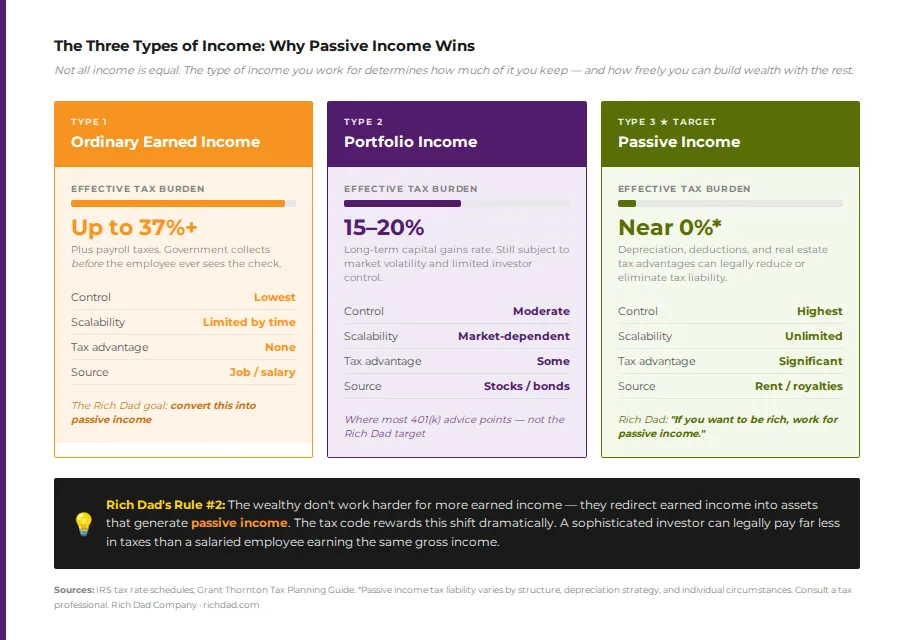
Where income comes from doesn’t just affect how much control an investor has — it directly affects how much of that income the IRS collects before it ever reaches a bank account. Wages are taxed first and hardest: payroll taxes are withheld before an employee ever sees the paycheck, and the effective federal rate on ordinary earned income can run well above 35% at higher incomes, according to Tax Foundation bracket data. Passive income sourced from real estate and business ownership benefits from depreciation, pass-through deductions, and long-term capital gains treatment that can push the effective rate down to roughly 15–21%.
This is one of the most overlooked reasons passive income investing outperforms a salary dollar-for-dollar over time: an investor isn’t just earning income that continues without labor — they’re keeping a meaningfully larger share of every dollar that comes in.
Four paths to building passive income
Rich Dad doesn’t prescribe one single passive income vehicle — different asset classes fit different levels of capital, time, and risk tolerance. What they share is the same test: does the asset produce income now, not just the hope of a future sale?
Real Estate: The Rich Dad favorite
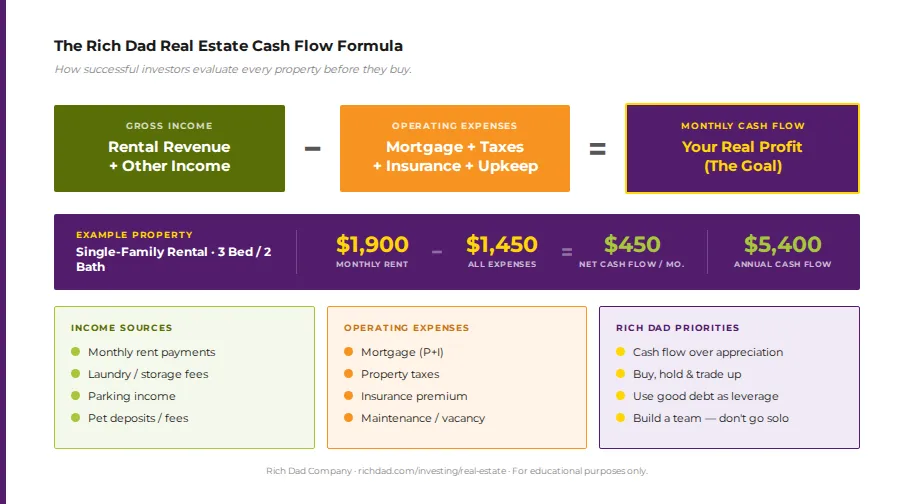
Real estate remains Robert Kiyosaki’s preferred passive income vehicle, and the math behind it is straightforward: rental income minus operating expenses equals monthly cash flow. Add leverage, depreciation, and the ability to use other people’s money, and even a modest property can produce a meaningful, recurring return. The Real Estate section covers how to evaluate deals, run the numbers, and scale from a single rental to a portfolio.
Stocks and paper assets: Dividends and covered calls
Rich Dad is skeptical of stocks bought purely for capital gains, but paper assets can absolutely produce passive income when the strategy is built around cash flow — dividend-paying stocks and options income strategies like covered calls both generate regular payouts independent of where the share price ends up. The Stocks and Paper Assets section and Rich Dad’s StockCast podcast with Andy Tanner go deeper on generating monthly income from a stock portfolio.
Business ownership: Investing in systems, not jobs
An investor doesn’t have to found or run a company to benefit from the B quadrant. Investing capital into someone else’s business — through equity, a board seat, or a straightforward profit-share arrangement — can generate passive income without taking on day-to-day operating responsibility. The Entrepreneurship section covers what to look for when evaluating a business as an income-producing asset rather than a job.
Other passive income assets: Crypto and beyond
Newer asset classes have added their own passive income mechanics — staking rewards on certain cryptocurrencies, for example, function similarly to a dividend. These carry a different risk profile than real estate or dividend stocks, so they deserve their own deep dive: see Cryptocurrencies for how staking and other crypto income strategies compare to traditional passive income assets.
How much passive income do you need to be financially free?
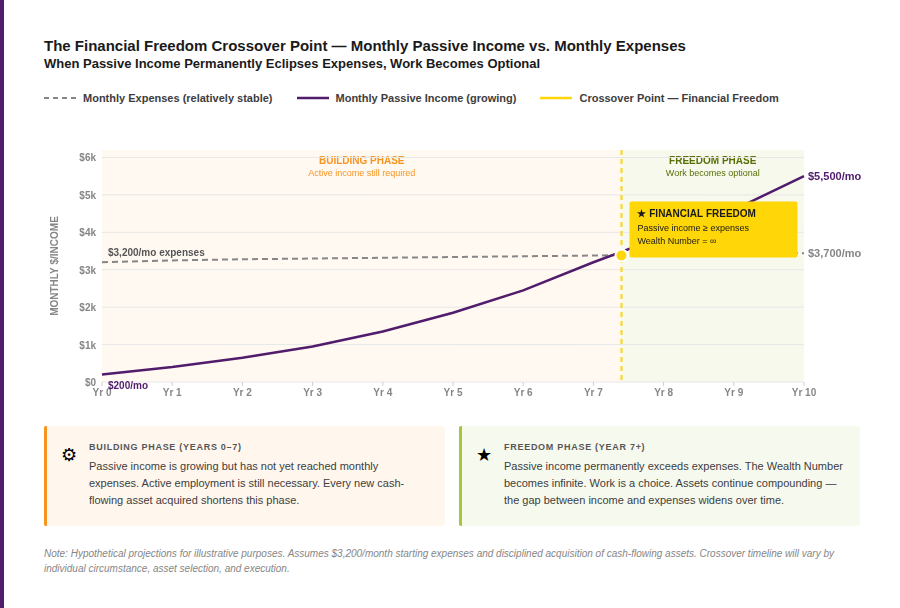
Financial freedom has a specific, measurable definition in Rich Dad terms: the point where monthly passive income permanently exceeds monthly living expenses. Below that line, an investor is still in the building phase and active income is still required. Above it, work becomes optional — the assets already cover the bills, and every dollar of additional income is a choice rather than a necessity.
How to start investing for passive income
Building passive income starts with financial education, not capital. Before writing a check, Rich Dad recommends running any opportunity through a simple filter: Is this inside my circle of knowledge? Does it generate cash flow? What are the tax advantages? What’s the real risk? Do I have the right team? An honest answer to each question closes a gap in financial knowledge before it becomes an expensive mistake. From there, most investors start small — a single rental property, a modest dividend portfolio, or a small stake in someone else’s business — and reinvest the income to acquire the next asset. The Personal Finance section covers how to build the savings base needed to make that first move, and the Tools page has calculators for tracking progress toward financial freedom.

The pattern is the same regardless of which asset class an investor starts with: acquire an asset that produces income, reinvest that income into the next asset, and repeat until passive income permanently exceeds expenses. That’s the entire Rich Dad definition of wealth — not a number in a brokerage account, but a cash flow that never depends on showing up to work.
FAQs
Dividend-paying stocks and REITs typically require the least hands-on management and the smallest starting capital, making them a common entry point. Real estate offers stronger long-term cash flow and tax advantages but requires more capital and, often, a property manager. See Stocks and Paper Assets and Real Estate for a deeper comparison.
Yes. Earned income (wages) is subject to the highest effective tax rates once payroll taxes are included. Passive income from real estate and business ownership can benefit from depreciation, pass-through deductions, and long-term capital gains rates, which is why the effective tax rate on the I quadrant is typically far lower than on the E quadrant — see Personal Taxes for details. This is general education, not individual tax advice; consult a qualified tax professional for a specific situation.
It depends entirely on the asset class. High-yield dividend stocks and REITs can be started with a few hundred dollars, while a rental property typically requires a down payment and reserves. The right starting point is the one that matches an investor’s current capital and their circle of knowledge, not the one with the highest headline return.
Yes — as long as the investor isn’t actively trading in and out of positions to chase price movement. A dividend portfolio held for its payout, not its share-price speculation, fits the Rich Dad definition of an income-producing asset.
Portfolio income (interest, most capital gains) is still subject to market swings and is typically taxed differently than true cash-flowing passive income like rents and business distributions. For a full breakdown of active vs. passive income mechanics, see Passive vs. Earned Income.