
The phrase that won’t go away
Since Robert first put “savers are losers” in print in Rich Dad Poor Dad, the line has followed him through three decades of market cycles, made the rounds on financial podcasts and social media, and still draws pushback from commentators who argue that cash has its own kind of value — as dry powder for opportunities, or a buffer against emergencies. Both things can be true. The math behind the phrase is real: money that sits in a low-yield account for a decade loses ground to inflation. A fully funded emergency reserve is also part of a sound plan. What separates the two is intention: an emergency fund with a defined size and purpose is a tool. A retirement plan that consists entirely of a savings account is a slow leak.
Where “savers are losers” comes from: 1971 and the end of real money
Robert’s poor dad — his own father — believed in saving. “A dollar saved is a dollar earned,” he told Robert throughout his childhood. What poor dad didn’t fully account for was a shift in monetary policy that changed what a dollar actually was.
On August 15, 1971, President Richard Nixon ended the U.S. dollar’s convertibility into gold, closing what economists call the “gold window” and effectively bringing the Bretton Woods system to a close, according to Federal Reserve History. Before that date, the U.S. dollar was backed by gold at a fixed rate; afterward, it became a fiat currency — a Federal Reserve Note the government could issue without a hard asset behind it.

Rich dad connected this to something darker: the collapse of Germany’s monetary system after World War I, when runaway money printing turned a 13-mark pair of shoes into a 32-trillion-mark pair within a decade, wiping out the middle class’s savings. Most economists reject the direct line rich dad drew from that collapse to the political chaos that followed in Germany. But the underlying lesson — that a currency untethered from a hard asset can lose value indefinitely, and that the people holding cash are the ones who absorb it — has stayed central to Rich Dad’s teaching ever since.
The 2026 math: What a savings account actually pays right now
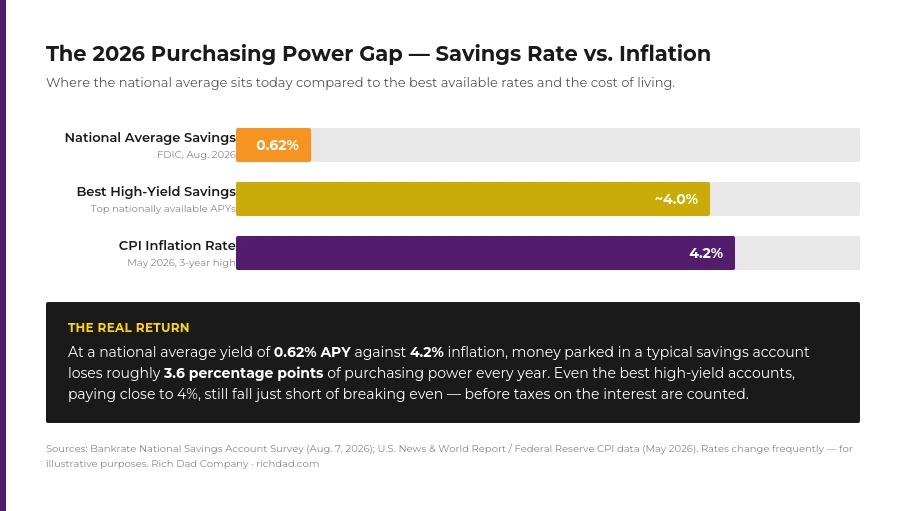
The historical argument is one thing. The current numbers make the case on their own. As of early August 2026, the national average savings account interest rate sits at 0.62% APY. Even the most competitive, nationally available high-yield savings accounts are paying close to 4% APY. Meanwhile, the Consumer Price Index has been running near 4.2%, a three-year high, according to Federal Reserve data reported by U.S. News.
Run the math on a typical account and the gap is stark: $10,000 sitting in a savings account earning the national average return would gain about $62 over a year, while the same $10,000 would need to grow by roughly $420 just to maintain its purchasing power against inflation. The saver isn’t just failing to get ahead — they’re falling behind by hundreds of dollars a year, every year, on money they worked hard to set aside.
What $10,000 becomes over 20 years
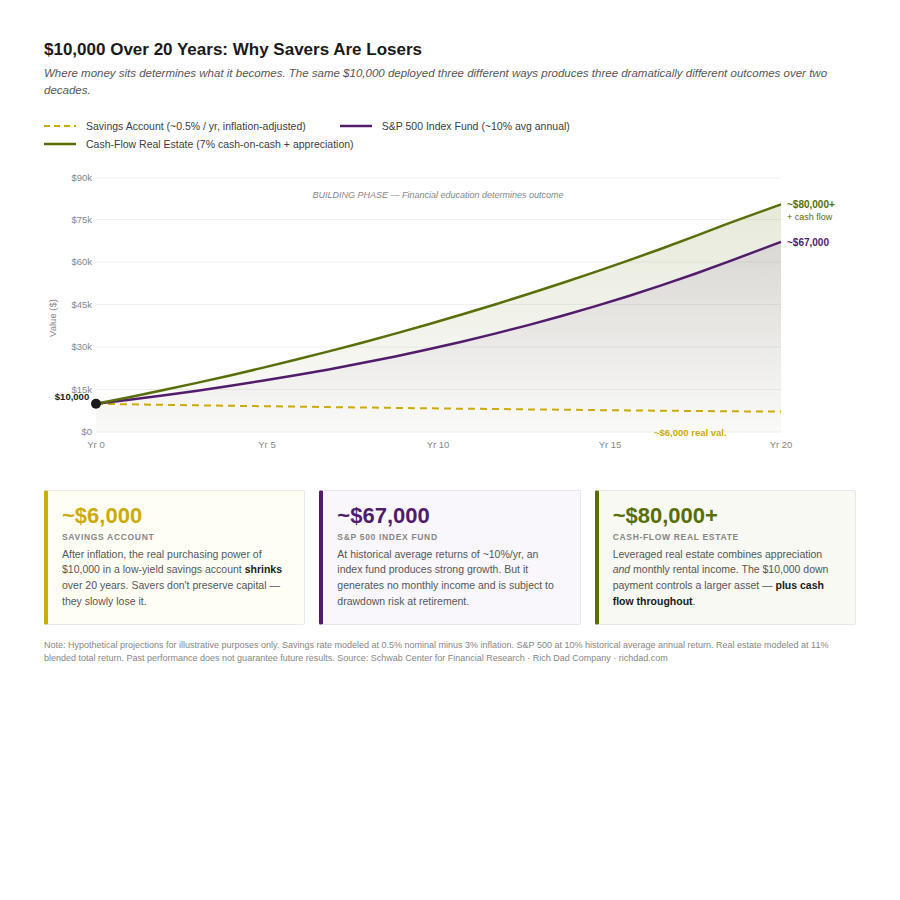
Stretch the rate gap out over two decades and the difference in outcomes becomes difficult to ignore. A saver who leaves $10,000 in a low-yield account for 20 years ends up with roughly $6,000 in real, inflation-adjusted purchasing power — the balance technically “grew,” but it buys less than it did on day one. The same $10,000 invested in a diversified stock index fund, compounding at historical average returns, would grow to roughly $67,000. Deployed into cash-flowing real estate with modest leverage, it could grow past $80,000 — and unlike the index fund, it would also throw off monthly income the entire time. Same starting dollar amount, same 20 years. The only variable is where the money was put to work.
Saving isn’t the enemy — sitting still is
None of this means Rich Dad is against having money in the bank. Robert and his wife Kim have always kept a reserve for emergencies and short-term opportunities. The distinction is between saving as a deliberate, sized tool and saving as a default, permanent strategy. A reserve with a clear purpose — covering a defined number of months of expenses, staying liquid for a deal that needs to close fast — isn’t the target of “savers are losers.” The target is the far more common pattern: money that accumulates in a savings account indefinitely, by default, because no one ever routed it anywhere else. Rich Dad’s guide to building an emergency reserve walks through how to size that fund without letting it become a permanent parking spot.
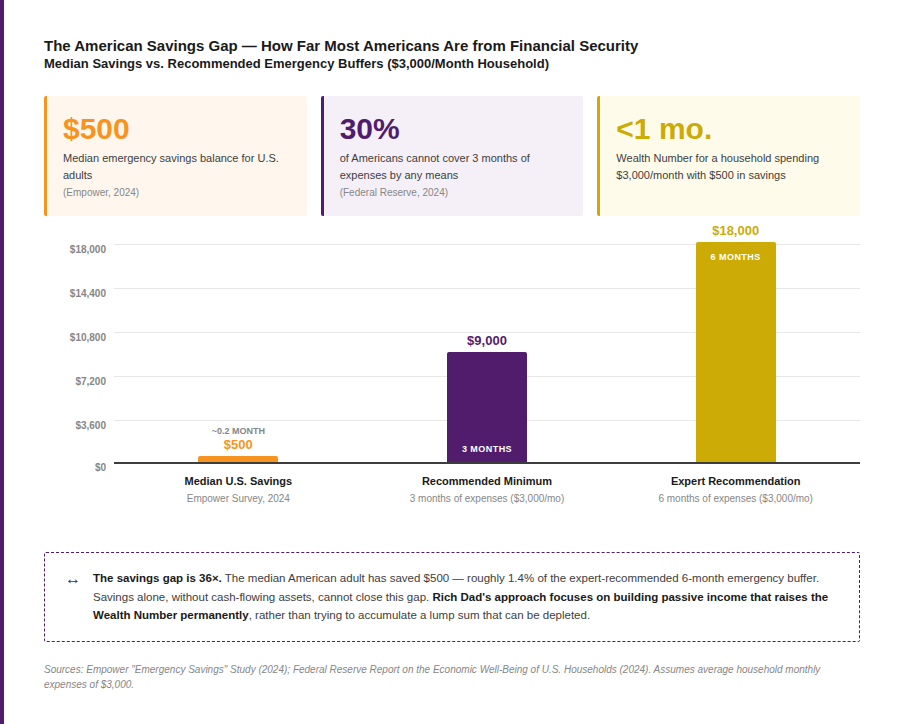
That default pattern is more common than most people realize. The median American adult holds about $500 in savings — a fraction of the three to six months of expenses most financial planners recommend — and nearly a third of Americans say they can’t cover three months of expenses by any means. The irony rich dad would point to is that most Americans aren’t stuck because they saved too little in a bank account. They’re stuck because saving in a bank account was never treated as anything more than a stopgap, rather than a wealth-building strategy.
The Rich Dad alternative: Pay yourself first
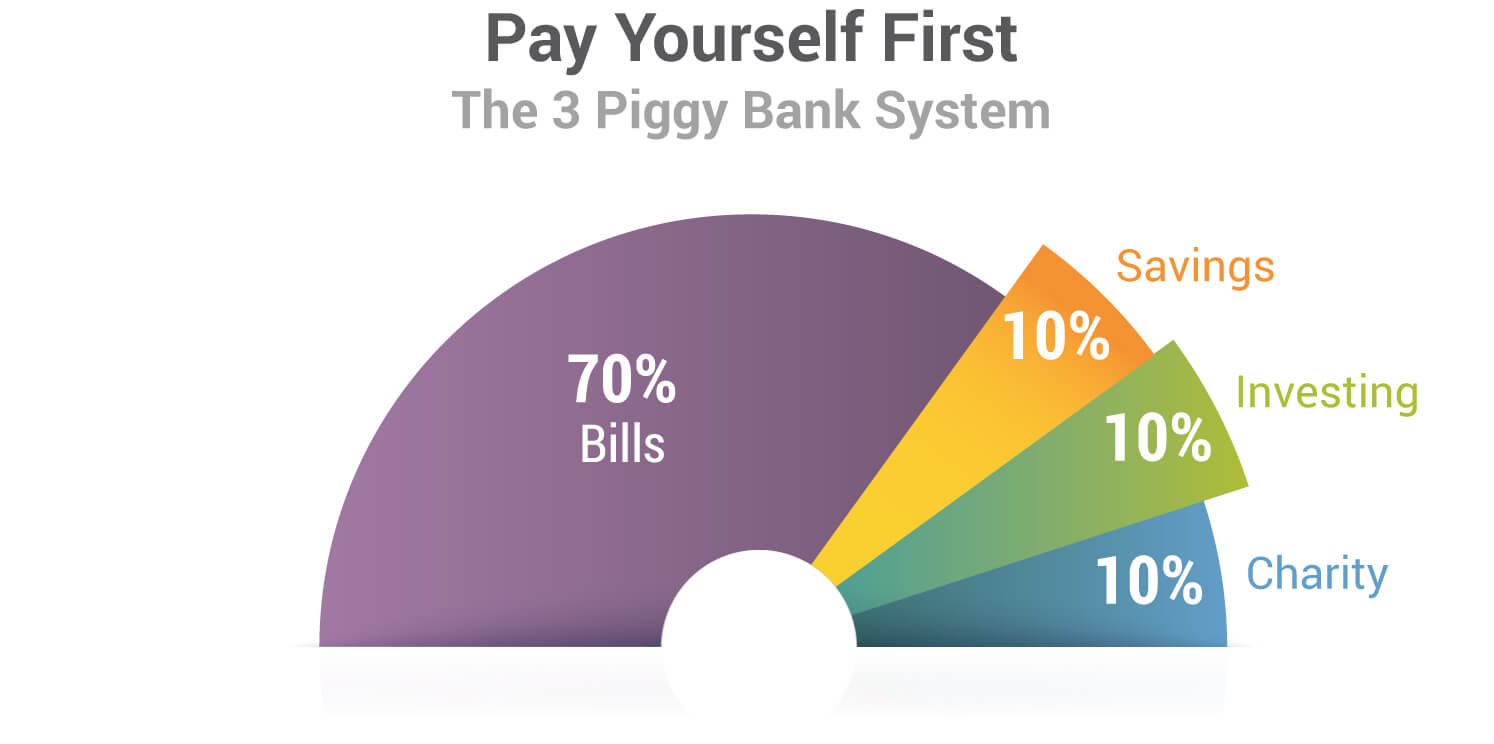
Later in life, when Robert and Kim were broke, they built a habit that became core to Rich Dad’s philosophy: pay yourself first. Every month, regardless of how tight things were, they set aside 30% of their paycheck and split it three ways — 10% into investments, 10% into charity or tithing, and 10% into savings — treating the transfer like a non-negotiable expense rather than whatever happened to be left over at the end of the month.
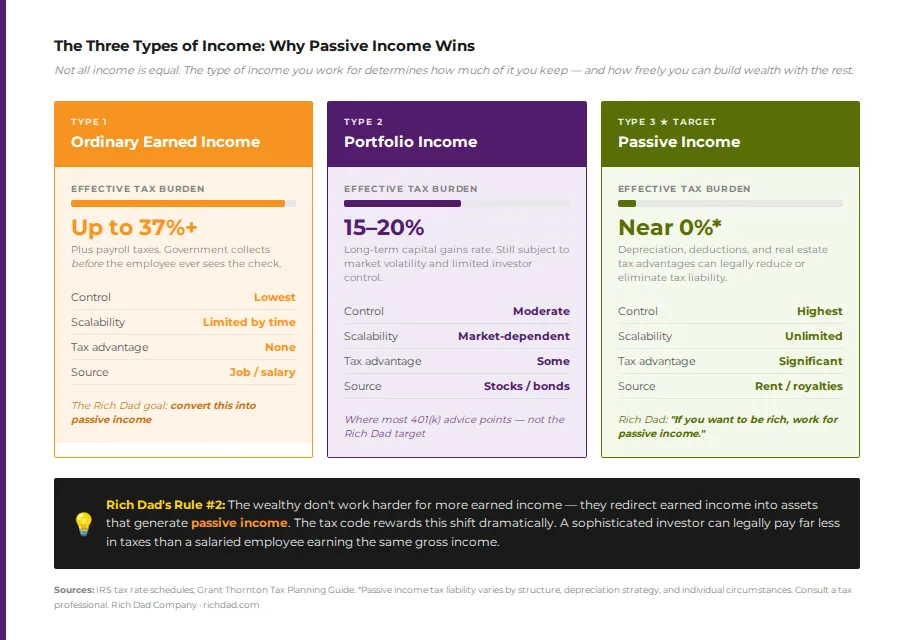
The investment piece is the part that does the heavy lifting. Passive and portfolio income — the kind that comes from rental property, dividends, royalties, or business ownership — carries a fundamentally different tax treatment and growth ceiling than the earned income most people rely on. Earned income is taxed hardest and stops the moment the paycheck does; passive income keeps flowing and, in many cases, comes with the deepest tax advantages in the code. Moving money from a savings account into assets that produce this kind of income is the entire mechanism behind “pay yourself first” — it isn’t a budgeting trick, it’s a redirection of capital toward the side of the CASHFLOW Quadrant that actually builds wealth.
How to start moving from saver to investor
The shift from saver to investor doesn’t require a large balance or a dramatic move. It starts with a change in the question being asked. Instead of “How much can I save this month?” this approach asks, “Where can I get a better return on this money, and what do I need to learn to get there safely?”
That usually means:
- Get financial education before capital
Understanding real estate, stocks and paper assets, or a specific asset class in depth is what separates informed investing from gambling. Rich Dad’s 17 financial literacy lessons are a starting point. - Start small and start now
Robert’s first investment was a handful of one-ounce silver coins — the amount mattered less than the habit of getting money moving. - Keep a defined reserve, not an open-ended one
Decide how many months of expenses the emergency fund needs to cover, fund it, and route everything beyond that into assets. - Track the split
The 10/10/10 plan is one version of the formula; the specific percentages matter less than treating investment as a fixed, automatic transfer.
None of this requires abandoning caution. It requires deciding, deliberately, where money goes once it leaves a paycheck — instead of letting it default into an account that quietly loses value year after year.
Savers are losers — or learners
Robert’s line will keep drawing pushback, and some of that pushback is fair — cash isn’t worthless, and liquidity has real value in the right amount. But the core of the lesson has held up for more than three decades and, on the current numbers, is as true in 2026 as it was in 1997: money that sits still loses ground to inflation, while money that’s deliberately deployed into cash-flowing assets has a chance to outrun it. The goal isn’t to villainize saving. It’s to make saving a decision, not a default.
FAQs
Kiyosaki uses the phrase to describe what happens when money sits in a low-yield savings account while inflation erodes its purchasing power. Since the U.S. dollar became a fiat currency in 1971, he argues, savers have effectively been on the losing side of a system that rewards owning assets over holding cash.
On the current numbers, yes, for money left in a typical account. As of August 2026, the national average savings account pays 0.62% APY against inflation running near 4.2%, a gap of roughly 3.6 percentage points a year in lost purchasing power.
No. Rich Dad’s financial plan includes a dedicated savings allocation as part of the 10/10/10 approach. The distinction is between a sized, purposeful reserve and using a savings account as a substitute for an investment strategy.
Pay yourself first: route a fixed percentage of income into financial education and cash-flowing assets like real estate, dividend-paying stocks, or business ownership, rather than letting savings accumulate by default.