
What is capital gains investing?
Capital gains is the profit an investor realizes when an asset is sold for more than its purchase price. In real estate, this is the classic buy-fix-and-flip model: purchase a single-family house for $100,000, invest in repairs, and sell it for $140,000 — the $40,000 difference is a capital gain. In the stock market, buying a share for $20 and selling it once it climbs to $30 produces the same kind of profit.
The challenge with capital gains is that the strategy has to be repeated to keep producing income — buy, sell, buy, sell — and every cycle depends on finding a buyer willing to pay more than the investor did. Most investors chasing capital gains in stocks and other paper assets through mutual funds and 401(k)s are effectively hoping the market is higher when they need the money. When prices are rising, capital gains investors win. When prices fall — something no one can reliably predict — they lose.
What is cash flow investing?
Cash flow is realized when an investor buys an asset and holds onto it, collecting income at regular intervals without ever needing to sell. A dividend-paying stock generates cash flow every time it pays out, for as long as the investor owns it. In real estate, the same $100,000 house that could be flipped for a gain can instead be rented out — the investor collects rent every month, pays the expenses and mortgage, and keeps the difference as positive cash flow.

Because a cash flow investor isn’t trying to sell, they’re far less concerned with whether the market is up today or down tomorrow. As explained elsewhere, cash flow is king — it’s the income stream that keeps paying regardless of short-term price swings, which is why it forms the backbone of most long-term financial independence plans.
Cash flow vs. capital gains: The core differences
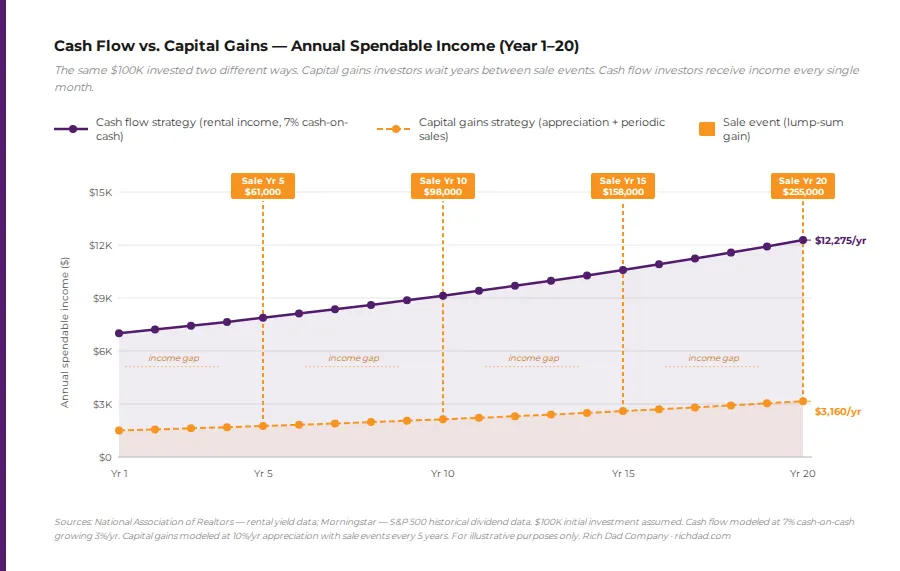
The starkest difference between the two strategies shows up in annual spendable income. A cash-flow investor who buys a rental property or a dividend-paying portfolio sees income rise steadily every year, deposited on a predictable schedule. A capital-gains investor holding the same size portfolio in appreciating assets sees no spendable income at all between sale events — the money only becomes real, and spendable, the years an asset is actually sold.
Over a 20-year period, that difference compounds. Even when a capital gains strategy delivers a larger total return on paper, a cash flow strategy delivers usable income every single year, which is why cash flow investors describe themselves as less dependent on market timing and less vulnerable to a bad year to sell.
How cash flow and capital gains are taxed differently
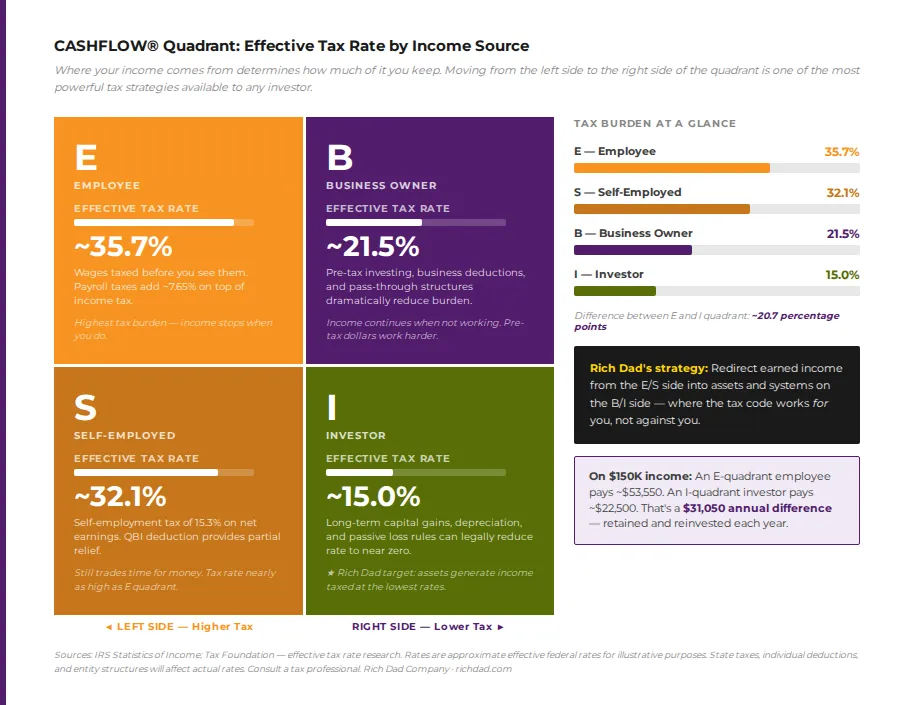
Where income comes from determines how much of it an investor actually keeps. Wages earned as an employee are taxed before the paycheck ever arrives, often carrying the highest effective tax burden of any income type. Business owners and investors, by contrast, can access pre-tax investing, depreciation, and pass-through structures that meaningfully lower their effective rate — investors ought to move from the left side of the CASHFLOW Quadrant toward the right.
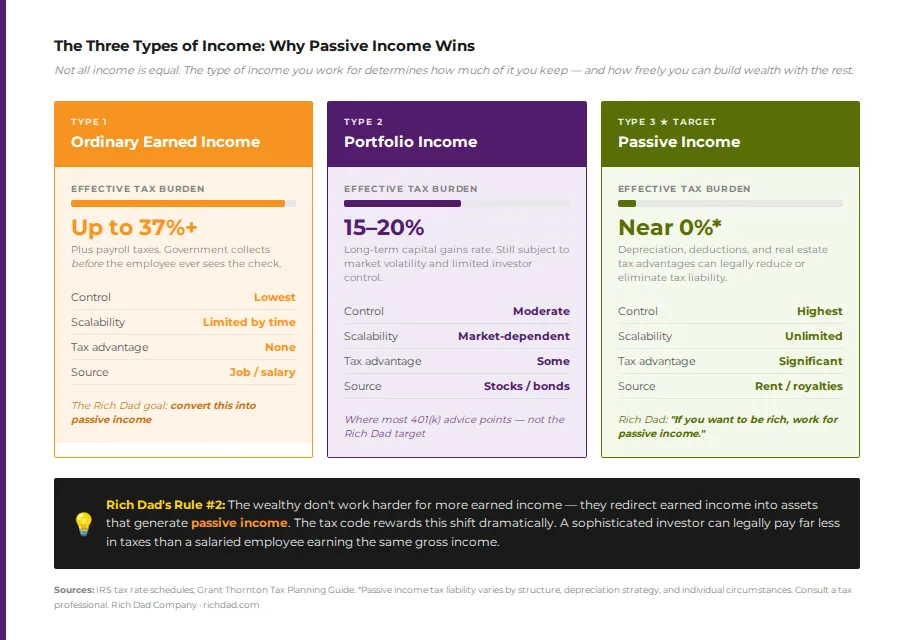
This is also where cash flow and capital gains split most clearly on tax treatment. Long-term capital gains are taxed at federal rates of 0%, 15%, or 20% depending on taxable income, according to the IRS’s official capital gains guidance, while short-term gains — on assets held one year or less — are taxed at ordinary income rates as high as 37%. Passive cash flow, particularly from real estate, can be sheltered through depreciation and other deductions that often bring its effective tax burden closer to zero than either type of capital gain. Investors comparing the two strategies for 2026 planning purposes can review the current bracket thresholds through the Tax Foundation’s 2026 federal tax bracket data, and should also read up on personal tax strategies the wealthy use to legally minimize what they owe on either type of income.
Which strategy carries more risk?
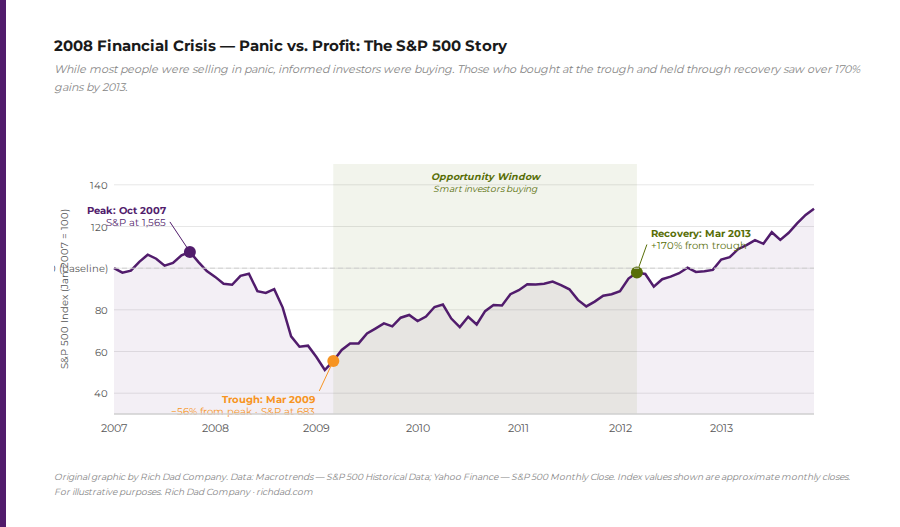
The 2008 financial crisis is the clearest illustration of capital gains risk. The S&P 500 fell roughly 56% from its October 2007 peak to its March 2009 trough. Investors who had built their retirement around capital gains and panic-sold near the bottom locked in devastating losses — while those who held on, and especially those who bought during the downturn, saw gains of over 170% by 2013 as the market recovered.
Cash flow investors experienced the same crash very differently. A rental property collecting $1,600 a month in 2008 was still collecting roughly that much in 2009, regardless of what the stock market or home values were doing on paper. A dividend-paying stock that didn’t cut its payout kept paying. That resilience — income continuing whether markets are calm or chaotic — is the central argument for weighting a portfolio toward cash flow rather than pure appreciation.
Can you invest for both cash flow and capital gains?
Cash flow and capital gains aren’t mutually exclusive, and the most sophisticated investors typically pursue both at once. A rental property can pay monthly cash flow while the underlying property also appreciates over time, giving the owner income today and a capital gain if they ever choose to sell. A dividend-growth stock can pay an increasing cash dividend every quarter while the share price itself climbs for decades.

The real estate BRRRR method — buy, rehab, rent, refinance, repeat — is one of the clearest examples of blending the two: an investor captures forced appreciation through renovation, refinances to recover their capital, and keeps the property cash-flowing indefinitely. Investors interested in this hybrid approach can start by exploring real estate investing strategies that combine both forms of return rather than treating cash flow and capital gains as an either-or choice.
How to decide which strategy fits your goals

Choosing between cash flow and capital gains — or deciding how much weight to give each — comes down to a few honest questions: How soon does this money need to become usable income? How much volatility can be tolerated without selling at the wrong time? And how does this investment fit inside an existing circle of knowledge? Investors who are closer to leaving a job, or who want their portfolio to replace a paycheck, generally benefit from weighting toward cash flow. Younger investors with a longer time horizon and higher risk tolerance can afford to weight more heavily toward capital gains, provided they have the financial education and patience to ride out a downturn without selling in a panic.
The bottom line
Neither cash flow nor capital gains is inherently right or wrong — they’re two different tools that serve different goals. But for investors building toward lasting financial freedom, cash flow offers something capital gains can’t: income that keeps arriving whether the market is up, down, or sideways. Explore Rich Dad’s investing education to go deeper on building a portfolio that puts cash flow first, or join the free financial education community to keep learning alongside other investors doing the same.
FAQs
Cash flow is generally considered the more reliable source of retirement income because it pays out on a predictable schedule without requiring a sale. Capital gains can supplement retirement savings, but relying on them requires selling assets at a time the market cooperates — which isn’t guaranteed.
Yes. A rental property that generates monthly rent while also appreciating in value, or a dividend-paying stock whose share price also rises over time, delivers both types of return simultaneously.
For 2026, long-term capital gains — on assets held more than one year — are taxed at federal rates of 0%, 15%, or 20% depending on taxable income and filing status, per the IRS’s updated 2026 thresholds. Short-term gains, on assets held a year or less, are taxed at ordinary income rates up to 37%.
Rental income is cash flow — it’s paid regularly while the property is held. Any profit from eventually selling that same property would be classified separately as a capital gain.
Capital gains investing generally carries more market-timing risk, since the entire return depends on selling at a favorable price. Cash flow investing carries its own risks — vacancy, dividend cuts, or property management issues — but its income is less directly tied to short-term price swings in the broader market.