Why most advice on how to achieve financial goals falls short
Search “how to achieve financial goals” and the same script repeats: make the goal specific, measurable, achievable, relevant, and time-bound, then build a budget around it. That framework is not wrong — but it’s incomplete, and the results back that up. A Harris Poll survey conducted for the AICPA found that among Americans who set financial goals in 2025, the large majority never followed through, with rising living costs identified as the single biggest obstacle.
The missing piece in most goal-setting advice is a mechanism for growth that does not depend entirely on cutting expenses or on willpower holding up for years at a time. This approach to personal finance, however, starts somewhere different: understanding how money actually works, then acquiring assets that produce income whether or not the goal-setter is still motivated in month fourteen.
Calculate your Wealth Number before you set a dollar goal
Before choosing a savings target, focus on calculating a single number: total available assets divided by monthly expenses. The result, known as the Wealth Number, measures how many months a person could survive without active income — not how much they have accumulated in the abstract.
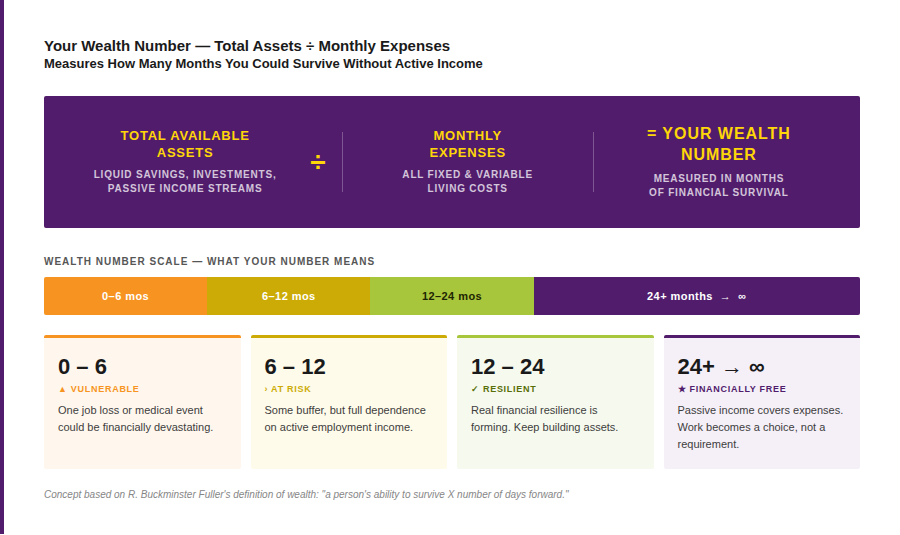
A Wealth Number under six months is vulnerable to a single job loss or medical event. A Wealth Number over twenty-four months signals real resilience. The formula itself traces back to a definition of wealth coined by R. Buckminster Fuller — a person’s ability to survive a certain number of days forward — which Rich Dad has explored in depth elsewhere as the dividing line between being rich and being wealthy. The advantage of using this number as the goal, instead of a fixed dollar figure, is that it can be raised two ways: by reducing monthly expenses, or by increasing the assets and passive income on the other side of the equation. Most conventional advice only offers the first lever.
Know your starting point: Run an income mix audit
A financial goal set without knowing where income currently comes from is a guess; instead, conduct an audit: add up last month’s income and sort it into three categories — earned income from a job or active work, portfolio income from paper assets, and passive income from rent, dividends, royalties, or business distributions that arrive without active labor.
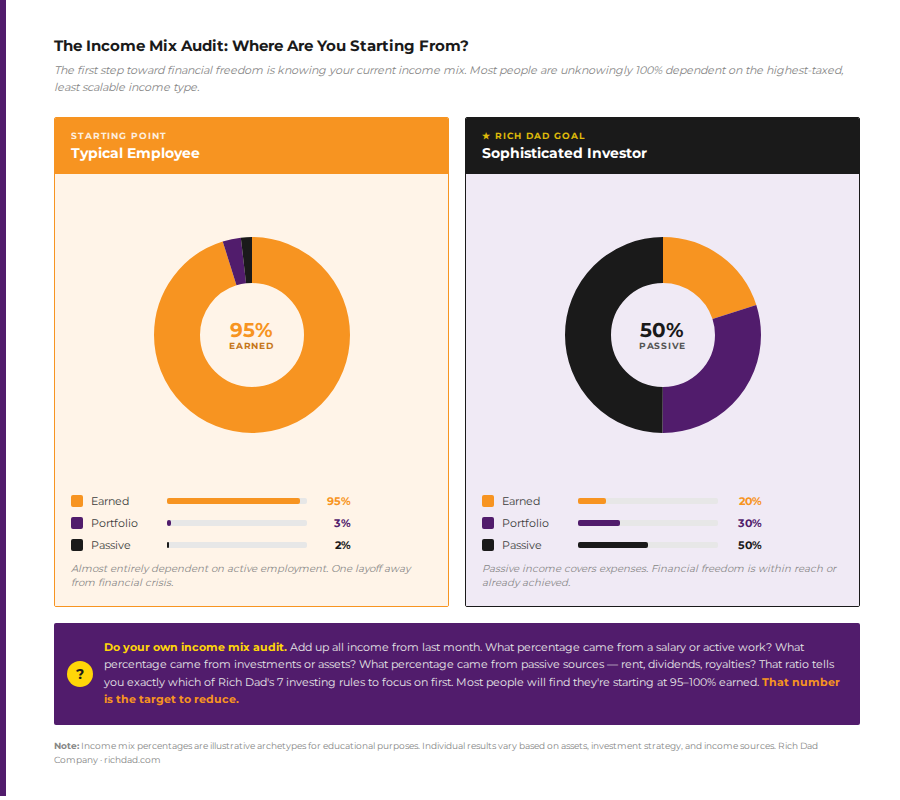
Most people find they are starting at 95 to 100 percent earned income — entirely dependent on a single employer or client relationship. That percentage is the actual number a financial goal needs to move. The Rich Dad target is a mix weighted toward the right side of the equation, where portfolio and passive income together cover a growing share of monthly expenses.

Why cutting expenses alone won’t get you there
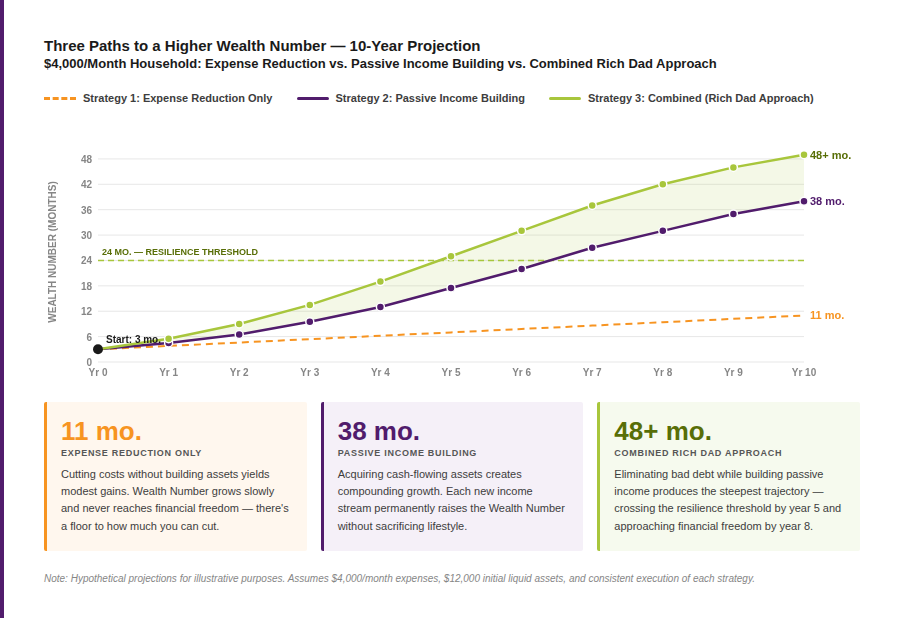
Budgeting advice tends to treat expense reduction as the whole strategy. It helps, but it has a ceiling. The Rich Dad budgeting philosophy is built around expanding income and acquiring assets rather than only cutting costs — and the ten-year math shows why that distinction matters.
In this projection, a household that only cuts expenses raises its Wealth Number from three months to roughly eleven months over ten years — a real improvement, but one with a floor, since there is a limit to how much any household can cut. A household that instead redirects the same effort into acquiring cash-flowing assets reaches roughly thirty-eight months. Combining both approaches — eliminating bad debt while building passive income — produces the steepest trajectory, crossing the twenty-four-month resilience threshold by year five and approaching financial freedom by year eight.
Move right on the CASHFLOW Quadrant
Every dollar of income falls into one of four categories, mapped by Robert Kiyosaki’s CASHFLOW Quadrant: Employee, Self-Employed, Business Owner, or Investor. The left side (E and S) trades time directly for money and carries the highest tax burden. The right side (B and I) is built on systems and assets that keep producing income independent of the owner’s daily labor.

A financial goal stated purely in dollars can be reached from either side of the quadrant, but only right-side income keeps compounding after the goal is hit. This is the core of the Rich Dad philosophy: the objective is not a single lump sum, but a permanent shift in which quadrant produces the household’s income.
Set the real finish line: The financial freedom crossover point
Rather than a fixed dollar goal, the real objective is a crossover point: the moment monthly passive income permanently exceeds monthly living expenses. Before that point, active income is still required and the household is in a building phase. After that, work becomes optional.
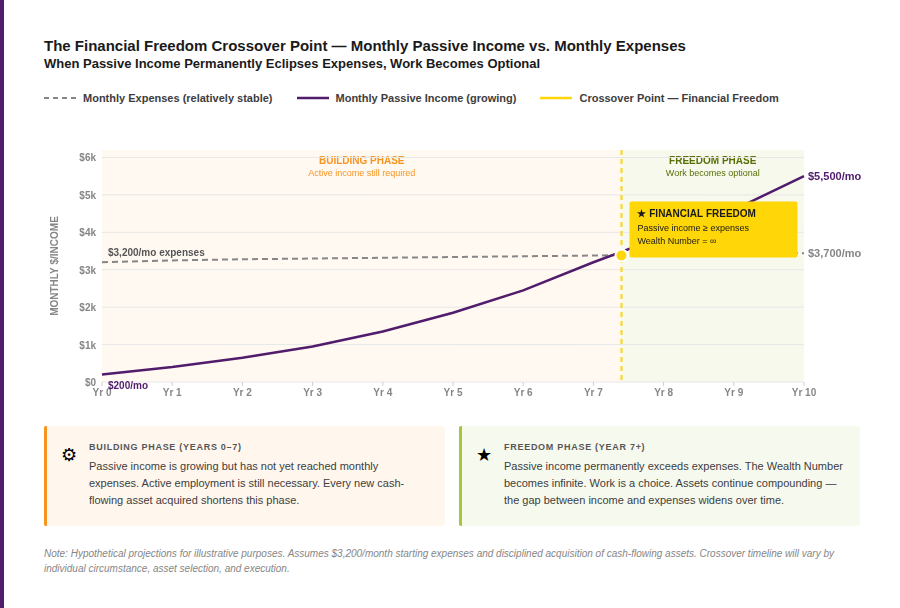
In this illustration, passive income starts at $200 a month and grows through consistent asset acquisition, crossing $3,200 in monthly expenses by year seven and continuing to compound afterward. The velocity of money — how many times the same capital gets redeployed into new cash-flowing assets — is what determines how early that crossover arrives.
Turning the framework into a plan: Five steps
- Run the income mix audit. Total last month’s earned, portfolio, and passive income before setting any target.
- Calculate the current Wealth Number and set the target as raising it, not as saving a specific dollar amount.
- Choose an asset class inside an existing circle of knowledge — real estate, business, paper assets, or commodities — rather than an unfamiliar one that requires speculation instead of analysis.
- Acquire one cash-flowing asset. Rich Dad’s guides to real estate investing and the language of paper assets both walk through the first purchase in detail.
- Reinvest and re-audit quarterly. Every new cash-flowing asset raises the Wealth Number permanently; track it the same way a budget gets tracked monthly.
Common mistakes that derail financial goals
- Confusing net worth with the Wealth Number. A paid-off house or an unvested retirement account can inflate net worth without producing a dollar of monthly cash flow.
- Treating a raise as an automatic lifestyle upgrade. Income growth that flows entirely into new expenses raises the goalpost instead of the Wealth Number.
- Chasing an asset class outside an existing circle of knowledge because it is trending, rather than one that can be properly evaluated.
- Outsourcing the goal entirely to a third party without building any personal financial education first. Advisors and planners can be useful members of a team, but they are not a substitute for understanding how the underlying assets work.
Reach your financial goals
How to achieve financial goals is ultimately a question of mechanism, not motivation. A dollar target with no plan for acquiring cash-flowing assets behind it depends on willpower lasting for years. A Wealth Number, tracked quarterly and raised through asset acquisition, keeps compounding whether or not the goal-setter feels motivated that month. Rich Dad’s personal finance education exists to make that shift — from earned income to passive income, and from budgeting alone to building.

FAQs
Run an income mix audit before setting a dollar target. Knowing what percentage of current income is earned, portfolio, or passive tells a person which lever — expense reduction, income growth, or asset acquisition — will actually move their financial position.
A savings goal is a fixed dollar amount. A Wealth Number is total assets divided by monthly expenses, measured in months of financial survival. It can be raised by reducing expenses or by increasing passive income, and it keeps being useful after the original goal is reached.
Rich Dad’s position is that financial education is the foundation every other step depends on. A financial advisor or planner can be a valuable part of a team, but delegating the decision entirely without understanding the underlying assets makes it difficult to evaluate whether the advice being given actually serves the goal.
It depends on starting assets, monthly expenses, and how consistently new cash-flowing assets are acquired. The illustrative ten-year projections in this article show a combined approach — reducing bad debt while building passive income — reaching a strong Wealth Number by year five and approaching full financial freedom by year seven or eight, though individual timelines vary widely.
Real estate, business ownership, paper assets (stocks, bonds, options), and commodities such as gold, silver, oil, and gas. The right starting asset class is the one that already fits an investor’s existing knowledge and experience, not the one that is currently trending.