
Real estate belongs in every wealth-building strategy
Robert Kiyosaki has said for decades that the rich buy assets — things that put money in their pocket every month. Real estate, when purchased correctly, is the most tangible expression of that idea. A properly selected rental property generates cash flow from day one, allows the investor to use good debt as leverage, benefits from depreciation deductions on taxes, and appreciates in value over time. That’s four distinct wealth-building mechanisms working simultaneously from a single asset.
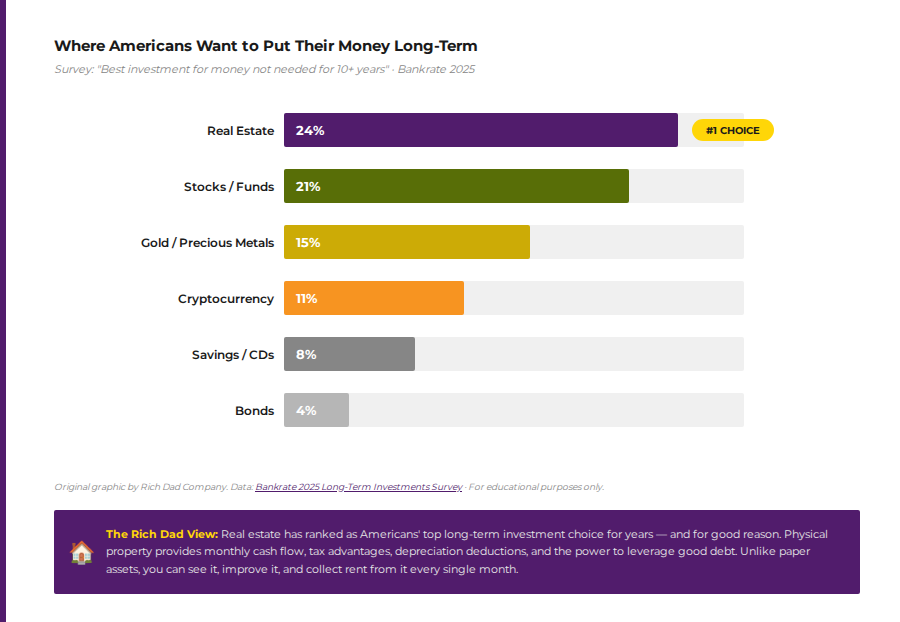
The conventional financial advice to max out a 401(k) and diversify into index funds ignores what the wealthy have known for generations: physical assets you can see, manage, and improve are categorically different from paper proxies. Real estate investors are not just passive shareholders. They are business owners generating income from property — and the government rewards them accordingly with tax treatment unavailable to wage earners.

None of this means real estate is risk-free or effortless. It means the risk is manageable through education, preparation, and the ten strategies below.
10 real estate investing tips the rich actually use
1. Start with your own home
For anyone who has not yet bought a primary residence, that first property is often the most practical entry point into real estate investing. Owner-occupied financing requires less of a down payment, typically offers better interest rates, and provides the most favorable tax treatment. More importantly, it gives the new investor front-row seats to every aspect of the process — from securing financing and navigating closing costs to handling maintenance and managing a mortgage. As Kim Kiyosaki has taught for years, her first investment property was a small two-bedroom house in Portland, Oregon. The knowledge she gained from that single transaction became the foundation of a portfolio that now spans thousands of rental properties across the country.
After a few years, that first home can be converted into a rental property while the investor moves into a larger property — effectively transforming personal housing into a cash-flowing asset without the higher down payment typically required for investment properties.
2. Buy for cash flow, not just appreciation
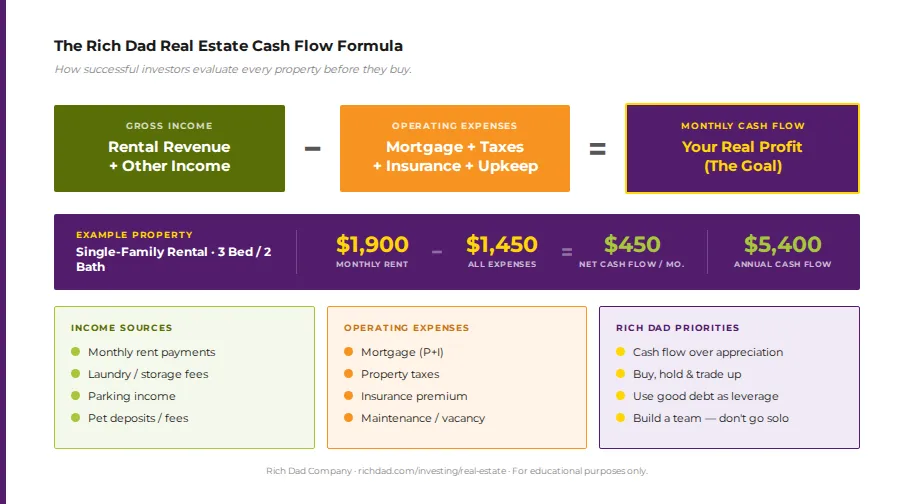
The most common mistake new real estate investors make is buying a property and hoping it goes up in value. That is speculation, not investing. The Rich Dad approach to real estate investing places cash flow at the center of every acquisition decision. If a property does not generate more income every month than it costs to own and operate, it is a liability masquerading as an asset.
Before making an offer on any property, investors should run a complete cash flow analysis: projected monthly rent minus mortgage payment, property taxes, insurance, property management, vacancy allowance, and maintenance reserves. The number that remains is the real profit — and it needs to be positive before the ink hits the contract.
3. Let the numbers tell the story
Numbers intimidate many beginning investors — but they should not. If an investor can add, subtract, multiply, and divide, they have everything they need to evaluate a deal. The key is understanding what the numbers represent, not just what they are.
A vacancy rate, a cap rate, a debt-service coverage ratio, or a price-to-rent ratio are not obstacles. They are clues — each one revealing something about how a property is truly performing or how it is likely to perform. A 50 percent vacancy rate in a 20-unit building is not just a number. It is a story about management problems, location challenges, or mispriced rents. Learning to read the three core financial statements — the income statement, the balance sheet, and the cash flow statement — transforms an intimidating spreadsheet into a decision-making tool.
The same discipline applies to emotions. Fear and greed are the two forces most likely to cause a bad real estate decision. Fear causes investors to pass on properties that would generate strong cash flow. Greed causes them to overpay or ignore red flags. The antidote to both is rigorous analysis. When the numbers are clear, the emotion becomes irrelevant.
4. Build a world-class investment team
No successful real estate investor operates alone. The most productive use of an investor’s time is finding and evaluating deals, not trying to become an expert in every discipline that touches a transaction. That is what teams are for. According to the Rich Dad investing philosophy, the right partners can increase the returns obtainable from investment ventures — sometimes dramatically so.
A well-constructed real estate team typically includes a real estate attorney, a CPA who specializes in investment property, a property manager, a lender who understands investor financing, a reliable contractor or handyman, and a trusted real estate agent who actively invests. Each member should not just talk about real estate — they should be doing it. An advisor who does not practice what they preach is not worth the fee.
Vetting a team takes effort upfront, but it pays dividends indefinitely. Investors who try to do everything themselves limit both their capacity and their returns. The right team multiplies both.
5. Understand the tax advantages — and use them
Real estate investing comes with tax benefits that most wage earners will never access. The government treats rental property as a business, which means investors can deduct mortgage interest, property taxes, insurance, repairs, property management fees, and travel expenses related to the property. More significantly, the IRS allows investors to depreciate residential rental properties over 27.5 years — meaning a $300,000 property generates a depreciation deduction of roughly $10,900 annually, even as the property’s actual market value may be appreciating. These strategies fall squarely within the Rich Dad framework for personal tax planning.
A qualified CPA who specializes in real estate taxation is not an optional expense — it is one of the highest-return investments a property owner can make. They can structure ownership entities, identify depreciation opportunities, and help plan 1031 exchanges that allow investors to defer capital gains taxes by rolling proceeds from one property sale into the next acquisition.
6. Plan your legal strategy before you need it
Real estate ownership comes with legal exposure that goes beyond what most investors anticipate. Tenant disputes, slip-and-fall claims, environmental liabilities, and property damage scenarios can all generate significant legal risk. Insurance covers some of it — but not all of it.
The most common protective structures for real estate investors include limited liability companies (LLCs) and land trusts. Holding property inside an LLC separates personal assets from investment liabilities, so a lawsuit involving one property cannot reach the investor’s home, savings, or other investments. This legal strategy should be established before the first property closes, not after a problem arises.
7. Start small, think big
Kim’s first investment was small by any measure. But it was not the size of the property that mattered — it was the size of the vision behind it. The Rich Dad approach has always been to set the large goal first, then reverse-engineer the small steps required to reach it.
Starting small is not a limitation. It is a strategy. Smaller investments carry lower financial risk, faster feedback loops, and more manageable learning curves. As confidence and cash flow grow, so does the capacity to take on larger and more complex acquisitions. Every experienced investor started somewhere modest. The goal is to keep moving forward, not to make a perfect first move.
8. Serve tenants well
A rental property is a customer service business. Tenants are the customers, and their satisfaction directly affects cash flow. High turnover is expensive — vacancy periods, re-listing costs, cleaning, and repairs between tenants can consume months of profit. An investor who maintains clean, functional, well-maintained properties and responds quickly to problems keeps tenants longer, reduces vacancy, and protects long-term cash flow.
This is not sentimentality. It is business logic. Treat tenants like valued clients, and they will stay. Every month a good tenant remains in a property is a month the investor is not spending money to find a replacement.
9. Play the long game — buy, hold, and trade up
Television shows built around property flipping make it look simple, fast, and lucrative. Reality is considerably more complex. Flipping generates earned income — taxed at the highest rates — and requires constantly finding the next project to sustain income. Holding rental properties generates passive income, taxed at more favorable rates, while the properties appreciate and the mortgages are paid down by tenants.
The Rich Dad strategy is to buy properties, hold them for cash flow, and trade up through 1031 exchanges into larger and more productive assets over time. Patience in real estate is not passivity — it is one of the most productive things an investor can practice. Market conditions shift, interest rates cycle, and neighborhoods evolve. Investors who stay disciplined through short-term volatility are the ones who build real wealth over decades.
10. Stay in continuous learning mode
Real estate investing is not a static skill. Tax laws change. Financing structures evolve. Markets shift. Technology is transforming how properties are found, managed, and evaluated. The investors who thrive are those who treat education as an ongoing practice, not a one-time event. Reading trusted sources daily, building relationships with experienced investors, attending local real estate investor meetups, and studying every deal whether or not a purchase follows — these habits compound into expertise over time. The Rich Dad CASHFLOW game was designed precisely for this: to train the investor’s mind to recognize opportunities and understand cash flow mechanics before real money is on the line.
What separates real estate investors from real estate owners
Owning real estate and investing in real estate are not the same thing. An owner buys a property and hopes for the best. An investor buys a property because the numbers support a specific return, the team is in place to manage it, the legal and tax structures are properly set up, and the acquisition fits a long-term strategy. The gap between those two approaches is financial education — which is exactly the foundation upon which Rich Dad has been built for decades. Explore the full Rich Dad investing resource hub to go deeper into the strategies that have helped millions of people move from earned income to passive income.
The market always creates opportunities for prepared investors. Rising interest rates thin out the competition. Economic uncertainty discounts prices. Inflation makes physical assets more valuable relative to cash. Every market condition that discourages the average person is a condition that the educated investor has studied, prepared for, and positioned to use.
Real estate wealth is built one disciplined decision at a time. Start with education. Build the team. Run the numbers. And let the properties do the rest.
FAQs
The most important tip is to invest for cash flow, not just appreciation. A property that generates positive monthly income from day one provides financial stability regardless of what the market does. Appreciation is a bonus — cash flow is the strategy.
Less than most people think. Owner-occupied properties like duplexes or triplexes can be purchased with as little as 3.5 percent down through FHA financing. Living in one unit while renting out the others — commonly called house hacking — allows beginners to start with minimal capital while building equity and cash flow simultaneously.
The Rich Dad philosophy distinguishes between physical assets and paper assets. Real estate provides unique advantages: leverage through debt, tangible value, tax depreciation, and direct control over the asset. Unlike stocks, a real estate investor can improve the property, renegotiate leases, and directly influence returns. That said, both asset classes play roles in a diversified wealth-building strategy. Learn more at the Rich Dad investing hub.
The five most critical figures are: (1) gross monthly rent, (2) total operating expenses including mortgage, taxes, insurance, property management, and maintenance, (3) net monthly cash flow, (4) cap rate — net operating income divided by purchase price — and (5) projected vacancy rate. Together, these numbers tell the full story of whether a deal is worth pursuing.
While not legally required, holding investment properties in a limited liability company separates personal assets from investment liabilities. This protects savings, other properties, and personal finances in the event of a lawsuit or claim involving the investment property. A real estate attorney can advise on the appropriate entity structure based on individual circumstances.
A 1031 exchange allows an investor to sell an investment property and defer capital gains taxes by rolling the proceeds into a “like-kind” replacement property within a specific timeframe. This powerful tool lets investors trade up into larger, more productive assets without surrendering a portion of their gains to taxes at each step — compounding wealth significantly over time.
Conventional financial advice focuses on saving, diversifying into index funds, and hoping for appreciation. The Rich Dad approach emphasizes financial education, cash flow over net worth, using good debt as leverage, and building a team of experts. The goal is not a growing account balance — it is a growing stream of monthly income from assets that work whether the investor is working or not.