
Two mindsets about work: Job security vs. financial education
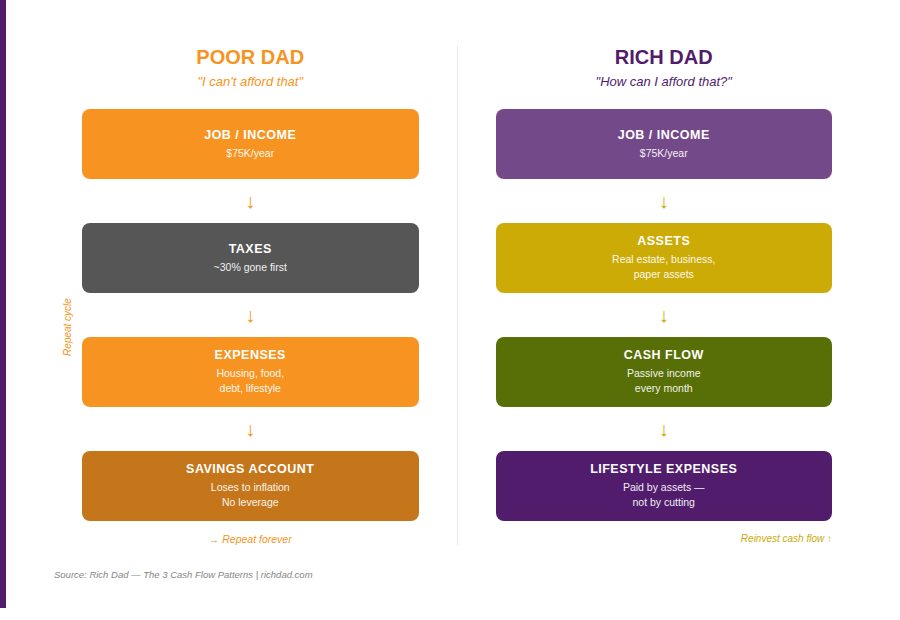
Robert grew up with two father figures who modeled opposite formulas for getting ahead. His poor dad — his natural father, a well-educated school administrator — believed job security was the most important thing a person could have. His rich dad — his best friend’s father, a businessman with no college degree — believed learning was the most important thing. Both men worked hard. Only one of them died wealthy.
Poor dad’s formula was the one most people are taught by default: go to school, get a degree, find a stable job, and climb the ladder. It’s the formula behind the modern rat race — earn money, pay bills, buy a few mutual funds, repeat until retirement. Rich dad’s formula ran in the opposite direction. He measured a job not by the paycheck but by what it added to a person’s financial education, on the theory that skills compound and paychecks don’t.
Why “work to learn, then earn” beats working for a paycheck
After graduating from the U.S. Merchant Marine Academy, Kiyosaki had a comfortable path already laid out. His first job, as a third mate on a Standard Oil of California tanker, paid $42,000 a year — good money in the 1970s — for seven months of work annually. His poor dad was thrilled.
Six months in, Kiyosaki resigned and joined the Marine Corps instead. His poor dad was devastated; his rich dad congratulated him. The Marine Corps didn’t pay well, but it taught him how to fly and how to lead people through genuinely difficult situations — skills he couldn’t have picked up on a tanker.

The pattern repeated after his tour of duty. Kiyosaki had an open path to a stable, well-paid career as a commercial airline pilot. Instead, he took a sales job at Xerox, specifically to learn how to sell. He knew that sales skill, layered onto the leadership training from the Marine Corps, would be worth more over a lifetime than any single salary. It was — that combination of skills became the foundation for the ventures that eventually made him wealthy.
“Learning is the most important thing.” — Rich dad
Specialist vs. generalist: Choosing your CASHFLOW Quadrant
The deeper disagreement between Kiyosaki’s two dads was about specialization. Poor dad believed in going deep — the more narrowly a person specialized, the more they’d be paid for what they knew, which is why he was proud to earn his doctorate. He also struggled financially his entire life, stuck as an employee in the E quadrant of Robert Kiyosaki’s CASHFLOW Quadrant framework, where income is capped by hours worked.
Rich dad believed the opposite: become a generalist first. Learn a little about a lot — sales, leadership, accounting, negotiation — by rotating through as many roles and departments as possible before settling into a specialty. His reasoning was practical: the person who understands every department in a company is the only one qualified to run it, and the business owner (B) and investor (I) quadrants pay in systems and assets rather than hours.

This is the practical argument for working to learn, then to earn: a generalist skill set is what makes moving from the E/S side to the B/I side possible at all. Someone who has only ever specialized has no foundation for starting a business, because running one requires a working knowledge of sales, cash flow, people, and risk — not mastery of one narrow function.
How to learn like the rich in an AI economy
The formulas worth chasing have changed since Kiyosaki was collecting them in the 1970s and 80s, but the strategy of learning fast, from practitioners, hasn’t. Traditional education is structurally built to teach yesterday’s formula — professors, textbooks, and multi-year curricula can’t move at the speed markets do. Rich dad’s approach was always to go around that system: take a weekend class from someone actually closing real estate deals, get mentored by a trader who’s actively in the market, and treat conferences and seminars as faster, more current classrooms than a degree program.
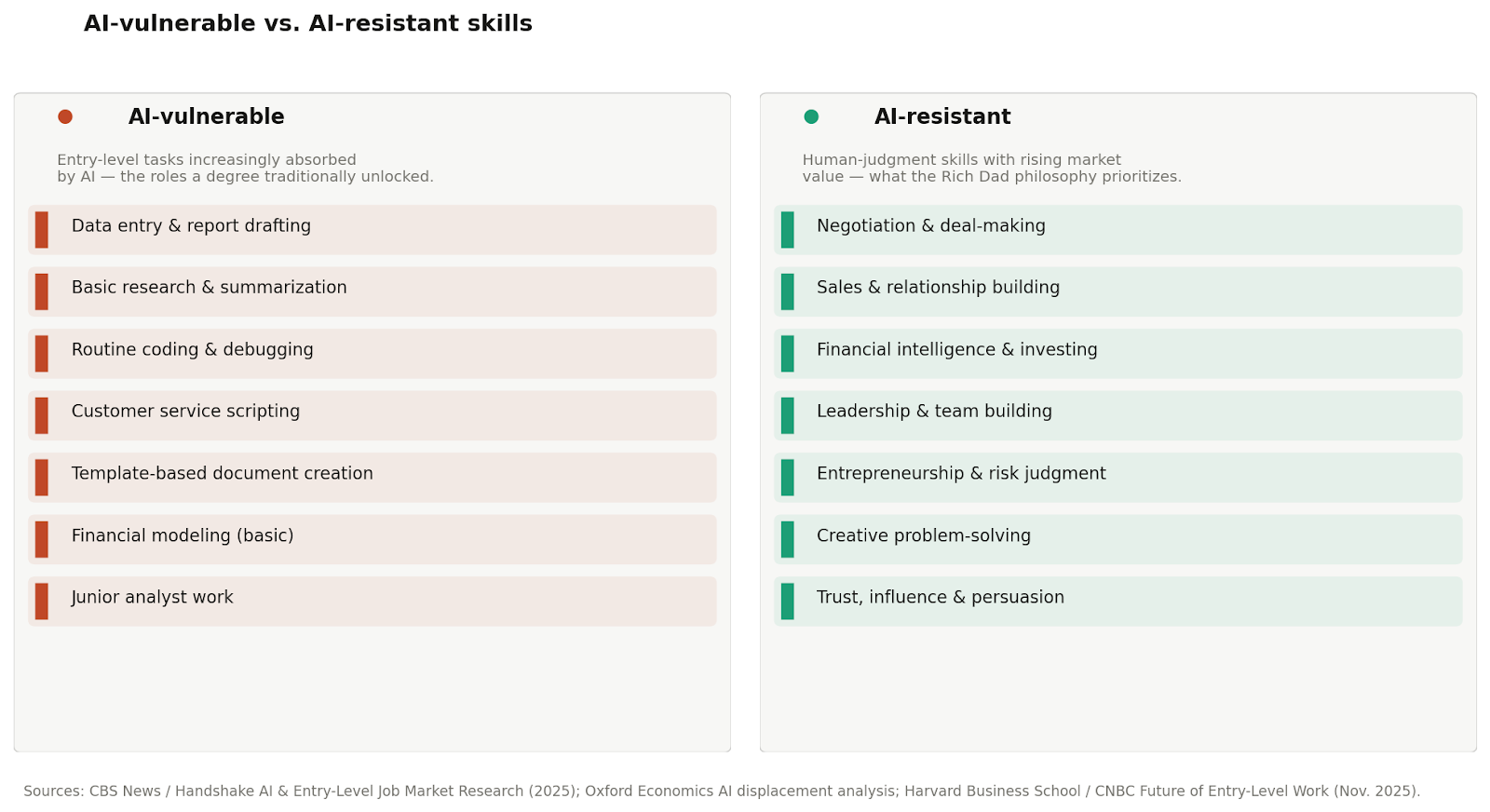
That gap between traditional education and current, practical skill has only widened. A 2025 CNBC report on the entry-level job market found that just 30% of 2025 college graduates landed a full-time job in their field, down sharply from the prior year, as AI tools absorb the routine research, drafting, and data-entry tasks that used to be a new employee’s on-ramp. The tasks disappearing are exactly the specialist, repeatable ones poor dad’s formula optimized for. The tasks rising in value — negotiation, sales, leadership, financial judgment — are the generalist, human ones rich dad prioritized all along.
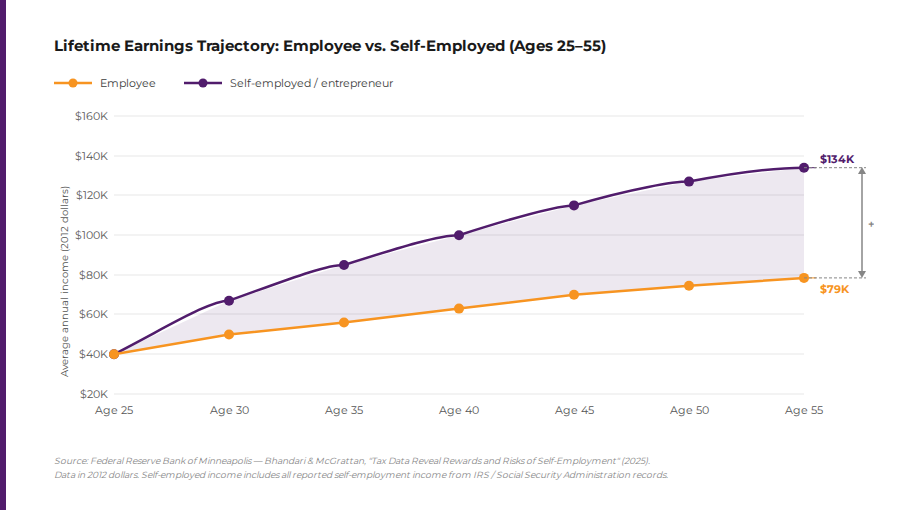
There’s a financial argument for this too, and it isn’t small. Research from the Federal Reserve Bank of Minneapolis found that self-employed and entrepreneurial workers out-earn traditional employees by a widening margin as their careers progress — the two groups start at similar income in their 20s, but by age 55 the self-employed are earning substantially more, on average, than employees in the same cohort. Generalist, risk-tolerant skill-building is what makes that path available in the first place.
This is a mindset shift as much as a skills one — see this take on working smarter, not harder for how that plays out once income starts flowing from assets instead of hours.
Embrace mistakes: From experience to wisdom
Poor dad came from academics, where mistakes are penalized and avoided. Rich dad came from the street, where mistakes were simply the price of learning something new. “There is a bit of magic hidden in every mistake,” he liked to say. “So the more mistakes I make and take the time to learn from, the more magic I have in my life.”
The pattern shows up everywhere success is studied. Thomas Edison ran through more than 10,000 failed attempts before the light bulb that built General Electric worked. Levi Strauss started sewing canvas pants for miners only after failing at gold mining himself. Michael Jordan has said outright that he missed more than 9,000 shots and lost almost 300 games — and credits that failure record, not his talent, as the reason he succeeded.
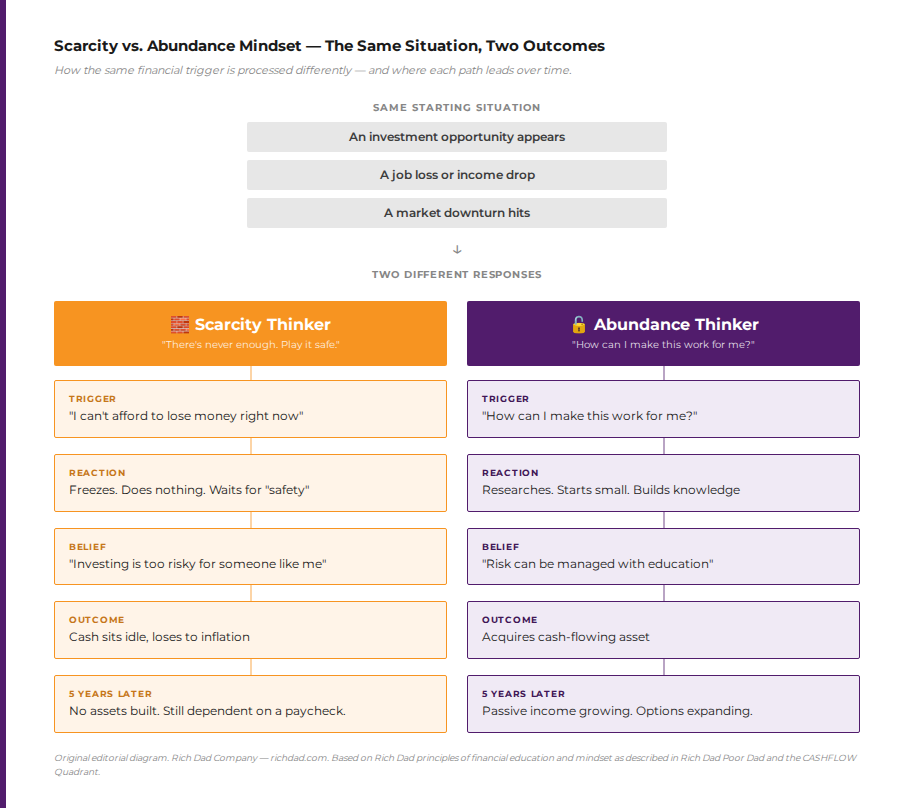
The common thread isn’t talent; it’s what each person did with the failure. Rich dad’s real point was about risk-aversion, not risk itself: people who play it safe rarely get ahead, precisely because playing it safe means avoiding the mistakes that teach the lessons that wealth requires. He called the discipline of not repeating a mistake, once you understood it, the move from experience to wisdom.
Work to learn, then to earn: Your action plan
The choice Kiyosaki poses is still binary for most people today: work to earn, and hold onto the security of a stable paycheck, or work to learn, and trade some of that security for skills that compound. Most people default to the first option, because it’s the formula school actually teaches. Getting rich requires deliberately choosing the second.

Before taking the next job, project, or role, it’s worth asking what skill it will actually teach — not what it will pay. That question is the starting point for financial education broadly, and it’s the same question that eventually determines whether a career stays capped on the E/S side of the CASHFLOW Quadrant or opens up on the B/I side. For a hands-on way to practice that decision-making without real-money risk, the CASHFLOW board game simulates exactly this kind of asset-versus-security tradeoff.
FAQs
It means choosing early-career jobs, mentors, and side projects based on the skill or financial education they provide rather than the salary attached to them, on the theory that skills compound into wealth over a career while a single paycheck does not.
Kiyosaki used the phrase to describe his own early-career choices — leaving a well-paid tanker job for the Marine Corps, then turning down a stable pilot’s salary for a sales job at Xerox — specifically to acquire leadership and sales skills he couldn’t get any other way. He’s framed it as advice aimed particularly at young people who still have room to trade short-term income for long-term skill.
The “work to learn, then to earn” philosophy favors skill-building, particularly in the first decade of a career, because a strong skill set (sales, leadership, financial literacy) raises earning potential for decades, while a slightly higher starting salary has a much smaller lifetime effect. This doesn’t mean ignoring pay entirely — it means weighing the learning opportunity as heavily as the paycheck when comparing offers.
Again, this philosophy favors generalist skill-building — sales, leadership, accounting, negotiation — because those skills are what allow someone to eventually own or run a business rather than simply perform one specialized function within it. Deep specialization can maximize pay within the employee quadrant, but it doesn’t, on its own, prepare someone to move to the business owner or investor side of the CASHFLOW Quadrant.
Treat financial education the way a practitioner would: take targeted classes from people actively working in the field (not academic teaching theory), attend industry conferences and seminars, seek mentors already doing the work, and prioritize speed of learning over credentials, since practical market knowledge changes faster than any curriculum can.