
The critical difference between owning a job and owning a business
Every year, headlines trumpet the rise of entrepreneurship. A 2025 report from the U.S. Bureau of Labor Statistics confirms that new business formation remains near historic highs — but formation is not the same as survival, and survival is not the same as success.
Robert Kiyosaki has made this point for decades using the CASHFLOW Quadrant — his framework for understanding how different people generate income. The quadrant divides earners into four groups: Employees (E), Self-Employed (S), Business Owners (B), and Investors (I). Most people who ‘start a business’ never leave the S quadrant. They fire their boss and hire themselves. The income ceiling is still their own available hours.
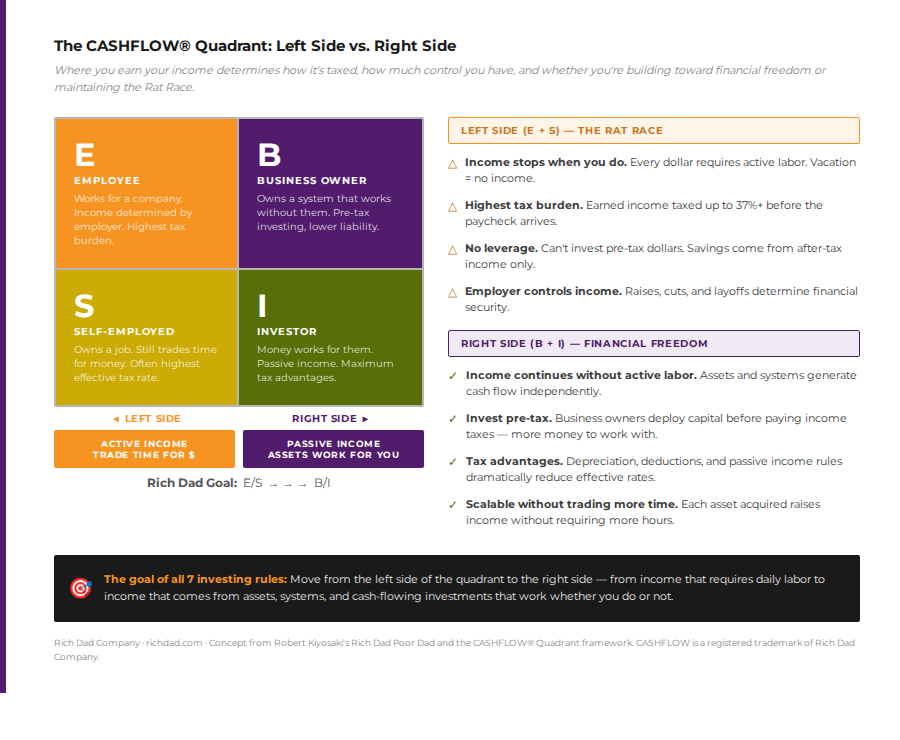
The S quadrant has real value — self-employment offers autonomy, pride of craft, and direct income. But it has a hard ceiling. The moment an S-quadrant business owner takes a vacation, gets sick, or steps away, the income stops. A B-quadrant business owner can take a year off and return to find the business more profitable than when they left. The income continues because the system continues.
That is the fundamental goal of the entrepreneurship journey Rich Dad teaches: not just to work for yourself, but to build something that works without you.
Why most businesses fail — and what the survivors know
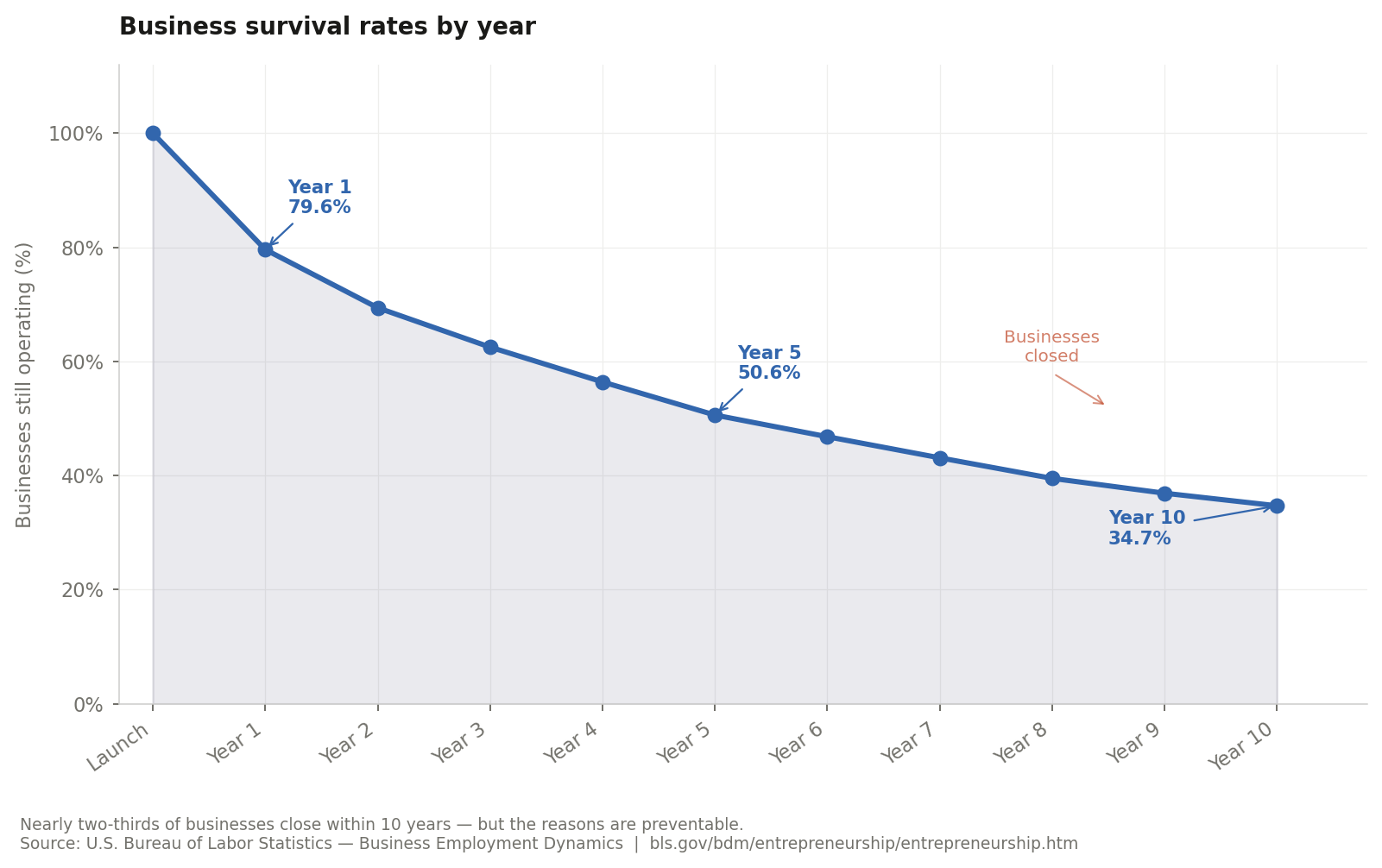
The numbers are sobering. According to U.S. Bureau of Labor Statistics data, only about 34.7% of businesses launched in a given year are still operating a decade later. Nearly two-thirds close within ten years. The reasons are not mysterious — they are documented, predictable, and largely preventable with the right financial education.
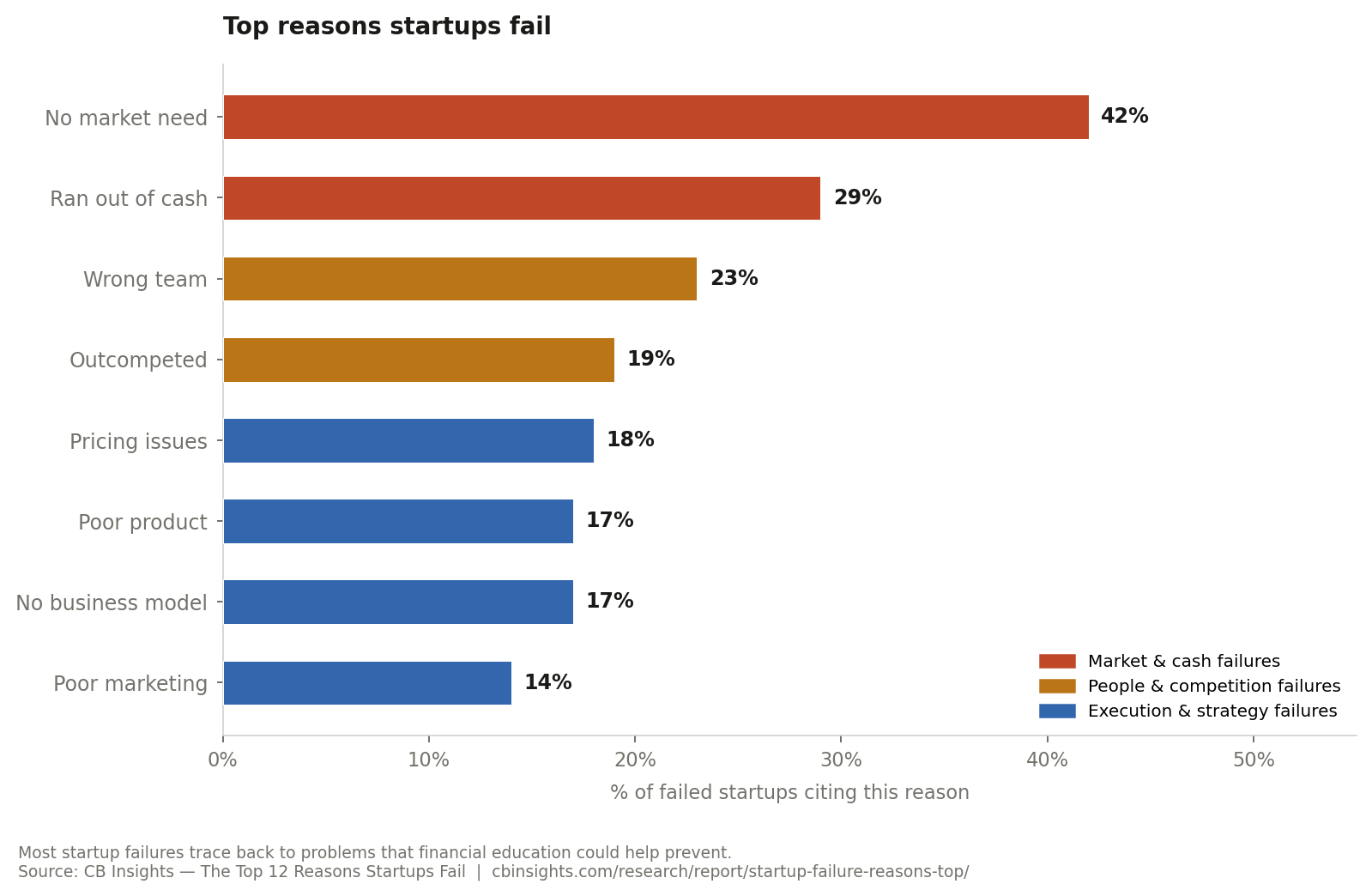
Research from CB Insights consistently identifies the top reasons startups fail: 42% cite no market need, 29% ran out of cash, and 23% had the wrong team. Notice what those top three causes have in common: they are all problems that financial education and systems thinking directly address. No market need is a validation problem. Running out of cash is a cash flow management problem. Wrong team is a leadership and relationship problem. These are not strokes of bad luck — they are gaps in financial intelligence.
Rich Dad’s position is consistent: most business failures are education failures in disguise. Entrepreneurs who understand cash flow, who build systems before they hire, and who choose the right partners make the same mistakes every new business owner makes — they just catch them earlier and recover faster.
The system is the business: The McDonald’s Principle
One of the most useful teaching tools Robert has used over the years is a simple question: Can you make a better hamburger than McDonald’s? Almost anyone would say yes. Then comes the follow-up: Can you build a better business system than McDonald’s?

That gap — between a great product and a great system — is where most aspiring entrepreneurs get stuck. They fall in love with their product or service, which rich dad always warned against. The product is the least important component of a lasting business.
The proof is everywhere. McDonald’s does not claim to make the world’s best burger. What McDonald’s built is a system that has served billions of people across thousands of locations, delivering a consistent result using mostly entry-level workers following a documented process. The system trains the people, the people run the system, and the owner profits from the output.
Visit any McDonald’s and observe the full picture: the supply chain, the training manuals, the regional management structure, the marketing machine, the real estate strategy. That is what a B-quadrant business looks like from the inside. It is a machine, not a craftsman.Why most businesses fail — and what the survivors know
The B-I Triangle: What every business needs
Rich Dad’s B-I Triangle illustrates the eight components every successful business must have. Mission sits at the base — the foundational reason the business exists. Working outward: cash flow management, communications, systems, legal protections, products, and team. The product is at the top, which means it is the most visible — but the most important element is always mission.

Most struggling businesses are built upside down. They start with a product and try to bolt on cash flow management and systems later. Successful B-quadrant businesses start with mission: why does this company exist, who does it serve, and what problem does it solve better than anything else available?The system is the business: The McDonald’s Principle
The financial case for moving to the B Quadrant
Beyond the freedom that B-quadrant ownership provides, the financial rewards are substantial. Employees in the E quadrant face the highest effective tax burden — payroll taxes arrive before they ever see their paycheck. The IRS tax code was written, in large part, to reward business owners and investors.
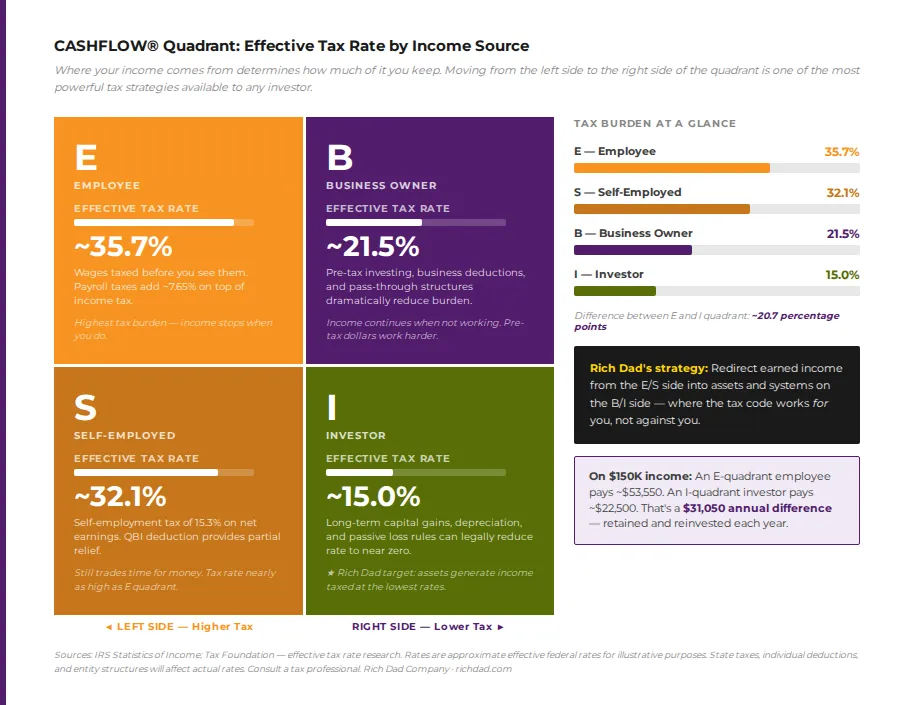
An employee earning $150,000 pays an effective federal rate near 35.7% when payroll taxes are included. A business owner with the same income often pays closer to 21.5% or less, thanks to pre-tax investing, business deductions, and pass-through structures. An investor in the I quadrant may pay as little as 15%. The difference is not a tax loophole — it is a deliberate feature of the tax code that rewards those who create jobs, build systems, and deploy capital productively.
The income ceiling is equally stark. As the CASHFLOW Quadrant income ceiling chart illustrates, employees are capped by hours times wage. Business owners and investors face no such ceiling — income scales with systems and assets, not personal labor hours.
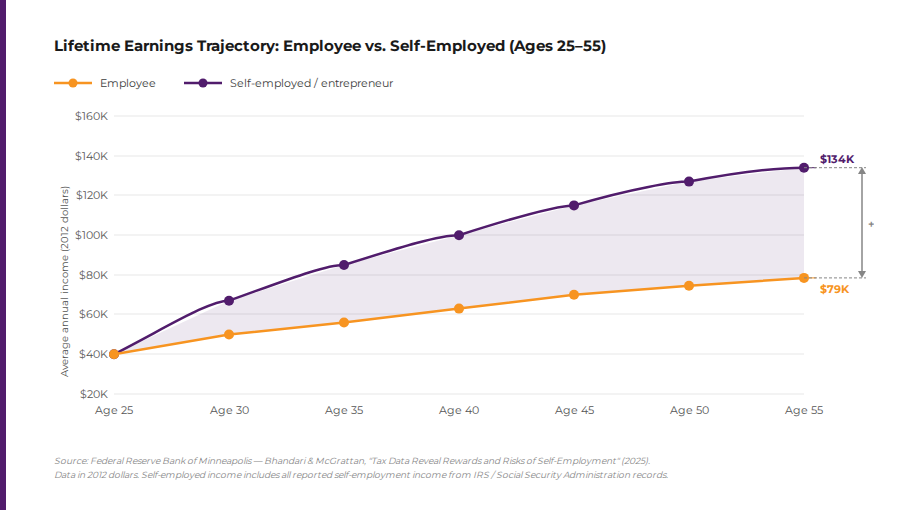
Even the data on self-employment versus employment tells an instructive story. Research from the Federal Reserve Bank of Minneapolis shows that self-employed individuals earn meaningfully more over a lifetime than salaried employees — but note: that research covers self-employment broadly. The gap between true B-quadrant ownership and both categories is wider still, and in favor of those who build systems.
Four paths to becoming a successful business owner
There is no single route to B-quadrant business ownership. Rich Dad has always emphasized that the right path depends on where someone is starting from, what resources they have access to, and how much time they are willing to invest in education. Here are four viable options:
- Start Your Own B-Quadrant Business
Building from the ground up is the hardest path — and the most rewarding. It requires developing both the system and the team simultaneously. The process demands financial literacy, leadership skills, legal knowledge, and the discipline to build cash flow management into the architecture of the business from day one rather than treating it as an afterthought.
Rich Dad’s guidance: do not start with the product. Start with the mission. Who does this business serve? What problem does it solve? What is the vision that will attract the right team members and loyal customers? Then build the system around that mission. The product follows.
- Buy a Franchise
A franchise gives the buyer a proven operating system. The systems, training, supply chains, and branding already exist — the franchisee’s primary job is to develop the team and execute the system with discipline. Banks generally prefer lending to franchises over startups because the risk profile is lower with a documented operating history.
The trade-off: franchisees do not call the shots. Every process is dictated by the franchisor. This is not a path for someone who wants creative control — it is a path for someone who wants to learn how a successful B-quadrant system operates from the inside, with training wheels intact.
- Network Marketing
For a relatively low entry cost, network marketing gives aspiring business owners access to an existing system with built-in product fulfillment, order processing, accounting, and distribution. The business owner’s job is to build the team and the customer base — not to invent the infrastructure.
Network marketing receives undeserved skepticism, often because people confuse legitimate network marketing businesses with pyramid schemes. Robert Kiyosaki has spoken favorably about well-structured network marketing companies not because of the income potential alone, but because the model forces participants to develop sales, leadership, and communication skills that are essential in any B-quadrant business.
- The Solopreneur Model
Technology has created a fourth path that did not exist a generation ago: the solopreneur. Unlike a traditional self-employed professional who is limited by personal hours, the modern solopreneur uses software, automation, and the internet to scale impact without building a large team.
A solopreneur can use cloud-based accounting software in place of an accounting department, legal platforms for entity formation, and digital delivery systems for products that require no inventory. The internet has made it possible to operate what functions like a B-quadrant business at S-quadrant startup costs. The key distinction from simple self-employment: the solopreneur is building systems and scalable assets, not just billing for hours.The financial case for moving to the B Quadrant
Mission-driven leadership: Purpose beats product
Every successful business runs on mission before it runs on anything else. When someone works for a corporation or buys a franchise, they adopt an existing mission. When they build their own business, they must define the mission themselves — and then lead from it under pressure.
There will always be pressure to pivot to what is selling, to cut corners on systems in favor of immediate revenue, or to compromise the original vision when the market pushes back. The business owners who survive and thrive are those who understand their mission deeply enough to hold it steady through those pressures while remaining flexible about tactics.
Rich dad’s maxim was clear: never fall in love with your product. Fall in love with your mission. Products become obsolete. Markets shift. Technology disrupts. But a business built on a genuine mission — one that serves a real need for real people — can adapt its products and methods while keeping its identity intact.
Business is a team sport; Build the right relationships
No B-quadrant business owner builds alone. Rich dad’s phrase — “business and investing are team sports” — is not a motivational slogan. It is a structural observation about how B-quadrant businesses actually work.
The wrong partners can destroy a business faster than any market downturn. A bad business relationship creates the same destructive dynamics as a bad marriage: mistrust, misaligned incentives, communication breakdown, and legal cost when the relationship ends. The people an entrepreneur chooses to build with are arguably more important than the idea they are building around.

Choosing good partners means investing time in due diligence that has nothing to do with spreadsheets. It means understanding someone’s values, their track record, how they behave under pressure, and whether their vision of success aligns with the mission being built together. As with a marriage, there is no need to rush. A mediocre partner chosen quickly is far more expensive than a great partner found slowly.
Beyond co-founders and partners, successful business owners build a team of advisors: a CPA who specializes in business tax strategy, an attorney who understands entity structure and asset protection, a mentor who has built what they are trying to build, and trusted peers who will challenge their thinking rather than validate it reflexively.Mission-driven leadership: Purpose beats product
Financial literacy is not optional
The CB Insights research is unambiguous: running out of cash is the second most common reason businesses fail. Not running out of customers — running out of cash. The distinction matters. A business can be growing, generating revenue, and still collapse because the owner does not understand the difference between profit on paper and cash in the bank, or because accounts receivable have grown faster than cash collections, or because the cost structure was never properly modeled against the revenue cycle.
The Rich Dad approach to personal finance and business finance starts with the same foundation: understanding cash flow. Specifically, understanding the difference between an asset and a liability. A business that consumes more cash than it generates is not an asset — it is a liability wearing a business plan. Building a business that generates positive cash flow consistently, and reinvesting that cash flow into income-producing assets, is the core of the Rich Dad wealth-building philosophy.
Aspiring business owners should be able to read a profit and loss statement, understand a balance sheet, and project a cash flow statement before they invest significant capital in any venture. These are not accounting skills — they are survival skills. The business owner who cannot read their own financials is flying blind.Business is a team sport; Build the right relationships
How to get relevant financial education
The traditional path to business knowledge — an MBA plus a decade in corporate — remains valid. But it is no longer the only path, and for most aspiring business owners it is not the fastest one. Technology has democratized access to business education in ways that would have been unimaginable a generation ago.
The fastest path, Rich Dad has always argued, is mentorship. A mentor is someone who has already done what the aspiring business owner wants to do and is willing to share what they learned along the way — including, and especially, the failures. Rich dad himself was a mentor. The education he provided Robert Kiyosaki had nothing to do with academic credentials and everything to do with real-world systems thinking, financial literacy, and leadership.
Working inside a well-run company — particularly in operations, finance, or sales — provides paid mentorship. The aspiring B-quadrant business owner is learning how a working system operates from the inside, observing how management makes decisions, and building the financial literacy they will need when they go out on their own. Rich Dad’s entrepreneurship resources and coaching programs are designed to accelerate this process for those who are ready to act.
The goal is not to acquire credentials. The goal is to acquire competence — in systems thinking, in financial literacy, in leadership, and in the ability to identify and manage risk intelligently. That competence, more than any degree or title, is what separates business owners who build lasting enterprises from those who build jobs.
Build the business — Not just the idea
The leap from employee or self-employed to true B-quadrant business owner is the most consequential financial move most people can make. It does not require a large inheritance or a prestigious degree. It requires a willingness to shift identity: from someone who performs work to someone who builds systems that perform work.
The starting point is honest self-assessment. Which quadrant does your current income come from? What would happen to that income if you stopped working tomorrow? If the answer is that it would stop, the next question is: what is the first step toward building something that does not require your constant presence to generate income?
That first step might be educating yourself on cash flow fundamentals. It might be finding a mentor. It might be buying into a franchise to learn how a real system operates before building your own. It might be launching a solopreneur business on nights and weekends while maintaining the financial stability of a day job.
What it cannot be is waiting. Every day spent entirely on the left side of the CASHFLOW Quadrant is a day the assets on the right side are not compounding. The best time to start building was years ago. The second-best time is today.
FAQs
A self-employed person (S quadrant) owns a job — their income depends on their personal labor. A business owner (B quadrant) owns a system — their income continues when they are not working because the system and team generate it independently. The Rich Dad framework defines this as the fundamental distinction between the left and right sides of the CASHFLOW Quadrant.
It depends on the model. A solopreneur business can be started with minimal capital using software tools, digital products, and internet distribution. A franchise requires anywhere from tens of thousands to several million dollars. A traditional B-quadrant business requires enough capital to build the systems and hire the initial team without relying solely on early revenue. The amount matters less than the discipline to manage cash flow from day one.
No. An MBA provides foundational knowledge in accounting and management, but it does not teach the practical systems thinking and financial literacy that B-quadrant business ownership demands. Mentorship, practical experience inside well-run businesses, and self-directed financial education are typically more valuable than a degree for aspiring entrepreneurs.
According to CB Insights, the top reasons include no market need (42%), running out of cash (29%), and having the wrong team (23%). The Rich Dad perspective: all three failures trace back to inadequate financial education — specifically, failing to validate market demand before building, failing to understand cash flow management, and failing to invest in the right people and relationships.
The CASHFLOW Quadrant is Robert Kiyosaki’s framework for categorizing how people earn income: Employee (E), Self-Employed (S), Business Owner (B), and Investor (I). The left side (E and S) trades time for money. The right side (B and I) uses systems and assets to generate income independently. Becoming a successful business owner means transitioning from the left side to the B quadrant on the right.
The honest answer is that no one ever feels fully ready — but there are signals that indicate preparation. You are ready to begin when you understand your target market’s real problems, you can model basic cash flow for the business, you have identified at least one mentor or advisor who has done what you are attempting, and you have a clear mission that is distinct from attachment to a specific product.
Financial education is the foundation of business success in the Rich Dad framework. Understanding cash flow, taxes, entity structure, debt, and financial statements allows business owners to make informed decisions, spot problems before they become crises, and take advantage of the tax benefits that the law provides specifically to business owners and investors. Most business failures are, at their core, financial education failures.