What Is the Difference Between Money and Currency?
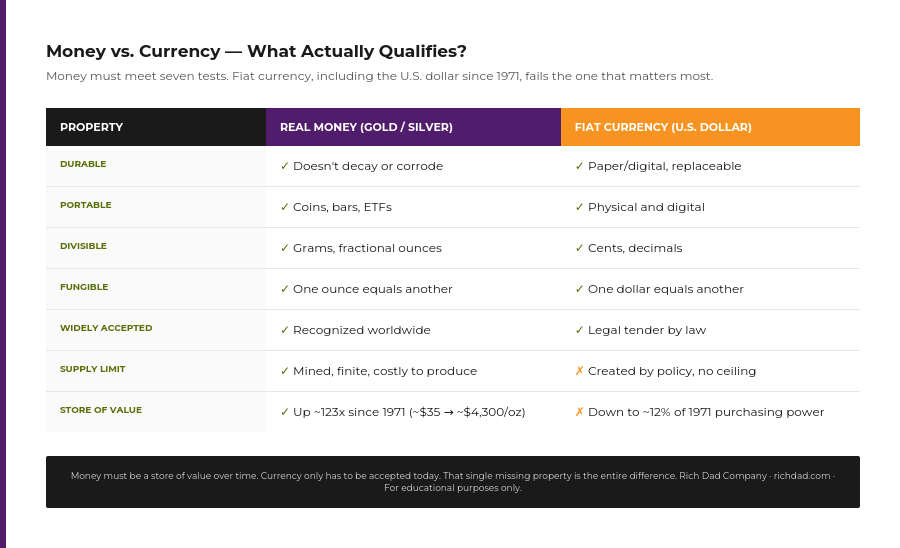
Money and currency both function as a medium of exchange, but only one of them is built to protect wealth over the long run. Economists generally agree that true money must meet several tests: it has to be durable, portable, divisible, fungible, and widely accepted. Gold and silver satisfy all of these. So, on paper, does the U.S. dollar. But there’s a seventh test that separates the two — and it’s the one that actually matters to your bank account.
The Property Currency Doesn’t Have: Store of Value

Real money has to preserve its purchasing power over time. A currency only has to be accepted in the moment. That’s a small-sounding distinction with an enormous consequence: a currency can be created in unlimited quantities by the institution that issues it, while real money — gold, silver, and other finite assets — cannot. When more units of currency enter circulation faster than the economy grows, each unit buys less. That’s inflation, and it’s not a side effect of currency — it’s baked into how currency works.
Why the U.S. Dollar Stopped Qualifying as Money
Before 1971, the U.S. dollar was different. It was a claim on a fixed amount of gold held in the U.S. Treasury, which is why older dollar bills were called silver certificates. That link meant the government couldn’t print more dollars than it had gold to back — a built-in ceiling on the money supply. Once that link was broken, the dollar became a Federal Reserve Note: a liability of the U.S. government rather than a claim on a real asset. The U.S. is now the largest debtor nation in history, a fact directly connected to that 1971 decision.The Property Currency Doesn’t Have: Store of Value
How the Dollar Became Currency: The 1971 Nixon Shock
Robert Kiyosaki has told the story of receiving a letter from his rich dad in 1972, while serving as a helicopter pilot in Vietnam, that read: “President Nixon took the dollar off the gold standard. Watch out, the world is about to change.” At the time, few people understood the significance. But the mechanics were straightforward.
In the closing days of World War II, the Bretton Woods Agreement pegged the world’s major currencies to the U.S. dollar, and the dollar itself was pegged to gold at $35 an ounce — a quasi-gold standard designed to stabilize the postwar global economy. It worked reasonably well until the 1960s, when the U.S. began importing more than it exported — Volkswagens from Germany, Toyotas from Japan — and foreign governments started redeeming their dollars for American gold. As the gold reserves at Fort Knox declined, Nixon closed the “gold window” in August 1971, formally ending Bretton Woods. For the first time in history, a single nation’s fiat currency became the world’s reserve currency, untethered from any physical backing.

Rich dad had young Robert Kiyosaki look up the dictionary definition of “fiat”: a command or act of will that creates something without or as if without further effort. In other words, fiat currency can be created out of thin air, by decision rather than by digging it out of the ground or backing it with something tangible.
What Is Fake Money?
Fiat currency is money that isn’t convertible into a commodity of equivalent value — it has worth only because a government declares it does and people agree to use it. Every major currency in the world today, including the dollar, euro, and yen, is fiat currency. That system isn’t inherently a crisis; it’s simply a different set of rules than a gold-backed system, and those rules favor whoever controls the printing press.
History offers a preview of what happens when a fiat system is abused. Ancient Rome debased its silver denarius for centuries until the coin was barely silver at all. After World War I, the German government printed marks with no restraint to pay its debts; a loaf of bread that cost a fraction of a mark in 1913 cost billions of marks by late 1923. More recently, Zimbabwe printed its way to hyperinflation in the 2000s, at one point issuing a 100-trillion-dollar note that couldn’t buy a bus ticket. In each case, the pattern is identical: once a government can create currency without limit, it eventually does, and the currency’s value collapses. The U.S. is nowhere near hyperinflation today, but the mechanism — currency creation outpacing the real economy — is the same one driving ordinary inflation, just at a dramatically slower pace.
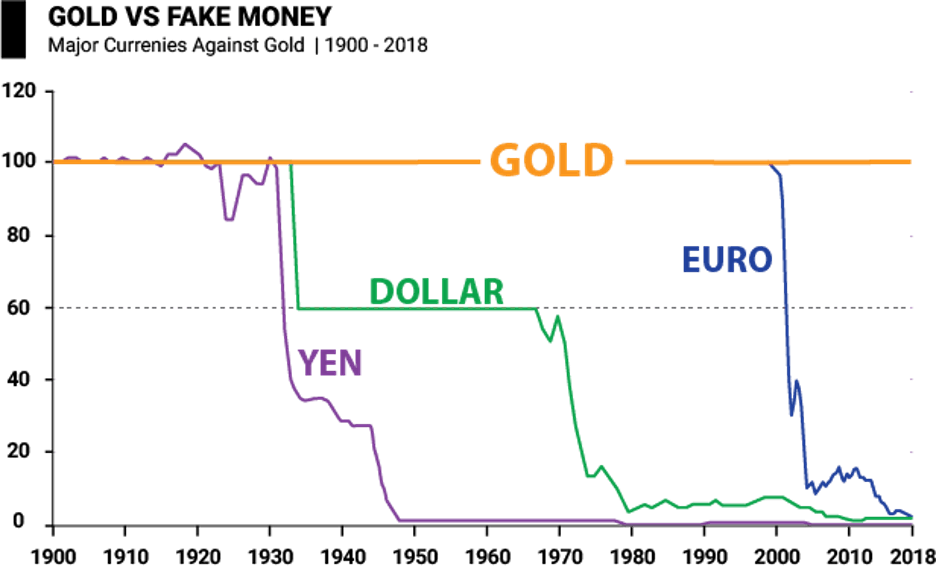
The chart below is a Rich Dad staple for a reason: it shows major currencies measured against gold, indexed to 100, from 1900 through 2018. Gold is the flat line — the measuring stick everything else is judged against. The yen collapses first, in the 1930s and ’40s. The dollar holds near the top until the 1971 gold-window closure, then falls off a cliff. The euro launches in 1999 near 100 and is already deep in decline by 2018.
How does this actually happen in practice? When a currency isn’t tied to a finite asset, the institution that issues it can create more of it whenever it chooses — and that’s exactly what’s occurred since 1971. The chart below shows the two lines moving in opposite directions from 1971 through June 2018: currency in circulation climbing as the dollar’s purchasing power falls. Over that stretch, the U.S. money supply increased 32.3 times, accompanied by an 84.1% drop in the dollar’s purchasing power.
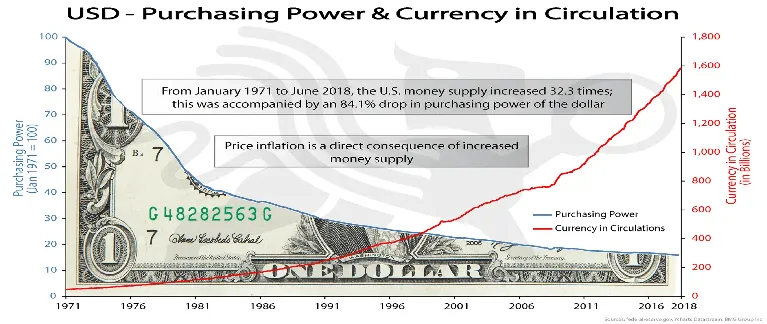
That trend hasn’t reversed — if anything, it’s accelerated. By 2026, cumulative purchasing power loss since 1971 sits at roughly 88%, and annual inflation was still running at 3.5% as of June 2026 according to the Bureau of Labor Statistics, after peaking near 4.2% in May — well above the Federal Reserve’s 2% target, and a reminder that the currency in a savings account is a moving target, not a fixed one.
Money Is No Longer Money
Most people think of dollars as money, but the reality is that it is not. Here’s an odd way to see it: you can buy $10,000 in cash directly from the U.S. Bureau of Engraving and Printing for around $45 — the catch is that it’s shredded currency, no longer legal tender, sold as a novelty. That $10,000 in shredded paper is worth exactly what any other piece of paper is worth: whatever someone will pay for it, nothing more, because it was never money in the first place. It was always currency — valuable only because it was accepted, not because it stored value.
It helps to compare currency to an electrical current. An electric current only does work while it’s moving; the instant it stops, it goes dead. Currency behaves the same way. It has to keep moving — spent, invested, redeployed — to be useful. Money that sits still in a low-yield account isn’t actually standing still; it’s losing purchasing power every year it doesn’t move. This is the same principle behind what Rich Dad calls the velocity of money: wealth isn’t built by accumulating and parking currency, it’s built by keeping it in motion through assets that produce cash flow.
Why Savers Are Losers in a Currency Economy
Rich Dad has said for years that “savers are losers,” and the purchasing-power math above explains exactly why. A dollar parked in a savings account earning less than the inflation rate isn’t standing still — it’s shrinking in real terms every single year, just more slowly than cash under a mattress. The chart below compares three ways to deploy the same $10,000 over 20 years.
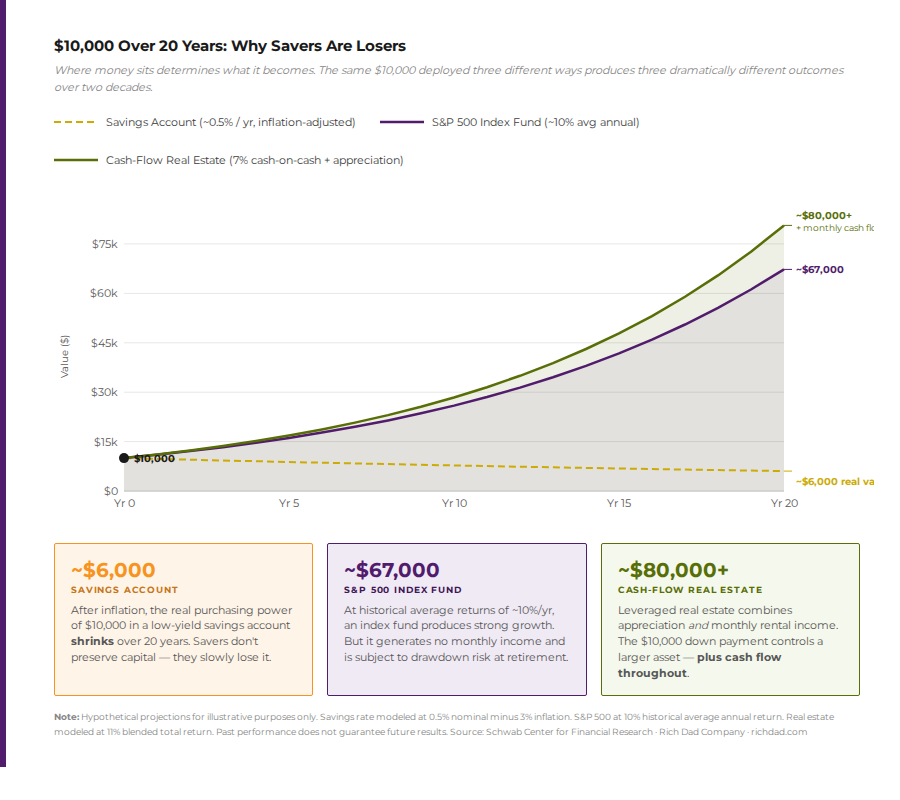
The gap isn’t small. Money left in a savings account loses real value to inflation, while the same amount deployed into cash-flowing assets — even conservatively — outpaces currency devaluation by a wide margin. This is the practical difference between treating currency as a place to park wealth and treating it as a tool to acquire real assets.
How the Rich Use Currency to Acquire Real Money and Assets
The wealthy don’t ignore currency — they use it differently. Robert Kiyosaki’s central argument in his book “Fake: How Lies Are Making the Poor and Middle Class Poorer” is that the rich have learned to use fake money (currency) to acquire real money (gold, silver) and real assets (income-producing real estate, businesses, cash-flowing paper assets). Every time a saver deposits currency into a low-yield account, they are effectively printing a small amount of money for the bank at whatever interest rate that account pays — often a fraction of a percent. Every time that same person carries a credit card balance, they’re printing money for the bank in the other direction, often at 18% or higher. The rich structure their finances so that currency flows toward them through cash-producing assets rather than away from them through debt and depreciating savings.
This isn’t limited to gold and real estate. In “Grunch of Giants,” Dr. R. Buckminster Fuller — a mentor to Robert Kiyosaki — described how those with the most power in the financial system manipulate currency to move real wealth toward themselves. The lesson isn’t that the system is unfair in some abstract sense; it’s that financial education is what allows an individual investor to use the same currency mechanics that work against uneducated savers.
How to Protect Your Wealth From Currency Risk
Understanding money vs. currency only matters if it changes what you do with your next dollar. A few practical starting points:
- Stop treating currency as a store of value. A savings account is a short-term holding tool, not a long-term wealth strategy.
- Convert currency into cash-flowing assets on a schedule, rather than waiting for a “better time” — inflation doesn’t pause while you wait.
- Hold some real money as a hedge. Gold and silver aren’t meant to outperform every year; they’re meant to preserve purchasing power when currency doesn’t.
- Understand good debt. Borrowing currency to acquire an appreciating, cash-flowing asset is a fundamentally different use of debt than borrowing currency to consume — a distinction covered in Good Debt vs. Bad Debt.
- Keep learning. The difference between money and currency isn’t intuitive, which is exactly why most people never act on it.
FAQs
The U.S. dollar is currency, not money, in the strict economic sense. Since 1971, it has not been backed by or convertible into gold or any other physical asset — it holds value only because the government requires its acceptance and the public agrees to use it.
Fiat currency is currency that a government declares to be legal tender without backing it by a physical commodity like gold or silver. Its value depends entirely on public trust and government policy rather than on an underlying asset.
In August 1971, foreign governments were redeeming U.S. dollars for gold faster than the U.S. could sustain, as trade deficits grew and gold reserves declined. President Nixon closed the “gold window” to stop the outflow, ending the Bretton Woods system and turning the dollar into a pure fiat currency.
Yes. Gold meets all of the traditional properties of money — durability, portability, divisibility, fungibility, wide acceptance, and, critically, a long track record as a store of value — without depending on any government’s promise to make good on it.
Common approaches include holding a portion of wealth in gold or silver, investing in cash-flowing assets like rental real estate or dividend-paying businesses, and limiting the amount of currency held in low-yield savings accounts beyond a reasonable emergency reserve. This is educational information, not personalized financial advice.