
What increasing cash flow actually means for investors
Most advice about increasing cash flow is written for small businesses trying to speed up invoices or trim overhead. That’s a real problem — a recent survey found more than half of small businesses report uneven cash flow from month to month — but it’s a different problem from the one facing an investor. For an investor, increasing cash flow means acquiring assets that pay income on a regular basis, not just watching a balance grow on paper.
There has always been a hard line between cash flow and capital gains. Capital gains require selling the asset to realize a profit — the money only shows up once, and only if the timing works out. Cash flow shows up every month the asset is held: rent from a property, dividends and option premium from stocks, or profit distributions from a business. The CASHFLOW Quadrant framework from Robert Kiyosaki’s Rich Dad Poor Dad describes this as the shift from the left side of the quadrant, where income requires active labor, to the right side, where assets and business systems generate income independently.

Increasing cash flow, then, isn’t about finding one big win. It’s a repeatable process — and Rich Dad’s five secrets below are the process, whether the asset is a rental property, a position in stocks and paper assets, or a business you built yourself.
Secret #1: Build a cash flow game plan before you invest a dollar
There are two types of investors: educated and successful. Educated investors understand how to do a deal. Successful investors also understand why — how that specific deal fits into a bigger plan to increase cash flow over time.
Without a plan, an investor ends up with a varied portfolio that never actually goes anywhere. It’s the investing equivalent of grocery shopping without a list: plenty of good individual choices, but nothing that adds up to dinner. Before making the next deal, an investor should be able to answer a simple question: what dollar amount of monthly cash flow am I working toward, and which asset classes get me there?

A useful starting point is an honest audit of where income currently comes from. Most people are almost entirely dependent on earned income from a job — the highest-taxed, least scalable type of income there is. Sophisticated investors deliberately shift that mix toward portfolio and passive income over time.
There has always been a hard line between cash flow and capital gains. Capital gains require selling the asset to realize a profit — the money only shows up once, and only if the timing works out. Cash flow shows up every month the asset is held: rent from a property, dividends and option premium from stocks, or profit distributions from a business. The CASHFLOW Quadrant framework from Robert Kiyosaki’s Rich Dad Poor Dad describes this as the shift from the left side of the quadrant, where income requires active labor, to the right side, where assets and business systems generate income independently.
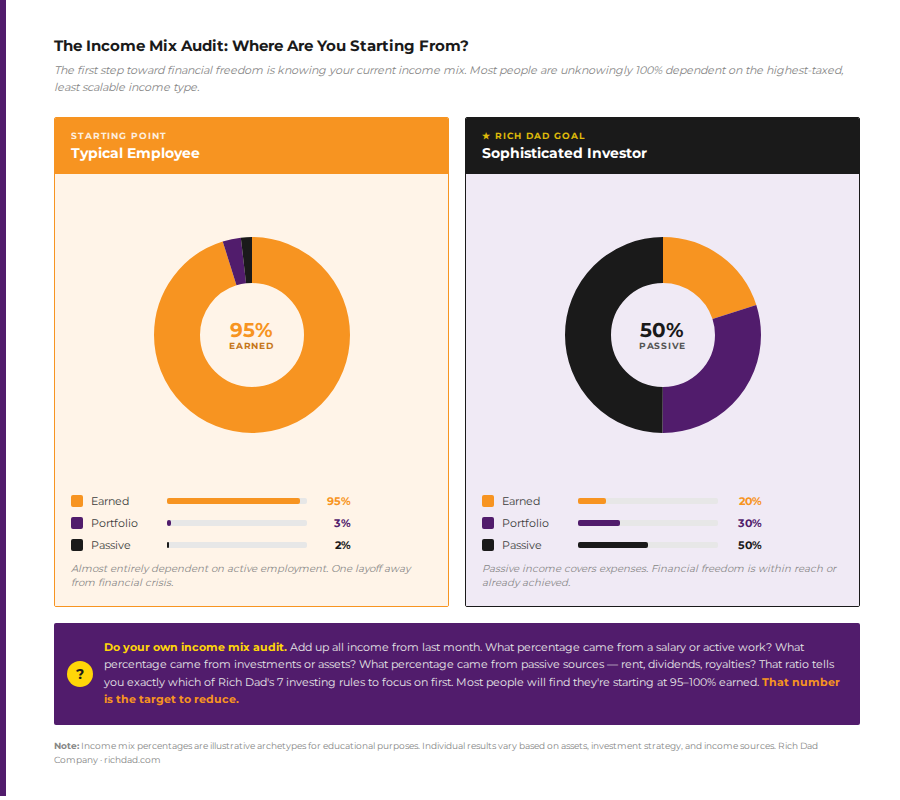
Rich Dad’s personal financial statement — a free download available in the Rich Dad tools library — is built for exactly this exercise. Filling one out honestly, then repeating the exercise quarterly, turns “increase cash flow” from a vague goal into a number an investor can actually track.
Secret #2: Stay agile as market conditions shift
A plan is only the starting point. The moment an investor puts a plan into practice, the real world starts to push back — interest rates move, a tenant gives notice, a stock’s dividend gets cut. None of that means the plan was wrong. It means markets adapt, and an investor’s approach has to adapt at the same pace or faster.
Agility means being fast enough to seize an opportunity while still having the resources on hand to act on it. An investor who takes too long to decide — waiting on committees, second opinions, or one more data point — will watch good deals go to someone else. That’s not a case for recklessness; it’s a case for doing enough homework in advance that a good opportunity can be recognized and acted on quickly when it appears.
Agility also means not limiting cash flow strategy to a single asset class. An investor who only knows real estate will sit out a window where paper assets are the better cash flow opportunity, and vice versa. Building at least a working knowledge of real estate, stocks and paper assets, and business ownership keeps more doors open.
Secret #3: Work on your portfolio like a business
If agility is making the right play in the moment, this secret is the halftime adjustment — stepping back from individual deals to look at the whole portfolio as a business.
Investors who stay buried in the day-to-day details of each holding tend to lose sight of the bigger picture. Treating a portfolio like a business — regardless of whether it’s built from real estate, stocks, or a company an investor started — means building systems that manage and even automate the parts that don’t require a judgment call.

In practice, that might mean setting up a website that automates how a real estate investor advertises properties and captures renter or buyer information. It might mean consulting legal and asset protection counsel to choose the right entity structure before scaling a rental portfolio or starting a business around it. For a stock market investor, it might mean setting hard rules — never risking more than a set percentage of the portfolio on a single position — and building the discipline to follow them automatically instead of relitigating the decision every time.
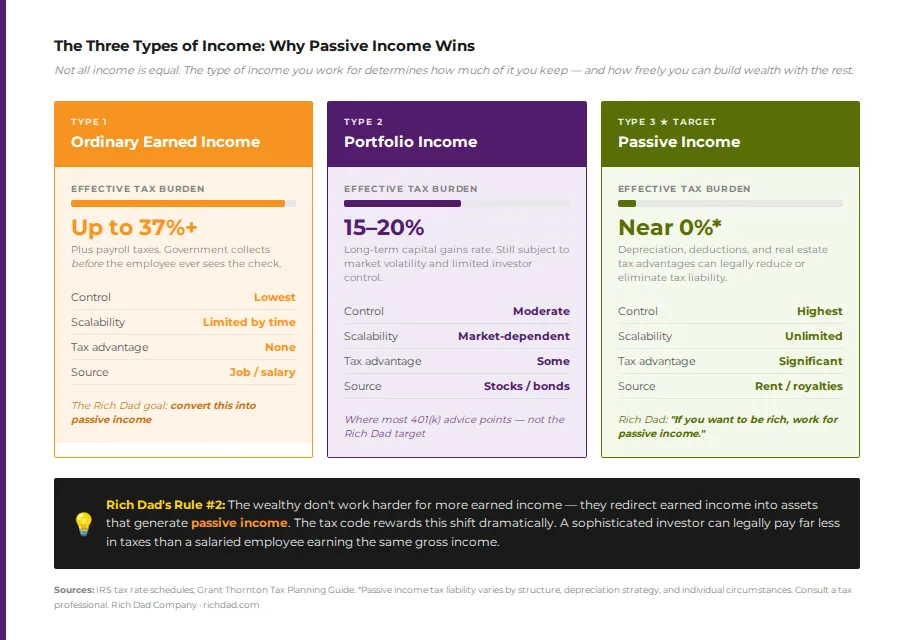
Working on the portfolio, not just in it, is also how an investor catches strategies that have quietly stopped working. A tactic can produce solid results for a while and then start to fade — money and attention that could have gone toward a stronger opportunity instead. The three types of income below are a useful lens for that review: earned income requires ongoing labor, portfolio income depends on selling at the right time, and passive income is what keeps paying regardless of what an investor does that day.
Secret #4: Find your blind spots before the market finds them
It’s difficult to recognize a bad habit that’s quietly working against an investor’s own cash flow goals. Most people aren’t eager to examine their own mistakes — and the more success an investor has had, the less inclined they are to believe anything is off. That’s exactly when outside perspective matters most.
Discussing both wins and losses honestly with other investors, and actually listening to the feedback, surfaces blind spots that are invisible from the inside. A CPA, attorney, property manager, or fellow investor who has been where an investor is trying to go can point out a habit or bias holding that investor back — even a small adjustment can lead to a meaningfully better outcome over time.
Taking feedback well means leaving emotion out of it. It’s tempting to dismiss a hard truth because of who delivered it, but the more useful question is always whether there’s something valid in the observation — regardless of the source — that would make the next deal better.
Secret #5: Balance confidence with humility as cash flow grows
Albert Einstein is often credited with the idea that doing the same thing repeatedly while expecting a different result is a form of madness. The same logic applies to a portfolio: sticking with a single asset class or strategy indefinitely produces the same results indefinitely. There’s real value in stability, but there’s also room to stretch beyond what’s comfortable once the fundamentals are solid.
Confidence comes from looking honestly at progress already made — the first deal, the first month of positive cash flow, the first year a rental property or dividend position actually paid for itself. Recognizing that progress is what makes the next stretch goal feel achievable rather than reckless.
Humility is the other half of that equation. In every hot market, unskilled investors make easy money and mistake luck for skill — and in every downturn, some of those same investors are wiped out because they never developed the fundamentals underneath the early wins. Most durable “luck” in investing is actually the product of skill, financial education, and a well-chosen team. Balancing confidence with humility is what lets an investor keep increasing cash flow steadily, deal after deal, instead of overreaching on a hot streak.
For a deeper look at what disciplined cash flow investing looks like in the stock market specifically, Rich Dad expert Andy Tanner breaks down dividends, covered calls, and option premium on the Rich Dad StockCast.
Putting the 5 secrets to work
Each of these five secrets is beneficial on its own, but they compound when used together: a game plan to know the target, agility to act when the market shifts, systems to run the portfolio like a business, feedback to catch blind spots, and a balance of confidence and humility to keep growing without overreaching. None of them require a specific asset class or a large starting balance — they’re the habits behind every cash flow pattern that leads toward financial freedom instead of away from it.
FAQs
There’s no single fastest way, but the quickest improvements usually come from redirecting existing capital toward an asset that already produces monthly income — such as a rental property, a dividend-paying stock, or an existing business — rather than waiting on an asset to appreciate in value.
Rich Dad teaches that cash flow is the more useful measure day to day, because it reflects money actually available to live on. Net worth can look strong on paper while producing little or no usable income — see What Is Cash Flow? for a full breakdown of the difference.
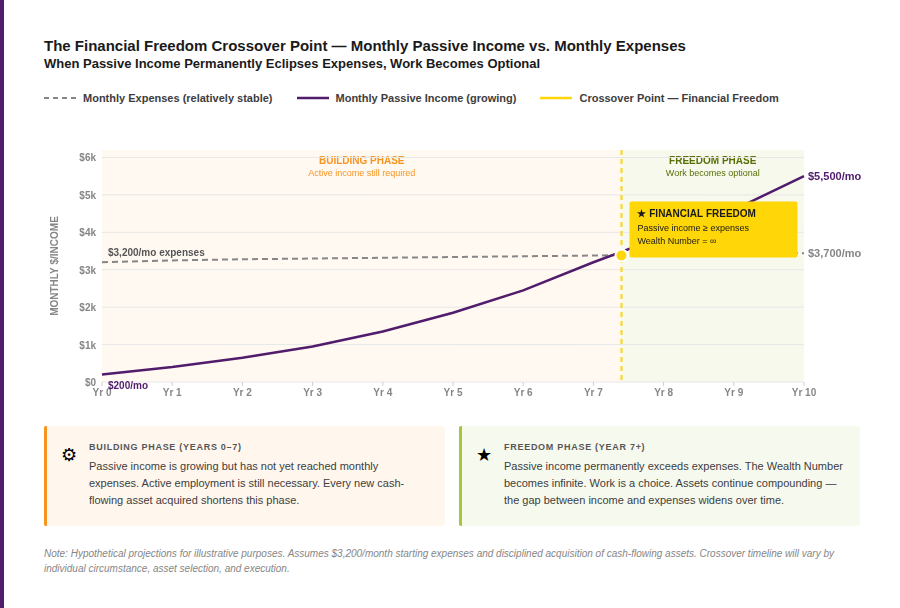
Financial freedom is reached when passive income permanently exceeds monthly living expenses, so the target number is different for every investor. The starting point is calculating current monthly expenses, then working backward to determine how much income-producing assets need to generate.
Capital gains are a one-time profit realized only when an asset is sold. Cash flow is ongoing income an asset produces while it’s still owned — rent, dividends, options premium, or business distributions. See the three types of income for how earned, portfolio, and passive income differ.
Yes. All five secrets apply across asset classes. In the stock market specifically, cash flow investors focus on strategies like dividend investing and covered calls rather than buying and hoping a stock’s price rises.