What Is the CASHFLOW Game?
The CASHFLOW game is a financial education board game created by Robert Kiyosaki (author of Rich Dad Poor Dad ) and Kim Kiyosaki, and first released in 1996. It rests on a simple idea: people learn money best by using it, not by hearing about it.
Every player starts in the Rat Race, the inner loop of the board, with a profession card and a personal financial statement. That statement tracks income, expenses, assets, and liabilities, just like the one Rich Dad teaches in real life. The object is to buy assets that produce enough passive income to cover your expenses. When passive income exceeds expenses, you leave the Rat Race and step onto the Fast Track.
A turn is simple. A player rolls a die and moves around the Rat Race, landing on spaces tied to the Small Deal, Big Deal, Market, and Doodad decks or on life events such as a paycheck, a new baby, or a downsizing. Opportunity cards let you buy assets, Market cards bring changing conditions, and life events add expenses or interrupt income. Together they mirror the choices and surprises real investors face.

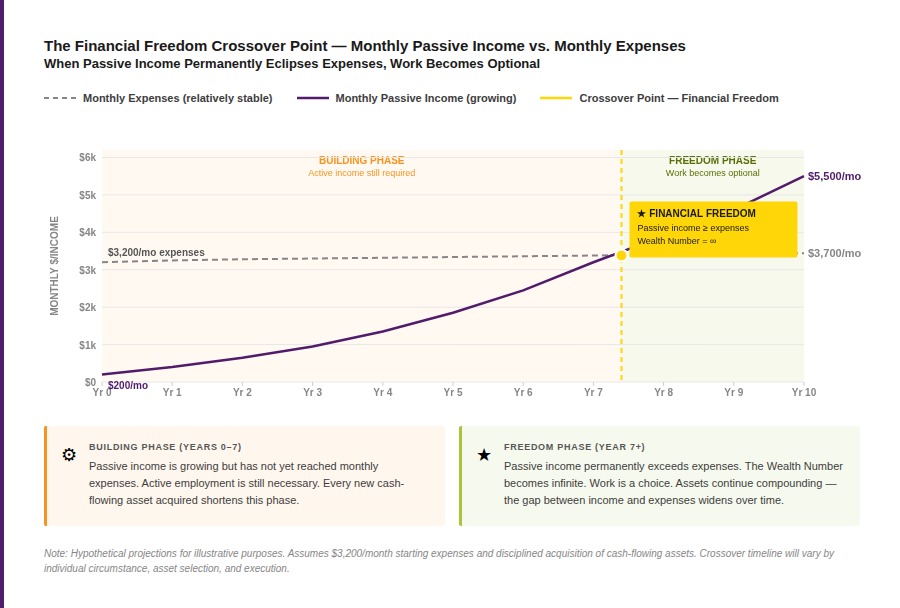
The Fast Track is the outer loop, where deals are larger and the goal changes. A player wins by buying their Dream or by raising CASHFLOW Day income by $50,000, according to the game rules. Outside the game, Rich Dad calls the Rat Race exit the financial freedom crossover point: the moment monthly passive income permanently exceeds monthly expenses and work becomes optional.
The official guidance is ages 14 and up, though Rich Dad notes that savvy 9- to 13-year-olds enjoy it, and a first game can take three to four hours. Younger players can start with CASHFLOW for Kids, recommended for ages 6 and up. Anyone can also try the digital version, CASHFLOW Classic, by creating a free Rich Dad account.
How Monopoly Teaches Cash Flow (and Where It Stops)
In 2017, Hasbro asked fans to vote on which Monopoly tokens should stay, and more than four million votes later the thimble was retired. People care deeply about the pieces. Far fewer think about the engine underneath them: cash flow.
Monopoly is a cash flow game at heart. Players buy properties, collect rent, and build houses and hotels to raise the rent each property pays. Take Oriental Avenue. According to its title deed, unimproved rent is $6, rent doubles to $12 once a player owns the full color set, and rent reaches $550 with a hotel. Houses and hotels cost $50 each.
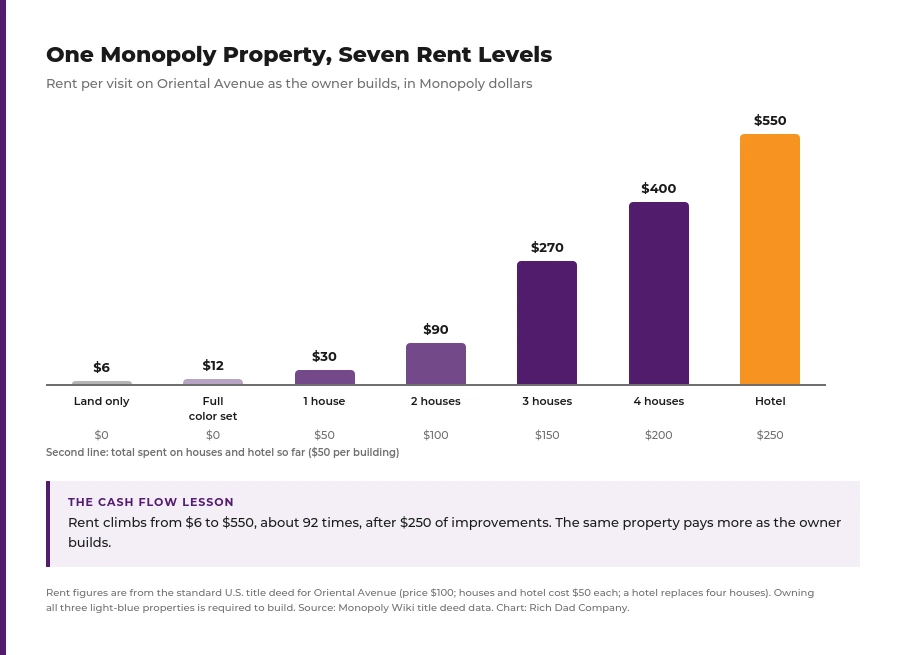
That progression is the first investing lesson hidden in Monopoly: an asset can pay more when its owner improves it. A rental property gets renovated, a business adds a product, a portfolio adds dividend payers. The income also has to keep moving, because cash that sits idle loses ground. Consumer prices rose 3.7% in the 12 months ended September 2026, which means a dollar kept in a drawer bought about 3.6% less than it did a year earlier.
Monopoly stops there. It has no monthly expenses, no financial statement, and only one type of asset, and a game ends when one player has bankrupted the rest. Robert and Kim designed CASHFLOW to add what Monopoly leaves out: expenses, debt, market swings, and a wider range of investments, from real estate to stocks to businesses. It is often described as Monopoly on steroids, and the description fits.
CASHFLOW Game vs. Monopoly: What Changes
Three differences matter most to investors. The first is the goal. Monopoly rewards the player who bankrupts opponents, while CASHFLOW rewards the player who replaces earned income with passive income. The second is debt. Monopoly treats debt as something to avoid, while CASHFLOW treats it as a tool that can leverage a good investment or sink a bad budget. The third is visibility. Every purchase in CASHFLOW shows up on your income statement and balance sheet, so you see exactly how one deal changes your monthly cash flow. The CASHFLOW page has a full side-by-side comparison for readers who want every row.
Why Playing CASHFLOW Can Make You a Better Investor
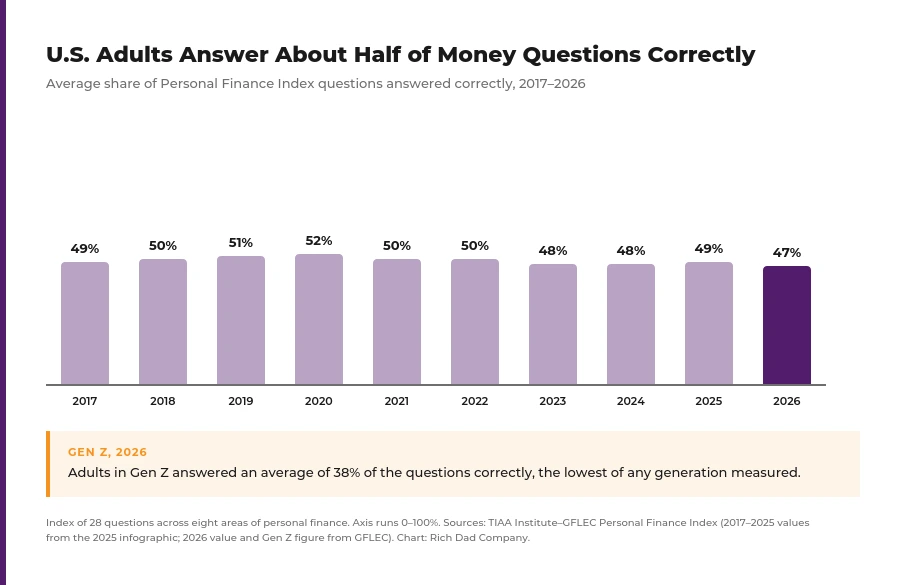
Most adults never get this kind of practice. In the TIAA Institute-GFLEC Personal Finance Index, U.S. adults answered an average of 47% of 28 questions correctly in 2026, and the average has never exceeded 52%. Gen Z averaged 38%.
Games are one promising way to close that gap, though results depend on design. A meta-analysis of digital games and learning covering K-16 students found a small-to-moderate learning benefit over non-game instruction, with an average effect size of 0.33, and showed that design choices mattered. That research tested educational digital games in general rather than CASHFLOW, so it supports the method without proving any result for CASHFLOW players.
Experts on a 2013 Stanford panel about educational games pointed to interaction and the chance to make choices as strengths of the format. CASHFLOW is built on both. Every turn forces a decision: take the deal, pass, borrow, or wait. Each decision updates your financial statement, so the consequence shows up in dollars of monthly cash flow.

Three skills show up again and again. Players learn to read an income statement and balance sheet. They learn the difference between an asset and a liability by seeing which cards put money in the pocket and which, like Doodads, take it out. And they learn to judge deals by cash flow rather than price alone.
Risk is part of the lesson too. As Rich Dad explains in The Game, and Risk, of Stock Investing, financial knowledge is what lets an investor manage risk. A board game lets players make beginner mistakes, such as overpaying for a deal or leaning too hard on debt, while the stakes are still play money.
How to Win the CASHFLOW Game: Five Habits That Transfer to Real Investing
No single strategy wins every game, because professions, cards, and dice change each time. These five habits hold up across most games, and each one maps directly to real life.
- Know your number. Write down your total monthly expenses and your passive income, and check the gap every turn. That gap is the whole game, and it is the same gap that separates the Rat Race from financial freedom in real life.
- Buy for cash flow, not bragging rights. A deal that adds monthly cash flow moves you toward the Fast Track. A deal that only looks impressive does not.
- Treat Doodads as a warning. Doodads are the impulse and unplanned expenses that drain cash. In real life they look like the latest gadget or the upgraded car, and the game shows how quickly small expenses can erase a good month.
- Use debt as a tool, not a crutch. Debt adds a monthly payment to your expenses, so it only helps when the asset it buys produces more cash flow than the payment costs. Rich Dad calls that good debt, and the game rewards it while punishing the other kind.
- Step onto the Fast Track, then think bigger. Once passive income exceeds expenses, you move to the outer loop, where deals are larger and bank loans are no longer allowed. The same sequence works outside the game: know your numbers, buy assets, control expenses, use debt carefully, then scale.
Learning With Other Players
CASHFLOW also works because it is social. A game gives people a reason to talk about money, ask questions, and see how other players solve the same problem with different cards. CASHFLOW groups and meetups exist for players who want a regular table of people to learn from. That fits the Rich Dad belief that financial education should be practical, and a game night is a low-pressure way to practice it. Playing again with a different profession changes the math, so the lessons repeat without getting stale.
From the Board to Real Life: The CASHFLOW Quadrant
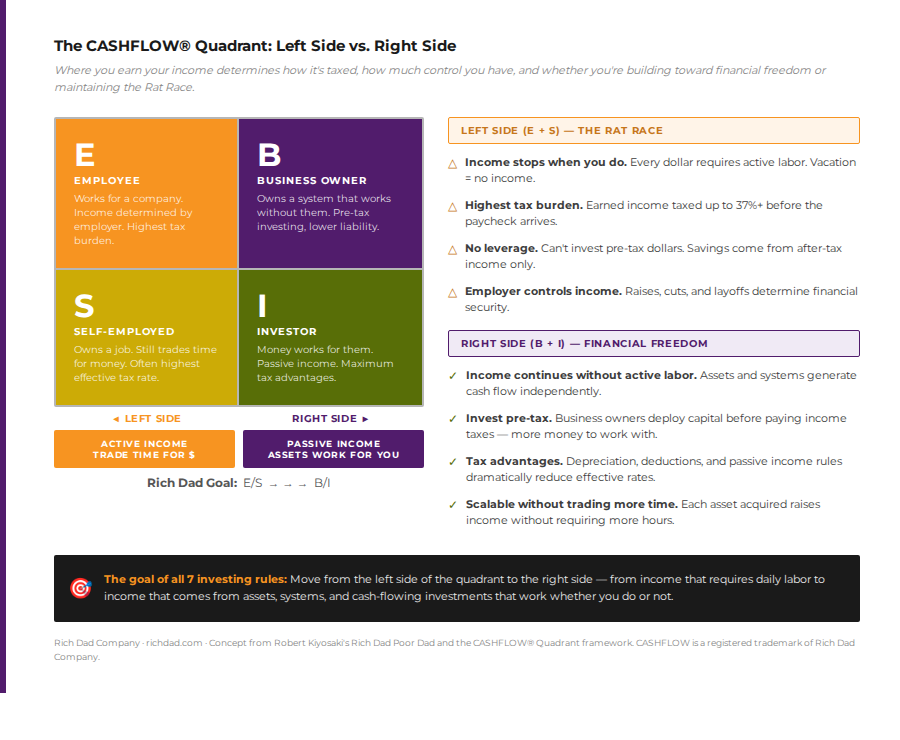
The CASHFLOW game and the CASHFLOW Quadrant teach the same idea: where your income comes from matters. Employees (E) and self-employed people (S) trade time for money. Business owners (B) and investors (I) own systems and assets that produce income without constant labor. The game makes that difference visible, because the way out of the Rat Race is to build the B and I side of the Quadrant, one asset at a time.
Play CASHFLOW, Then Put the Lessons to Work
The CASHFLOW game will not make anyone an investor on its own, and it is not a substitute for financial education or your own due diligence on real deals. What it does well is give you a safe place to practice the habits investors need: reading a financial statement, buying assets for cash flow, controlling expenses, and using debt carefully. To try it, create a free account and play CASHFLOW Classic, or pick up the CASHFLOW board game for the kitchen table. Then take the first lesson into real life by writing down your own income, expenses, assets, and liabilities.
FAQs
The CASHFLOW game is a financial education board game created by Robert Kiyosaki. Players start in the Rat Race, buy assets, and try to earn more passive income than expenses so they can move to the Fast Track.
First leave the Rat Race by making passive income higher than total expenses. On the Fast Track, you win by buying your Dream or by raising CASHFLOW Day income by $50,000.
Both involve cash flow, but they reward different goals. Monopoly ends when one player bankrupts the others. In CASHFLOW, the goal is to replace earned income with passive income, using financial statements, debt, and a wider range of investments.
Yes. CASHFLOW Classic is the free digital version. Create a free Rich Dad account, then log in to play.
The board game is officially for ages 14 and up, and Rich Dad says savvy 9- to 13-year-olds often enjoy it. CASHFLOW for Kids is recommended for ages 6 and up.
A first game commonly takes three to four hours, and later games move faster once the rules are familiar.
It is worth playing if you want hands-on practice with financial statements, assets, and cash flow. It is a learning tool, not a guarantee of investing results, and the first game takes a few hours.