Why real estate is the Rich Dad investor’s preferred asset
Americans consistently rank real estate as their top long-term investment — ahead of stocks, gold, and savings accounts. According to the Bankrate 2025 Long-Term Investment Survey, 24% of Americans named real estate the best place to park money not needed for 10 or more years. The data supports that instinct: real estate generates monthly cash flow, provides depreciation deductions, uses leverage to amplify returns, and builds equity over time.
But Robert’s philosophy goes further than just owning property. The meaning behind an asset is specific: something that puts money in your pocket every month — not something that simply gains value on paper. That distinction separates a successful real estate investor from the speculator waiting for appreciation.
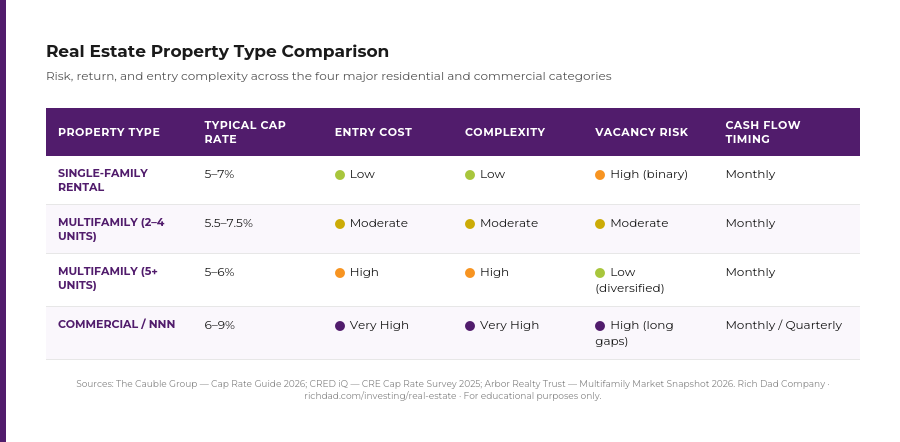
The challenge is that “real estate” is not one thing. A single-family rental in suburban Indiana is a fundamentally different investment than a commercial strip mall in Dallas. Each property type carries different entry costs, vacancy risk, cash flow mechanics, and financing complexity. Building the right portfolio means choosing the right type of property at the right stage of an investor’s financial education.
Single-family rentals: The best entry point for new investors
Single-family homes (SFRs) are the most common starting point for new real estate investors, and with good reason. Financing is straightforward, management is learnable, and the barrier to entry is lower than any other cash-flowing property type. The number of households renting single-family homes rose 1.7% in 2025, reaching a seven-year high, according to Arbor Realty Trust and Chandan Economics — which means tenant demand is strong and vacancy periods are shrinking in most markets.
The upside of single-family rentals
- Simpler financing
SFRs qualify for residential mortgages, which carry lower rates and down payment requirements than commercial loans. - Longer tenancy
Families who rent single-family homes tend to stay longer than apartment renters, reducing turnover costs and vacancy risk. - Easier to sell
When it’s time to exit, a residential home attracts both investors and owner-occupants — a much larger buyer pool than a commercial property. - Lower maintenance burden
Tenants in single-family homes typically handle landscaping and minor upkeep, lowering operating costs. - Strong value retention
Single-family homes hold their value better through downturns than many other residential categories, according to the
The downside of single-family rentals
- Binary vacancy risk
One tenant leaving means zero cash flow until a replacement is found. This is the SFR’s most serious structural weakness. - Limited scale
Each property requires its own acquisition, financing, and management — making it harder to build portfolio income quickly. - Smaller renter pool
At higher price points, many prospective tenants can afford to buy, narrowing the qualified applicant pool.
The Rich Dad approach to the SFR’s vacancy risk is the BRRRR method — Buy, Rehab, Rent, Refinance, Repeat — which allows investors to recycle capital across multiple properties rather than sitting concentrated in one. For a detailed breakdown of how that works, see the article on infinite returns in real estate.
Multifamily properties: More units, more stability
Multifamily investing spans a wide range — from the two-unit duplex an investor manages with a part-time job to the 200-unit apartment complex with a full-time property management company. The defining characteristic of multifamily is that vacancy is diversified: one move-out doesn’t eliminate all cash flow.
The U.S. multifamily market finished 2025 with growing optimism. Investment volume accelerated to a three-year high, bolstered by greater interest rate clarity and the tightest cap rates across major real estate sectors, according to Arbor Realty Trust. Multifamily rental households hit an all-time high of 22.4 million — a record driven by housing affordability pressure and the long-term shift toward renting.
Small multifamily (2–4 Units): The sweet spot for scaling
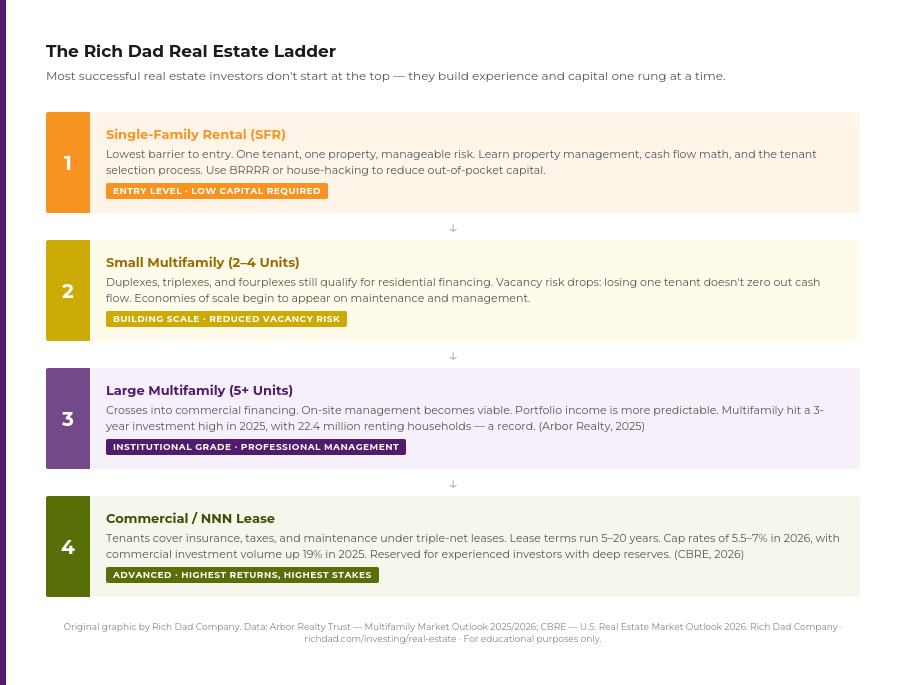
Duplexes, triplexes, and fourplexes occupy a unique position: they are classified as residential properties for financing purposes, which means investors can still access conventional mortgage rates and FHA loans in some cases. Yet they generate multiple income streams from a single acquisition.
- Reduced vacancy risk
If one of four units goes vacant, the other three continue generating cash flow. - On-site living option
An investor who occupies one unit (house-hacking) dramatically lowers personal housing costs while building equity. - Economies of scale
Landscaping, insurance, and routine maintenance costs spread across multiple units. - Geographic efficiency
Four families paying rent from one address is operationally simpler than four separate single-family homes.
Large multifamily (5+ Units): Commercial territory, institutional returns
Once a property crosses five units, it moves into commercial financing territory. Lenders evaluate these properties based on the income they generate, not the borrower’s personal income alone — which is actually an advantage for investors with strong properties but modest W-2 income.
The large multifamily sector is currently favored by institutional investors for a reason: with construction starts 74% below their 2021 peak by mid-2025, according to CBRE, supply pressure is easing while demand is still rising. Average rents are projected to grow 3.1% annually over the next five years, above the pre-pandemic average.
Commercial real estate: Higher returns, higher complexity
Commercial real estate — office space, retail, industrial, and warehouses — is where many experienced investors eventually migrate, drawn by the promise of longer leases and triple-net structures where tenants cover insurance, taxes, and maintenance. But commercial investing requires a different level of financial education, capital, and risk tolerance.
According to the CBRE U.S. Real Estate Market Outlook 2026, commercial real estate investment activity is expected to increase by 16% in 2026 to $562 billion — nearly matching the pre-pandemic annual average. That momentum is real, but it is unevenly distributed across property types.
Industrial and warehouse: The strongest commercial category
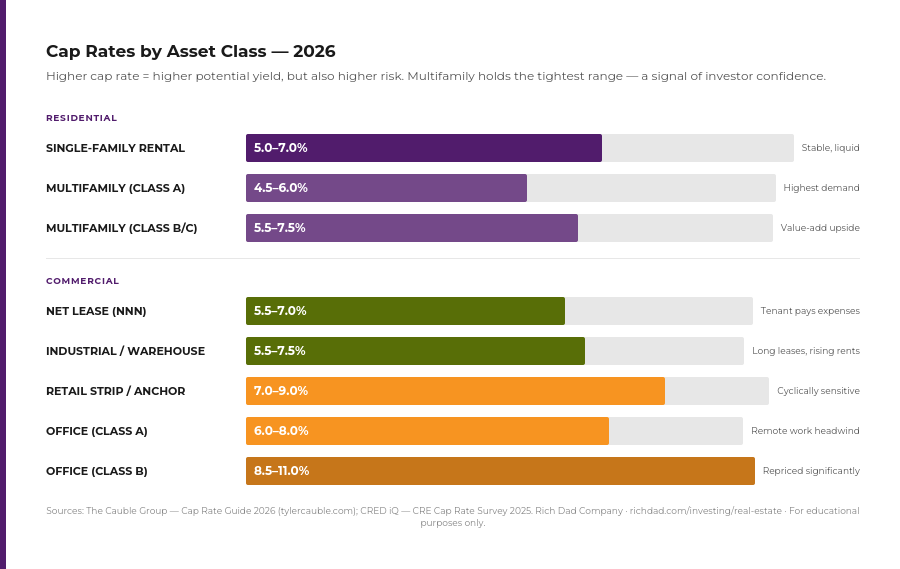
Industrial properties have benefited from the surge in e-commerce and supply chain reshoring. Cap rates for industrial real estate finished 2025 between 5.5% and 7.5%, according to CRED iQ — a range that reflects both strong income and relatively stable tenant demand. Long lease terms (often 5–15 years) and NNN structures keep operating costs predictable.
Retail and office: Proceed with education
Retail strip centers and office buildings carry the highest vacancy risk of any commercial category. Office cap rates finished 2025 at 7.07%, according to CRED iQ — signaling repricing that reflects remote work disruption and tenant contraction. Class B office has repriced even more dramatically, with cap rates of 8.5–11% in 2026. These numbers signal higher yields but also lower demand — a combination that requires deep market knowledge to navigate safely.
Retail is similarly bifurcated: anchor centers and necessity-based retail have held up well, while less-trafficked strip malls carry meaningful vacancy risk as consumer behavior continues to shift.
Uneducated investing is risky; educated investing controls risk. Commercial real estate is where gaps in financial education show up fastest.
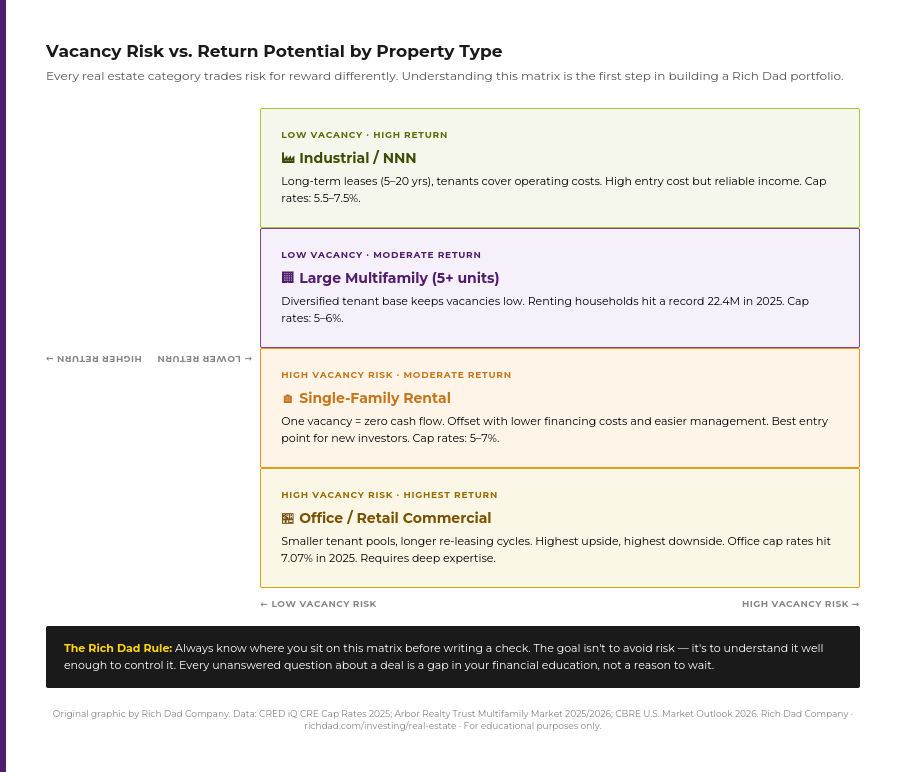
How successful investors choose their property type
The five questions every Rich Dad investor asks before any real estate decision are rooted in the same framework applied to all asset classes. For real estate specifically, those questions have a property-type dimension.
- Is this inside my circle of knowledge?
An investor who has never managed a tenant relationship should not start with a 20-unit apartment building. Financial education precedes the check. - Does it generate monthly cash flow?
Not appreciation potential — actual monthly income after mortgage, taxes, insurance, and maintenance. If the numbers don’t cash flow from day one, reconsider the deal. - What are the tax advantages?
Real estate offers depreciation, interest deductions, and 1031 exchange options that no other asset class can match. Know these before signing. - What is the real vacancy risk — and can I manage it?
For SFRs, vacancy is binary. For multifamily, it is diversified. For commercial, vacancies can last 12–18 months. Size the risk against your reserves and cash flow cushion. - Do I have the right team in place?
A property manager, CPA, real estate attorney, and lender who understand investment properties are not optional. They are the team that protects the investment.
For a deeper look at how these five questions apply across all investment types, see Rich Dad’s guide to how to find good investments.
The rental demand tailwind making now the right time to act
The affordability data from NAR’s 2025 Profile of Home Buyers and Sellers tells a clear story: first-time buyer share of home sales hit a record low of 21% in 2025, down from the historical norm of 40%. Middle-income affordable listings fell to 21% of the market, down from 50% before the pandemic. Both metrics converged at the same number — 21% — by coincidence.
What that means for real estate investors is straightforward: the people who cannot buy homes become long-term renters. Priced-out buyers don’t disappear — they rent single-family homes and apartments. That’s a structural demand tailwind that benefits every level of the real estate ladder, from the SFR investor renting to a family priced out of homeownership to the large multifamily investor whose vacancy assumptions keep improving.
Renters accounted for roughly four-in-five new households formed in 2025, according to Arbor Realty Trust — one of the most striking data points in recent housing market history. When paired with a construction pipeline that has shrunk 74% from its 2021 peak, the supply-demand math favors investors who hold quality rental properties for the long term.
For a more detailed look at the 2026 housing market conditions affecting real estate investors, see the analysis of housing inventory and the affordability double squeeze.
Building the portfolio: Start where you are, not where you want to be
The most common mistake in real estate investing is skipping steps. An investor who reads about triple-net commercial leases and immediately pursues a $3 million retail center — without having first managed a tenant relationship, read a lease, or navigated a repair call — is not investing. They’re speculating with leverage.
The real estate ladder is not based on a ranking of what’s best. It’s a map of how financial education and investment complexity compound together. Start with a single-family rental if it’s the most a new investor can confidently underwrite. Graduate to a small multifamily once the operational and financial mechanics feel familiar. Move into a large multifamily when the team and capital structure can support it.
Commercial real estate is not off-limits — but it is reserved for investors who can answer Robert Kiyosaki’s five questions with confidence, not guesses. The difference between an experienced investor and an inexperienced one in commercial real estate isn’t the size of their net worth. It’s the depth of their financial education.
Rich Dad’s full approach to building a real estate portfolio is detailed in Real Estate Investing — The Rich Dad Strategy, along with resources on the BRRRR method, cash flow formulas, and using good debt as leverage.
The bottom line: Every property type has a place in the right portfolio
Real estate wealth is not built by choosing the “best” property type in the abstract. It’s built by matching the right property type to the right investor at the right stage of their financial education. A single-family rental that cash flows $400 a month is not a lesser investment than a commercial NNN lease — it’s the right investment for a first-time investor who can underwrite it, manage it, and repeat the process.
The through-line across all four property categories is the same principle Robert Kiyosaki has taught for decades: the goal is assets that generate cash flow every month, whether the investor shows up to a job or not. Single-family rentals get there one property at a time. Multifamily accelerates the process. Commercial, done right, can transform a portfolio’s income ceiling entirely.
The blueprint is not complicated. The education required to execute it is.
FAQs
Single-family rentals are generally the best starting point. They require less capital, qualify for residential financing, and are operationally simple enough for a first-time landlord to manage. The most important factor is finding a property that cash flows positively from day one.
Cap rates vary by market and property type. For single-family rentals and small multifamily, a 5–7% cap rate is typical in most markets as of 2026. Commercial properties range from 5.5% (NNN/industrial) to 9%+ (Class B office, certain retail). Higher cap rates mean higher yield — but they also mean higher risk or less desirable markets.
Multifamily provides more income diversification — one vacancy doesn’t eliminate all cash flow. Single-family homes are simpler to finance, manage, and eventually sell. Most experienced investors own both. The right choice depends on the investor’s capital, experience level, and local market conditions.
Commercial properties are evaluated primarily on Net Operating Income (NOI), cap rate, tenant creditworthiness, lease length and terms, and the specific supply-demand dynamics of their local market. Unlike residential investing, commercial real estate requires understanding triple-net lease structures, zoning, and economic sensitivity — all areas where financial education is non-negotiable.
Rich Dad prioritizes cash flow over appreciation, good debt over no debt, and financial education over speculation. Robert Kiyosaki has consistently taught that the goal of a real estate investment is an asset that puts money in your pocket every month — not a bet on rising prices. The CASHFLOW Quadrant framework places the real estate investor firmly on the right side (B/I) where assets work for the investor rather than the investor working for a paycheck.