
Good investments are everywhere — if you know what to look for
There is a reason Robert opens nearly every conversation about investing with the same statement: great investments are all around you. It sounds almost too simple to be useful. But it contains one of the most important truths in financial education.
The problem is not the supply of opportunities — it is the demand for knowledge. An untrained investor looking at a distressed rental property sees a headache. A trained investor sees cash flow, depreciation deductions, and a future 1031 exchange into a larger property. An untrained investor watching silver prices see a speculative commodity. A trained investor sees a hedge against currency debasement and a Rich Dad-endorsed store of real value. The investment did not change. The investor’s ability to evaluate it did.
This is why the first and most productive investment any aspiring investor can make is in their own financial education. Not a course that promises overnight returns — but a genuine, ongoing commitment to understanding how money, assets, taxes, and markets actually work.
Why most people miss great investment opportunities
Robert is the first person to admit that he has missed spectacular investment opportunities over the course of his career. eBay, YouTube, Google, MySpace — each of these was already in motion as Robert built his wealth in real estate, gold, oil, and silver. If he had recognized those technology opportunities early, he has said, he might be a billionaire today. He didn’t. And his candor about this fact is one of the most instructive things he has ever shared.
The lesson is not that Robert failed. The lesson is that his brain was not trained to see technology investments. He was trained — through deliberate education and years of repetition — to evaluate physical assets: cash-flowing properties, precious metals, and commodities with intrinsic value. That training made him extraordinarily successful in those areas. It left him blind to others. And this is the condition most investors find themselves in, except they are often blind across every category, not just one.

Consider the other story Robert shares: Early in his career at Xerox, he was introduced to what would eventually become the Macintosh computer. He was looking directly at one of the most consequential business opportunities in American history. He didn’t see it — not because he lacked intelligence, but because his brain wasn’t yet trained to recognize that category of opportunity.
Research in behavioral finance confirms this pattern. According to MoneySense, humans are not naturally wired to be disciplined, long-term investors. Cognitive biases, emotional reactions, and lack of pattern recognition cause the vast majority of people to either miss opportunities entirely or pursue them for the wrong reasons. The antidote is not more willpower — it is more education.
The Rich Dad 5-question investment filter
Rather than chasing the next hot asset class, Rich Dad has always advocated for a consistent evaluation framework — a set of questions that turns raw investment opportunities into clear, analyzable decisions. These five questions apply regardless of asset type and are the foundation of what Robert calls finding your personal investment formula.
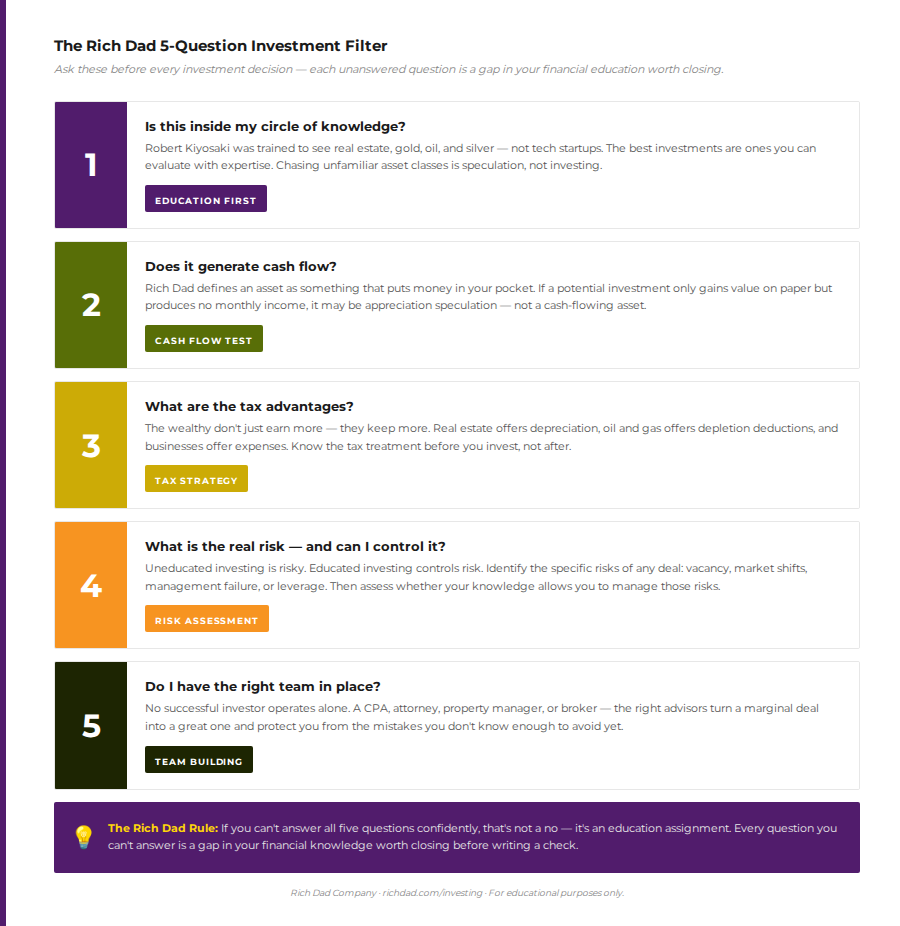
If an investor cannot answer all five questions confidently, that is not a reason to walk away — it is a study assignment. Every unanswered question represents a gap in financial knowledge worth closing before committing capital. This framework prevents the most expensive mistake in investing: writing a check before the education is complete.
How to find good real estate investments
Real estate remains the asset class most directly addressed in Robert’s foundational investment education. In 1974, he paid $385 for a real estate course in Honolulu. It lasted only a few days. Near the end, the instructor told the class something Robert has never forgotten: “Now you know the difference between good real estate investments and bad real estate investments. The problem is, most people will tell you such investments don’t exist.” The Rich Dad real estate investing philosophy was shaped by what happened next.
For months after that course, Robert went from real estate office to real estate office looking for the kind of deals the instructor described. Every agent told him those deals didn’t exist. His friends told him the same. Then, in a small, obscure office in downtown Waikiki, a scruffy broker said, “I have what you want.” The following weekend, Robert flew to Maui — where an entire condominium development was in foreclosure.
He purchased his first investment property for $18,000, funding the $2,000 down payment on a credit card. The one-bedroom, one-bath condo generated positive cash flow from the first month, even after all expenses and the mortgage payment. That single transaction — made possible by three days of education and months of persistent searching — became the foundation of a career in real estate that made him a multimillionaire.
The takeaway is not that foreclosures are always good investments. It is that a trained investor knew what to look for and was willing to look longer and harder than everyone else. That combination of preparation and persistence is what finds great real estate deals. They exist. They are rarely obvious. They go to the investors who are ready to recognize and act on them.
What to look for in a real estate investment
- Positive monthly cash flow after all operating expenses and debt service
- A cap rate that reflects local market conditions and your required return
- Depreciation and tax deduction potential — what does the tax treatment look like?
- Neighborhood trajectory: Is employment growing? Is the tenant pool stable?
- A competent property management team, whether self-managed or third-party
How to find good stock market investments
For investors interested in paper assets, the Rich Dad approach to stocks and paper assets differs fundamentally from the conventional advice most people receive. Conventional wisdom says to buy index funds, diversify broadly, and wait. Rich Dad says that diversification — done blindly — is a protection against ignorance. The investor who truly understands a small number of assets well will outperform the investor who superficially understands a great many.
Rich Dad advisor Andy Tanner teaches a framework built on four pillars: fundamental analysis, technical analysis, cash flow generation (including options strategies), and risk management. A good stock investment is not simply a company whose price might go up. It is a company whose business the investor genuinely understands, whose financial statements they have studied, and whose cash flow they have a plan to extract — whether through dividends, covered calls, or other strategies.

According to research by The Motley Fool, about 62% of U.S. adults own stocks — but the wealthiest 1% hold 50% of all stocks. The gap between those who own stocks and those who build wealth from them is almost entirely explained by the quality of their investment education and the discipline of their decision-making process.
How your asset class determines what you’re looking for
One of the most important insights in finding good investments is that the criteria shift dramatically depending on the asset class. A great real estate deal looks nothing like a great stock opportunity. A great precious metals position is evaluated entirely differently than a great business acquisition. This is why generic investment advice — “diversify,” “buy low, sell high,” “invest for the long term” — is nearly useless in practice. The question is not just whether an investment is good, but rather, by what criteria is it good?The Rich Dad 5-question investment filter
This is also why trying to invest across all asset classes simultaneously — without deep knowledge of any — produces mediocre results. Robert has been explicit about this: he does not attempt to be an expert in technology startups. That is not his area of trained vision. His expertise is in real estate, gold, oil, and silver. Within those domains, he sees what others miss. Outside them, he has the self-awareness to recognize his blind spots.
Building the financial intelligence to spot good investments consistently
Financial education is not a one-time event. It is an ongoing practice — a discipline that compounds just like the investments it enables. Robert’s $385 real estate course did not make him rich. What made him rich was the decision to apply that education persistently, to refine his ability to evaluate deals through repetition and experience, and to keep learning through every market cycle. The CASHFLOW game was designed with exactly this purpose in mind: to train investors to recognize cash flow opportunities in a low-stakes environment before deploying real capital.
As research from Gatsby Investment confirms, the psychological dimension of investing — managing cognitive biases, avoiding emotional decision-making, and developing pattern recognition — is as important as any financial metric. The investor who panics during a market correction and the investor who sees a buying opportunity are looking at the same data. Their training is different.
Three disciplines that build investment vision
1. Read deeply and specifically — not just financial news, but the primary sources: SEC filings, property listings, commodity reports, and the financial statements of businesses in your target area. The brain learns to see patterns through sustained, focused exposure.
2. Analyze deals you’ll never make — look at real estate listings in your target market and run the cash flow numbers. Study 10-K filings of companies in your target sector. Evaluating 100 deals before making one sharpens the instinct that identifies the right one.
3. Build a team before you need it — a CPA who specializes in investment taxation, a real estate attorney, a trusted broker, and experienced fellow investors. The team is both an execution resource and an education source. Other investors’ pattern recognition accelerates your own.
Finding the investment approach that works for you
The concept Robert calls “finding your magic formula” is not mystical. It is the practical recognition that every successful investor builds depth in a specific area — one where their knowledge, interest, and experience create genuine competitive advantage. Robert’s formula involves real estate investing, physical precious metals, and energy-sector commodities. Someone else’s formula might center on small-cap stocks in a sector they understand from their professional career, or franchise businesses in markets they know intimately, or a specific geographic real estate niche they can evaluate better than any outsider.
The conventional financial planning advice — save money, diversify into mutual funds, live below your means, wait for retirement — is not wrong so much as it is insufficient. It produces average results by design. It is built for people who do not want to invest in their own financial education. Rich Dad challenges that model not because conventional advice is fraudulent, but because it leaves a tremendous amount of wealth-building potential on the table for everyone willing to learn more.The investors who find the best opportunities — the ones who see a great real estate deal in a distressed property, a strong stock position in an undervalued company, or a commodity play before the crowd arrives — are not smarter or luckier than everyone else. They are better educated, more specifically trained, and more disciplined in their approach. That is a formula anyone can develop. It starts with the decision to invest in financial education first. Explore the full Rich Dad investing resource hub to begin building your own investment vision.How your asset class determines what you’re looking for
FAQs
A good investment meets five core tests from the Rich Dad framework:
- it falls within your area of knowledge and training;
- it generates cash flow rather than relying solely on appreciation;
- it carries favorable tax treatment;
- its specific risks are identifiable and manageable;
- and you have a competent team in place to execute and protect the position.
Any investment that fails one of these tests is either a gap in education to address or a deal to pass on.
The best opportunities for beginning investors are almost always in asset classes they are already familiar with from their professional or personal experience. A nurse who understands healthcare operations may find excellent medical office real estate deals. A retail manager may spot franchise business opportunities before the broader market does. The key is to pick a lane, deepen the knowledge deliberately, and build a trusted team of advisors in that area before deploying capital.
Because his brain was trained to see real estate, gold, oil, and silver — not technology ventures. This is not a failure. It is the natural consequence of building genuine expertise in a specific domain. The lesson Robert draws from this is not regret, but self-awareness: know your investment circle of knowledge, invest deeply within it, and do not confuse unfamiliarity with opportunity.
Emphatically, yes. Uneducated investing is speculation. The $385 real estate course Robert took in 1974 was not an expense — it was the highest-returning investment of his career, generating millions of dollars in real estate wealth over the following decades. Every dollar invested in financial education before a major capital deployment dramatically reduces risk and increases the probability of a successful outcome.
Rich Dad does not prescribe a single “best” investment for everyone, because the best investment depends on the individual’s knowledge, interest, risk tolerance, and financial goals. What Rich Dad does prescribe is starting with financial education, running the cash flow numbers on any potential deal, and beginning with the asset class you are most willing to study deeply. For many people, that starts with real estate — specifically the owner-occupied first property that provides real-world experience with the lowest financing barriers.
Conventional financial advice optimizes for safety and simplicity: index funds, diversification, dollar-cost averaging, and long-term holding. Rich Dad optimizes for financial intelligence and cash flow. Rather than spreading capital thinly across assets no one truly understands, Rich Dad advocates for deep knowledge in a small number of asset classes, active cash flow generation, and strategic use of tax planning to keep more of what is earned. The result is not necessarily higher risk — it is better-educated risk.
Robert’s personal investment focus centers on cash-flowing real estate, physical gold and silver, and oil and gas commodities — asset classes where he has invested decades of education and practical experience. He is clear that this formula is his, shaped by his background, his training, and his risk tolerance. The goal of Rich Dad financial education is not to have everyone replicate Robert’s portfolio — it is to give everyone the tools to build their own.