
Raising capital is a sales skill, not a net worth test
Say you have a chance to buy a classic 10-room boutique hotel headed into foreclosure, or you’re ready to grow a business you’ve already built, but you need an injection of money to get there. The instinct is to assume the deal is dead without a war chest of personal cash. It isn’t.
What used to be a relationship business — walking into a local bank, sitting down with a banker who knew your name — has largely been replaced by underwriting algorithms and online applications. That shift is actually an opportunity: today there are more paths to capital than at any point in recent history, from government-backed loans to platforms that let thousands of everyday people fund your business a few hundred dollars at a time.
One of the core skills of entrepreneurship is raising capital, and the entrepreneurs who do it well tend to treat it as what it is: a sales process. The question every investor is silently asking is, “What exactly am I being asked to buy into?” Answer that clearly, and the rest of the conversation gets much easier.

The four factors every investor and lender evaluates
Before approaching anyone for capital, address these four factors clearly and confidently. Investors and lenders are running through this checklist whether they say so out loud or not — and founders who address it up front close funding faster than those who wait to be asked.
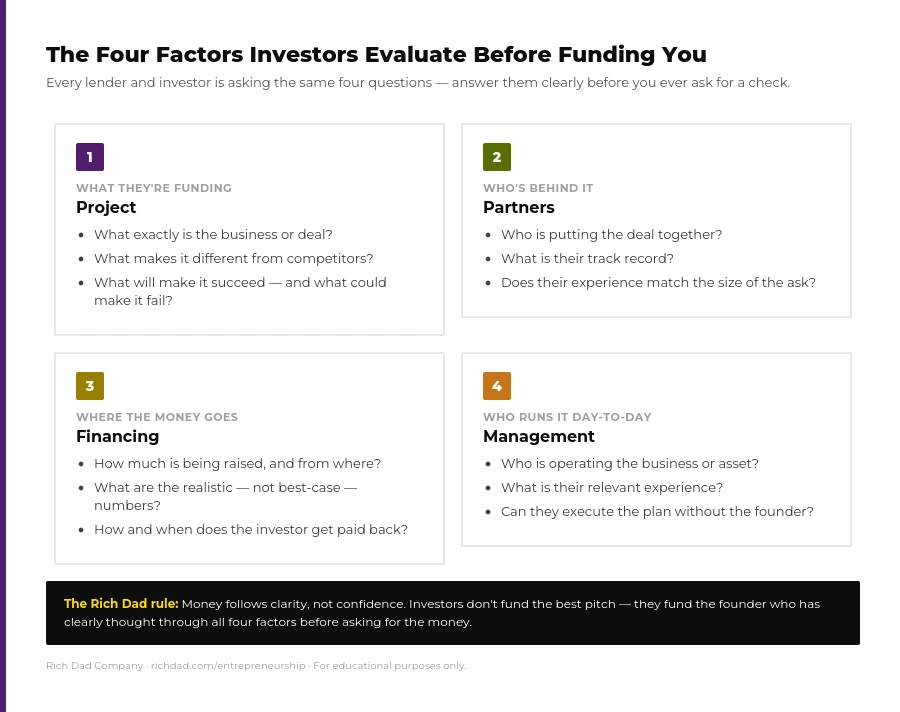
1. Project — What are they actually funding?
Keep the explanation simple, concise, and honest. What is the business or investment? What makes it different from others in the space? What’s the realistic case for why it succeeds — and what could make it fail? Investors trust founders who name the risks unprompted far more than founders who only show the upside.
2. Partners — Who’s behind the deal?
Investors are backing people as much as ideas. Whose new venture would you rather fund — someone with a track record in the space, or someone with none? The experience the partners bring, and how much the investor trusts that experience, drives the decision more than the pitch deck does.
3. Financing — Where does all the money actually go?
Show real numbers, not best-case projections. For a startup, most of the numbers will be forecasts rather than actuals — that’s expected, but the forecast needs to be grounded and the risks need to be named. Investors want to know exactly how much is being raised, where it’s coming from, what it’s being used for, and — critically — when and how they get paid back. One flag that stops conversations cold: using investor money to pay yourself a founder salary before the business can support one.
4. Management — Who runs it day to day?
“Money follows management” is a cliché because it’s true — but a strong case addresses all four factors, not management alone. Investors want to know who’s actually running daily operations, what their background is, and whether the venture can function without the founder in the room every day. If the partners and the management team are the same people, that’s fine, as long as the investor has confidence in their experience.
Debt financing: Raising capital without giving up ownership
Debt financing keeps 100% of the business in your hands, in exchange for a fixed repayment obligation that exists whether the business has a good month or a bad one. It’s the most familiar path to capital, and in 2026 it splits into two broad categories: government-backed loans through banks, and fast, tech-driven online lenders.
SBA loans
The U.S. Small Business Administration doesn’t lend money directly — it guarantees a portion of loans issued through partner banks, which lowers the bank’s risk and often gets the borrower a better rate than an unsecured loan. SBA 7(a) loans typically range from $50,000 to $5 million, with rates in the neighborhood of prime plus 2.75% to 4.75%. The trade-off is speed: approval can take anywhere from a few weeks to a few months, and lenders want to see financial statements, cash flow history, and a clear explanation of how the loan will be used.
Online term loans and lines of credit
For entrepreneurs who need capital faster than a bank can move, online lenders have built businesses around speed. Square Loans, built into Square’s point-of-sale platform, lets qualifying merchants accept a fixed advance repaid automatically as a percentage of daily card sales — no separate application process.
OnDeck offers term loans and lines of credit with approval in minutes and funding as fast as the same day, though the trade-off for that speed is a meaningfully higher cost of capital — recent reviews put average APRs on OnDeck products near the high-double-digit range, well above a bank loan. LendingClub, once a peer-to-peer lender in its own right, now routes smaller business loans through its partnership with Accion Opportunity Fund while offering SBA 7(a) and 504 loans directly through LendingClub Bank. Funding Circle — now operated by iBusiness Funding after a 2024 acquisition — still lends $25,000 to $500,000 under the Funding Circle brand, with SBA 7(a) loans available alongside its term loan product.
A note on Kabbage: Entrepreneurs researching this space will still see Kabbage mentioned as a lending option in older articles. It’s no longer a standalone product — American Express acquired Kabbage in 2020 and fully retired the brand in 2023, folding its line-of-credit product into American Express® Business Blueprint™, which today is available only to existing Amex Business cardholders.
Equity crowdfunding: Raising capital from the crowd
Since the SEC’s Regulation Crowdfunding rules took effect, any business can raise up to $5 million per year by selling small equity stakes to the general public — not just accredited investors. It’s a meaningfully different tool than the debt options above: there’s no repayment schedule, but founders give up real ownership, and every dollar raised this way is reported through a Form C filing with the Securities and Exchange Commission.
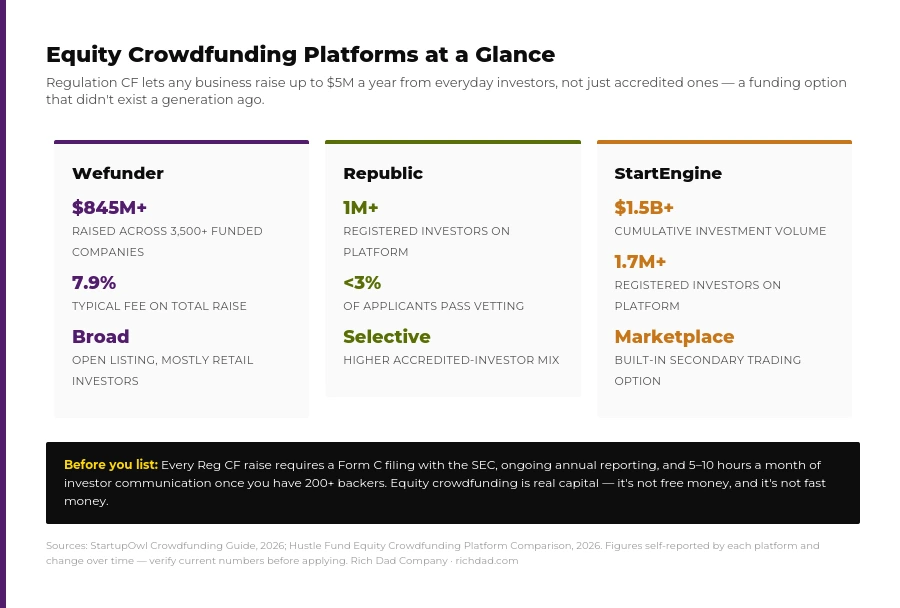
Wefunder leans toward broad, open listings with a mostly retail investor base and has helped fund thousands of companies. Republic is more selective — reportedly accepting fewer than 3% of applicants — and skews toward a higher share of accredited investors. StartEngine has built the largest cumulative volume of the three and includes a built-in marketplace for later share trading. None of the three is free money: platform fees typically run 6% to 8% of the total raise, and a successful campaign still requires 5 to 10 hours a month of investor communication once it closes.
Rewards crowdfunding: Raising capital by pre-selling the product
Kickstarter remains the best-known name in rewards-based crowdfunding — raising money by pre-selling a product or offering a reward rather than equity or debt. Since its 2009 launch, Kickstarter has funded more than 245,000 projects and directed over $7 billion toward creative and consumer products, some of which have gone on to win Grammys and Oscars. Because it’s all-or-nothing funding, a Kickstarter campaign forces the same discipline that traditional investors demand: a clear, well-organized plan and a real marketing angle, not just a good idea. Platforms like Indiegogo work similarly and are worth comparing before choosing a platform.
Angel investors and venture capital: Raising equity from a few, not the many
For high-growth startups aiming at a large exit, angel investors and venture capital firms remain the traditional equity route — typically funding $50,000 to $10 million or more in exchange for meaningful ownership, and often a board seat or approval rights over major decisions. There’s no interest to pay and no fixed repayment schedule, but the cost is real: VCs and lead angels expect a return through an eventual sale or IPO, and they will have a say in how the company is run in the meantime. This route makes the most sense for businesses built to scale quickly and exit — not for a steady, owner-operated cash-flowing business, where debt financing or equity crowdfunding usually preserves more control.
Debt vs. equity: Choosing your trade-off
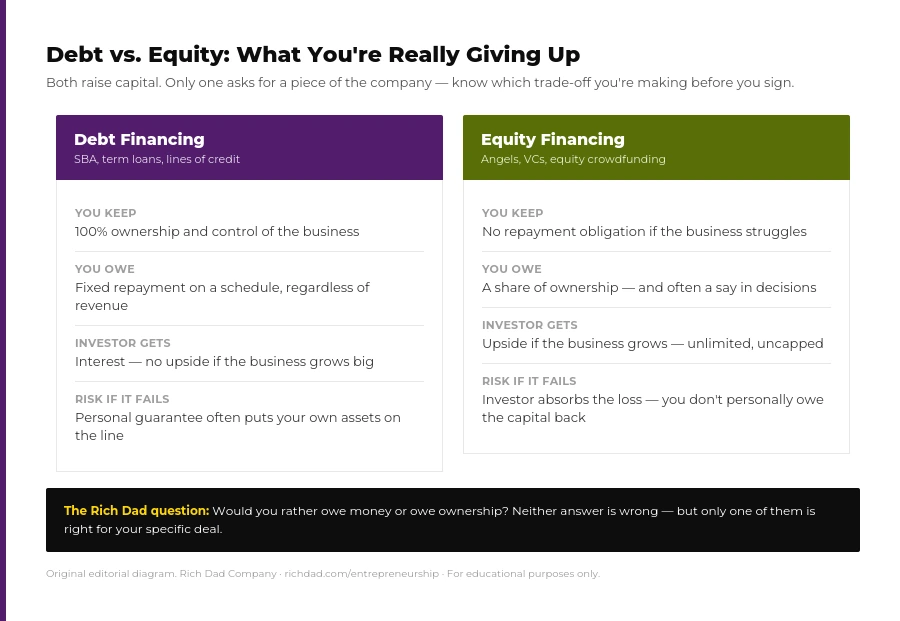
Every capital-raising decision eventually comes down to one question: would you rather owe money, or owe ownership? Debt financing is repaid in dollars, on a schedule, regardless of how the business performs — but it leaves the cap table untouched. Equity financing removes the repayment pressure but permanently changes who owns the business and, often, who has a say in running it.
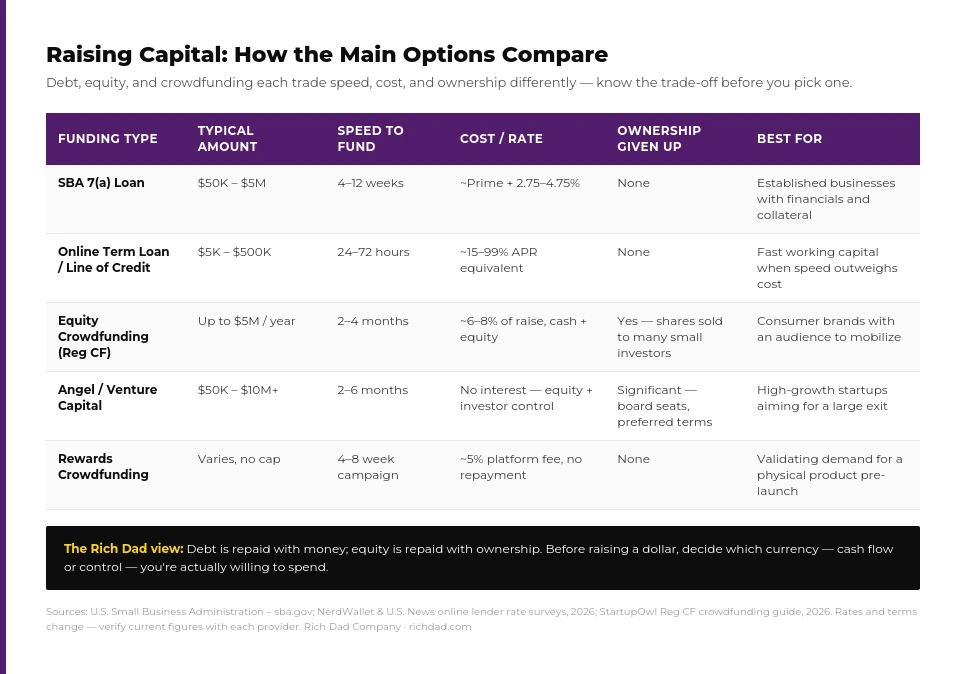
Raising capital: How the main options compare
Here’s how the five most common paths to capital stack up side by side, from fastest and least dilutive to slowest and most equity-intensive.
No more excuses
“I don’t have the cash to invest” is no longer a sufficient excuse, and it hasn’t been for a while. Between SBA loans, fast online lenders, equity crowdfunding, rewards crowdfunding, and traditional angel and venture capital, there’s a funding path for nearly every stage of business — the work is matching the right tool to your deal and being able to speak clearly to the four factors every investor is evaluating: project, partners, financing, and management. Address those four points with confidence, deliver on what you promise, and the capital tends to follow.
For a deeper look at how the rich use borrowed capital specifically — the difference between good debt and bad debt, and how to use leverage without taking on unnecessary risk — see Rich Dad’s guide to good debt vs. bad debt and the related breakdown of how smart entrepreneurs use OPM to build wealth. And if you’re still validating the business idea itself before you raise a dollar, start with Rich Dad’s guide to how to start a business.

FAQs
Online term loans and lines of credit from lenders like OnDeck or Square Loans are typically the fastest, with funding possible within 24 to 72 hours. The trade-off is cost — these products carry meaningfully higher rates than an SBA loan or a bank line of credit.
No. SBA loans, online term loans, and lines of credit are all debt — you repay principal and interest, but you keep 100% ownership. Equity is only required for angel investment, venture capital, and equity crowdfunding (Reg CF) raises.
Under SEC Regulation Crowdfunding, a company can raise up to $5 million in a 12-month period from both accredited and non-accredited investors through platforms like Wefunder, Republic, or StartEngine.
No. Kickstarter is rewards-based crowdfunding — backers receive a product or perk, not equity in the company. Equity crowdfunding platforms like Wefunder and StartEngine sell an actual ownership stake and are regulated as securities offerings.
Across every funding type, investors and lenders evaluate the same four factors: the project itself, the partners and their track record, the realistic financing numbers, and the strength of the management team running day-to-day operations.