
What Are Business Financing Strategies?
Business financing is how a company pays for startup costs, operations, equipment, real estate, or growth. There are three basic sources: the owner’s own money, borrowed money (debt), and money from investors who take an ownership stake (equity). A business financing strategy is the plan for combining them.
Rich Dad’s term for the second and third sources is OPM. Using Other People’s Money means controlling an asset or opportunity with capital that belongs to a bank, a lender, a partner, or an investor. The Rich Dad guide to other people’s money explains how OPM shows up in paper assets, real estate, and business. In business, it connects directly to the Business Owner and Investor sides of the CASHFLOW Quadrant, where people build systems and assets instead of trading time for a paycheck.

Good Debt vs. Bad Debt: The Test Every Business Financing Decision Must Pass
The test is simple. Bad debt takes money out of your pocket. Good debt puts money into your pocket. A credit card balance used to buy a big-screen TV is bad debt: the TV loses value while interest keeps accruing. A loan for a rental property whose rent covers the payment with cash left over is good debt, because the asset pays for itself and someone else, the tenant, makes the payment.
Cost matters too. Bankrate’s weekly survey put the average credit card APR at 19.67% as of October 14, 2026. A business financed on that rate has to earn more than 19.67% on the borrowed money just to break even on the interest. That is why Rich Dad pairs every financing decision with the cash flow test: if the income from what you are buying does not cover the debt payment, it is speculation, not good debt. The good debt vs. bad debt guide walks through the test in more detail.
Three Business Financing Mistakes That Keep Entrepreneurs Small
Mistake 1: Financing lifestyle with business debt
An entrepreneur opens a business line of credit and buys a luxury vehicle “for the business,” reasoning that success has to look the part. Unless the vehicle earns more than it costs, it is a personal liability wearing a business label.
Mistake 2: Funding the business with personal credit
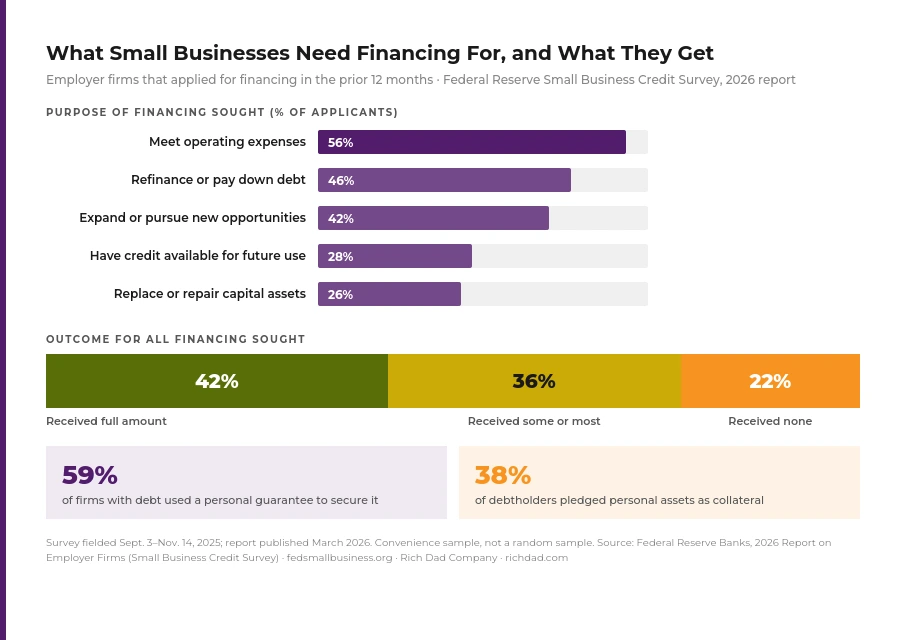
Maxing out personal cards puts high-interest consumer debt behind business operations, like filling a bucket with a hole in the bottom. It also ties the owner’s personal credit to every slow month. The line between owner and business is often thinner than founders expect: the Federal Reserve’s 2026 Small Business Credit Survey report found that 59% of firms with debt used a personal guarantee to secure it, and 38% of debtholders pledged personal assets as collateral.
Mistake 3: Confusing cash flow with wealth
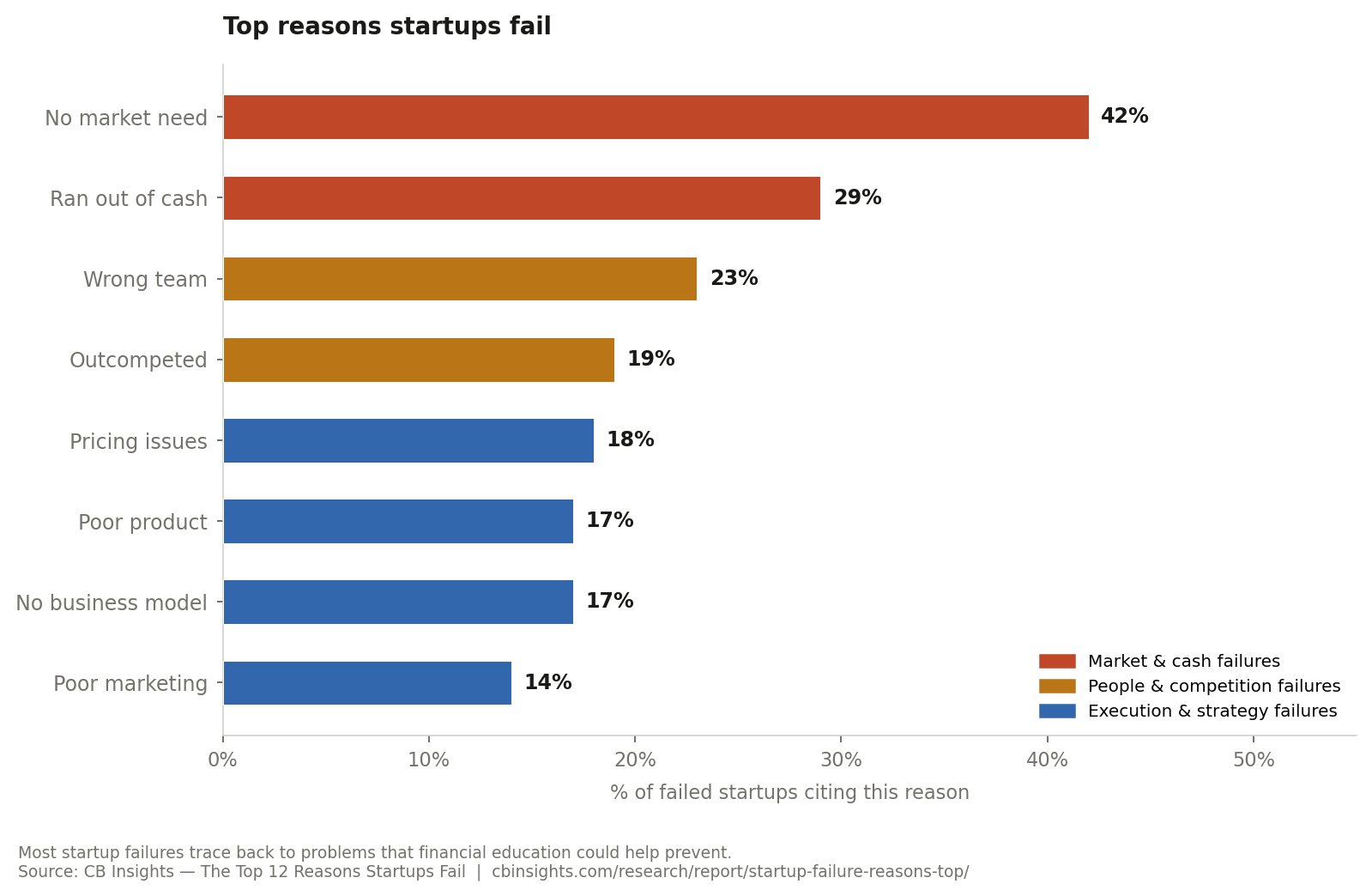
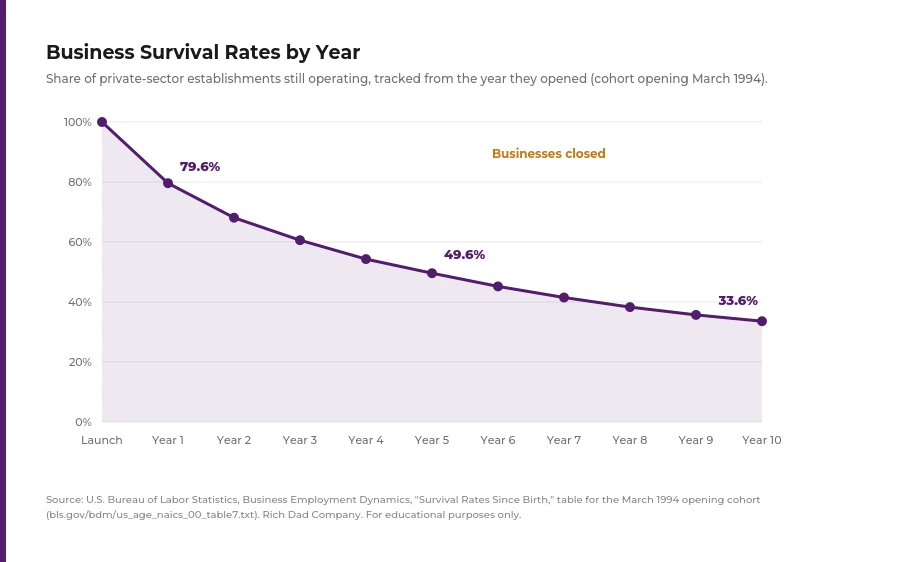
This is the costliest mistake. A business that throws off cash feels like wealth, but if every dollar stays tied up in the business and none is used to acquire income-producing assets, the owner has bought a job, not built wealth. Cash problems are also a recurring theme in why businesses close, as the charts below show.
How OPM Multiplies Capital: One Example, Three Financing Structures
Here is how the math changes with the financing structure. Assume an entrepreneur has $100,000 and finds properties priced at $100,000 that each produce $750 a month in net operating income, after taxes, insurance, maintenance, vacancy, and management. Real estate makes leverage easy to see, but the same logic applies to equipment, a franchise, or a business with steady cash flow.
- All cash: one property, $9,000 a year in cash flow, a 9.0% return on the $100,000.
- 20% down: five properties, each with an $80,000 loan at 6.5% over 30 years (about $505.65 a month). Each produces about $244 a month after the loan payment, or $14,661 a year across all five: a 14.7% return.
- 5% down plus investors: twenty properties with $5,000 down each, an $80,000 bank loan, and $15,000 per property from an investor paid 8% interest-only ($100 a month). Each produces about $144 a month, or $34,644 a year across all twenty: a 34.6% return.
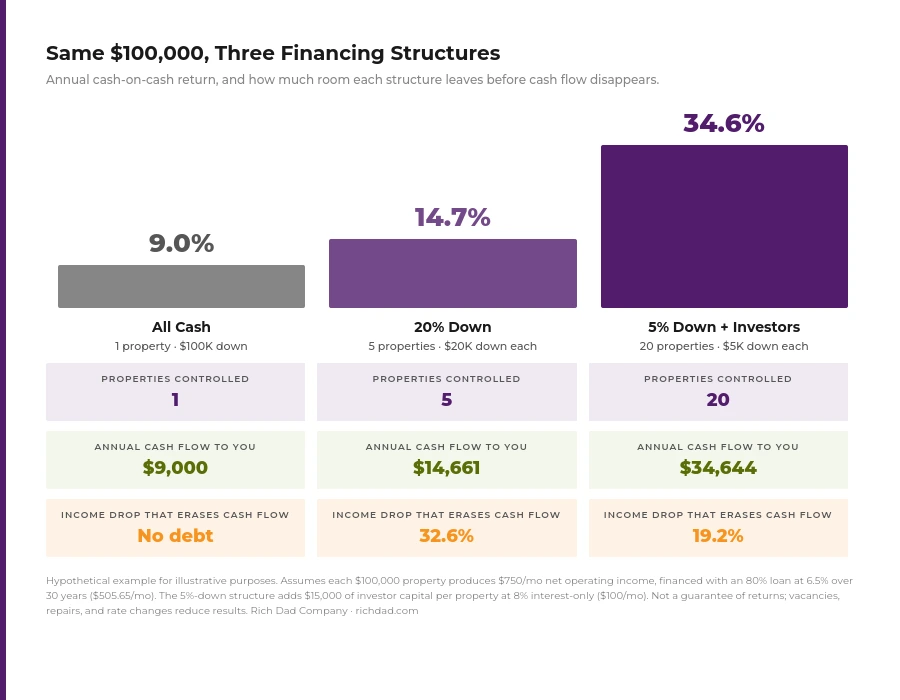
Now read the bottom row of the chart. With 20% down, net operating income can fall about 33% before cash flow hits zero. With 5% down and investor money, a drop of about 19% erases it, and with twenty properties a vacancy spike or rate change hits every one of them at once. OPM raises returns only while the asset’s income comfortably exceeds the cost of the money. The thinner that cushion, the more the structure depends on everything going to plan.
Some investors go one step further. After improving a property and stabilizing its income, they refinance, return the invested capital, and keep the asset. If all capital is recovered while the property still produces cash flow, the return is called an infinite return. The infinite returns guide explains the method, and also why it depends on appraisals, lender terms, and renovation costs coming in as planned.
Business Financing Options: Six Places Entrepreneurs Find OPM
1. Bank loans
Banks tend to favor borrowers who borrow for income-producing purposes. A loan to buy equipment or property that generates revenue is easier to justify than a loan for expenses with no return. Preparation matters: clear financial statements and a plan for repayment are the starting point.
2. SBA-backed loans
The Small Business Administration does not lend directly in most cases; it backs loans made by approved lenders. Its 7(a) program offers loans up to $5 million for uses that include working capital, equipment, real estate, refinancing business debt, and changes of ownership. The 504 program is for long-term, fixed-rate financing of major fixed assets, with 10-, 20-, and 25-year maturities, and it cannot be used for working capital, inventory, or speculation in rental real estate. SBA microloans are available for amounts up to $50,000 through SBA intermediary lenders. Each program has eligibility rules, so confirm the current terms with an SBA-approved lender.
3. Business lines of credit
Unlike personal credit cards, a business line of credit can be good debt when it funds assets or working capital that produces more income than it costs. The key is discipline: never use business credit for consumption.
4. Private investors and partners
Most people with money do not have the time or skill to find good deals. Entrepreneurs who bring the deals, and the work, can structure partnerships where investors provide capital. Terms vary widely, from fixed interest to a share of profits. Put everything in writing, and talk with an attorney first, because raising money from investors can trigger securities rules.
5. Seller financing
Sometimes the best lender is the person selling the asset. A seller who accepts payments over time acts as the bank, and the terms, from down payment to interest rate, are negotiable. It is common in business acquisitions and real estate.
6. Creative financing
This category includes lease options, subject-to deals, and wraparound mortgages. These structures can work, but they carry legal and lender-consent risks, such as due-on-sale clauses. Rich Dad’s rule applies here more than anywhere: get the education before using the strategy.
What Lenders and Investors Look For Before They Fund a Business
Lenders and investors generally want answers to four questions: is the project profitable, who are the partners, what are the financing terms and how will the funds be used, and can management execute? The OPM guide breaks down what a lender or investor wants to hear in more detail.
It also helps to know the odds. In the Federal Reserve survey, 42% of financing sought was received in full, 36% was received in part, and 22% was not received at all. Small banks had the highest full-approval rate, at 57%, while 60% of online lender borrowers said their costs were higher than expected, compared with 4% who said lower.
Debt vs. Equity Financing: What You Give Up
Debt financing means borrowing money and repaying it with interest. The owner keeps full ownership, but the payments are due whether or not the business performs. Equity financing means selling a share of ownership. There is no loan payment, but the owner gives up a share of profits and sometimes a share of control. Neither is better by default. Rich Dad’s question is the same for both: does the asset produce enough cash flow to justify what it costs?
The Risks of Business Financing With OPM
Leverage cuts both ways. It magnifies losses as much as gains, and borrowed money must be repaid even if the asset underperforms. Never borrow more than you can afford to repay if the investment does not perform as expected.
Personal guarantees can pierce entity protection. Even inside an LLC or corporation, a personal guarantee can put personal assets on the line. The legal and asset protection hub covers how entities and risk interact.
Tax treatment differs. Interest on business debt is often deductible, while interest on most personal debt is not, but limits and rules apply. Understand the tax effect before structuring a deal, and review it with a qualified tax professional; the business taxes hub is a good place to start.
A Five-Step Business Financing Strategy
Step 1: Build your financial education
Learn to read financial statements, understand different asset classes, and see the tax effect of each structure. Rich Dad’s guide to managing your money is a practical starting point.
Step 2: Clean up your bad debt
It is hard to use good debt well while drowning in bad debt. Follow the six steps to get out of bad debt, then redirect the cash flow you free up toward assets.
Step 3: Run the cash flow test and build your deal flow
Look for assets that produce more income than they cost to own: real estate, businesses, or other investments. Evaluate every deal on its own merits. If the numbers do not work without OPM, more OPM will not fix them.
Step 4: Start small and build a track record
Do not attempt a million-dollar deal first. Start with deals small enough to manage well. Investors and lenders want to see results before they trust you with their money.
Step 5: Scale with a team and written agreements
As deals grow, build a team of qualified professionals, such as a CPA, an attorney, and a lender, and put every agreement in writing. Structure deals so the borrower, the lender, and the investor can each see how they get paid.
Conclusion: Use OPM Without Letting It Use You
The goal is not to use debt. It is to build a portfolio of cash-flowing assets that eventually covers living expenses, which Rich Dad calls financial freedom. OPM is a tool for getting there faster, and like any tool, it works for people who have learned how to use it. Debt is not the enemy; financial ignorance is.
If you are ready to take the next step, explore Rich Dad’s resources on how to start a business, and keep building the financial education that makes every financing decision clearer. This article is for educational purposes only and is not financial, legal, or tax advice; see the earnings disclaimer.
FAQs
Business financing strategies are plans for paying for a business or its assets using a mix of your own money, debt, and investor capital. Rich Dad emphasizes borrowing for assets that produce enough income to cover the cost.
OPM stands for Other People’s Money. It means using capital from banks, lenders, partners, or investors to control an asset or fund growth, then repaying them from the asset’s income or returns.
Good debt funds an asset that produces income covering its payment. Bad debt funds things that lose value or drain cash, such as consumer purchases on high-interest credit cards.
Start with deals small enough to manage, consider seller financing or partnerships where an investor supplies capital, and ask an SBA-approved lender about microloans for amounts up to $50,000. Low cash does not remove risk, so keep the cash flow test front and center.
Often, yes. In the Federal Reserve’s 2026 survey, 59% of firms with debt used a personal guarantee. Understand exactly what you are putting at risk before you sign.