The gig economy is bigger than most people realize
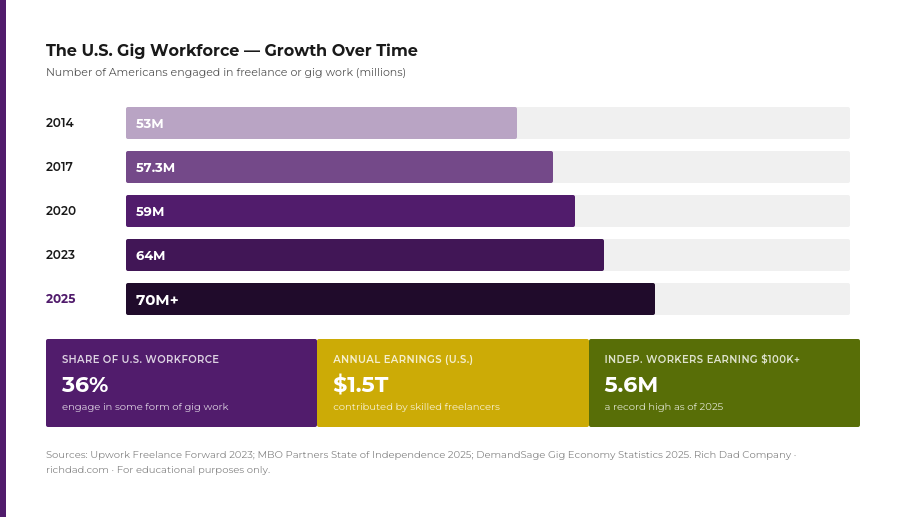
The numbers are striking. More than 70 million Americans now participate in some form of gig or freelance work, representing roughly 36% of the total U.S. workforce. That figure has climbed steadily from 53 million in 2014. The global gig economy is valued at over $582 billion and is projected to approach $674 billion by 2026, driven by platform expansion, AI-enabled work, and corporations’ increasing reliance on contingent labor.
The reasons people enter gig work tell an important story. According to Upwork’s Freelance Forward research, flexible hours top the list at 55%, followed by the belief that income potential is higher at 25%. Gen Z is entering gig work at rates no prior generation matched — 43% of Gen Z workers participate, often by first choice rather than last resort. For many, gig work represents a first taste of controlling their own income — and that instinct is worth celebrating. The question is what happens next.Gig economy jobs are taking over?
The gig economy isn’t entrepreneurship
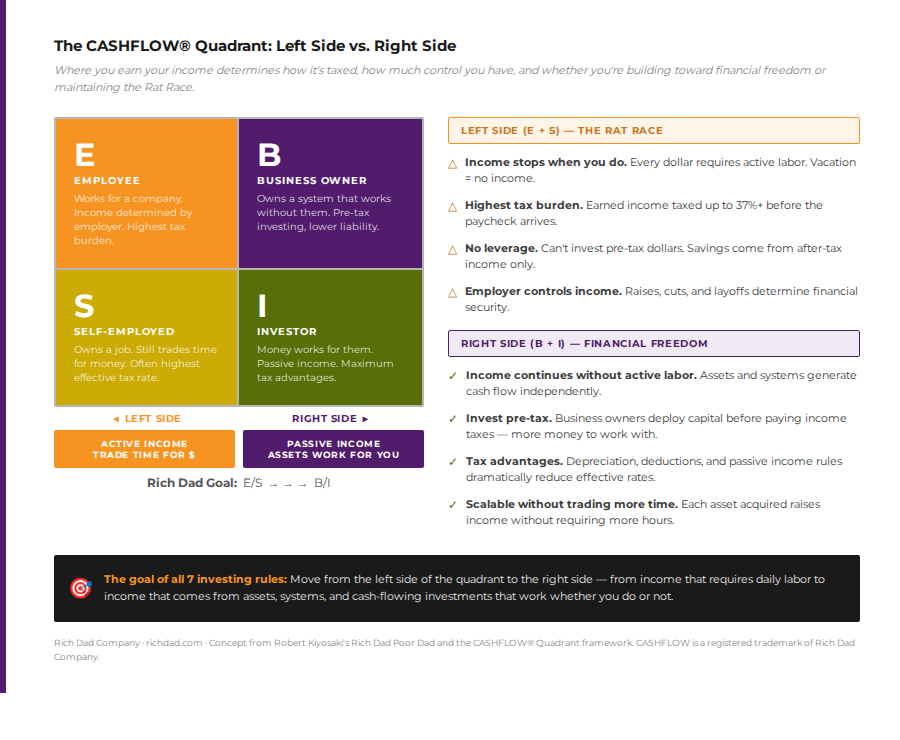
Here is the first thing to know about gig economy jobs: they are a form of self-employment, not business ownership. And in the CASHFLOW Quadrant framework, there is an important difference between the two.
The CASHFLOW Quadrant divides how people earn money into four categories: E (Employee), S (Self-Employed), B (Business Owner), and I (Investor). Most gig workers operate in the S quadrant. They are their own boss in the sense that they schedule their own time — but their income is still entirely dependent on trading that time for money. If they stop working, income stops immediately. That structural reality does not change because the employer is an algorithm instead of a manager.

This is not a judgment on gig workers. It is a structural observation. The platforms — Uber, DoorDash, Instacart, Upwork — are B-quadrant businesses. They built systems, apps, logistics, insurance frameworks, payment processing, and the marketing that connects labor to customers. The gig workers who use those platforms are providing skilled labor to someone else’s B-type business.
The hidden costs of gig work most people ignore
Beyond the structural trap, gig economy jobs carry significant financial risks that rarely show up in the marketing narrative around “be your own boss.” According to research by Prudential Financial, the numbers tell a sobering story:
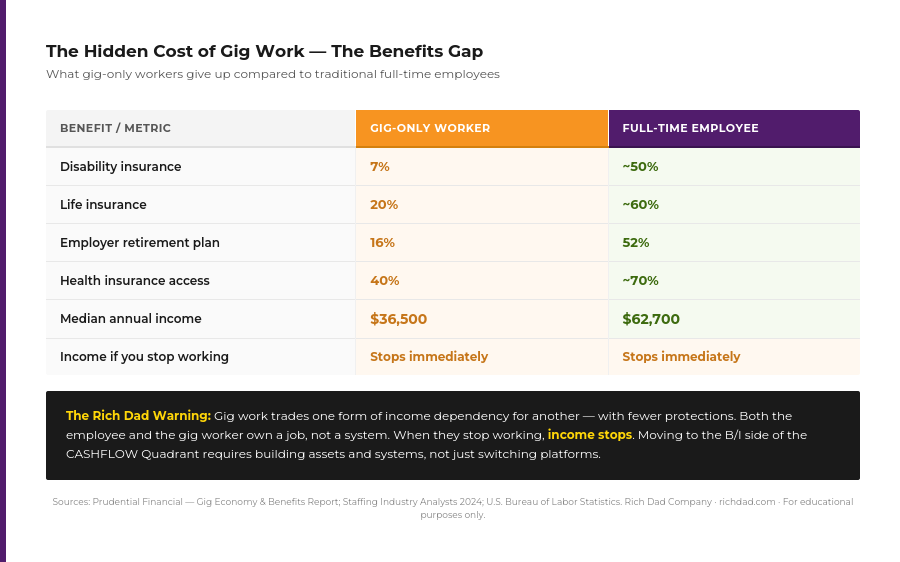
- Only 7% of gig-only workers have long-term disability insurance, compared to roughly 50% of traditional employees.
- Only 20% of gig-only workers carry life insurance.
- Only 16% of gig-only workers have assets in any retirement plan, versus 52% of full-time employees.
- Median annual income for gig-only workers is approximately $36,500 — compared to $62,700 for full-time employees.
- Just 40% of all gig workers have access to any form of health insurance.
These are not minor inconveniences. They represent real financial fragility. An injury, an illness, or a platform algorithm change can eliminate all income overnight. In the CASHFLOW Quadrant framework, a key insight about the E and S quadrants applies equally here: income stops the moment you do. That is true whether the platform is a corporate employer or a delivery app.
Financial stress follows the paycheck — no matter what it looks like
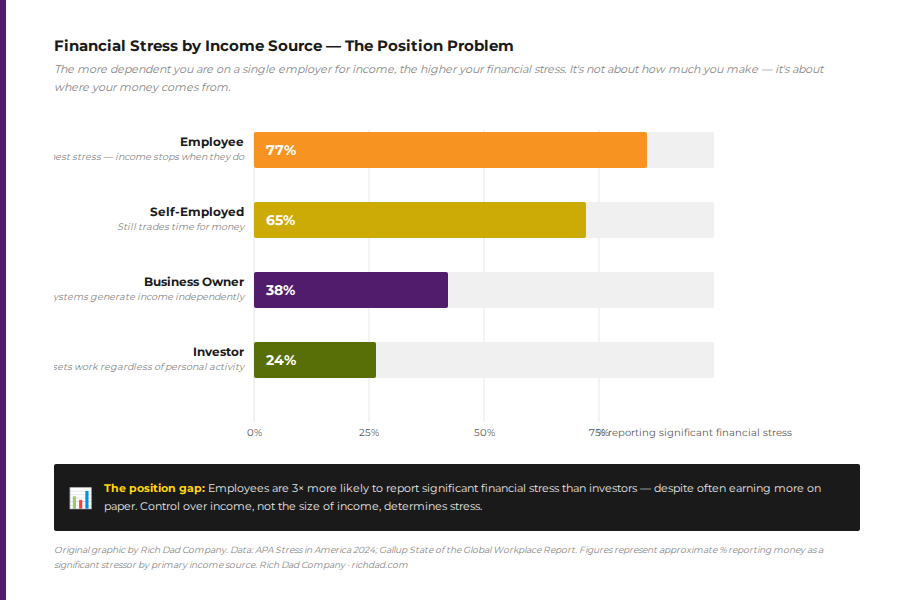
The data on financial stress reinforces why the source of income — not just its size — determines financial security. Employees report the highest rates of financial stress at 77%. Self-employed workers, including gig workers, report 65%. But business owners drop to 38%, and investors to just 24%.
The difference is not income level. MBO Partners reports 5.6 million independent workers earning over $100,000 annually in 2025 — a record high. But high earnings in the S quadrant still collapse the moment a person stops working. The structural difference — income that does not depend on daily presence — is what reduces financial anxiety and builds long-term wealth.
The burger vs. the business: Why systems create wealth
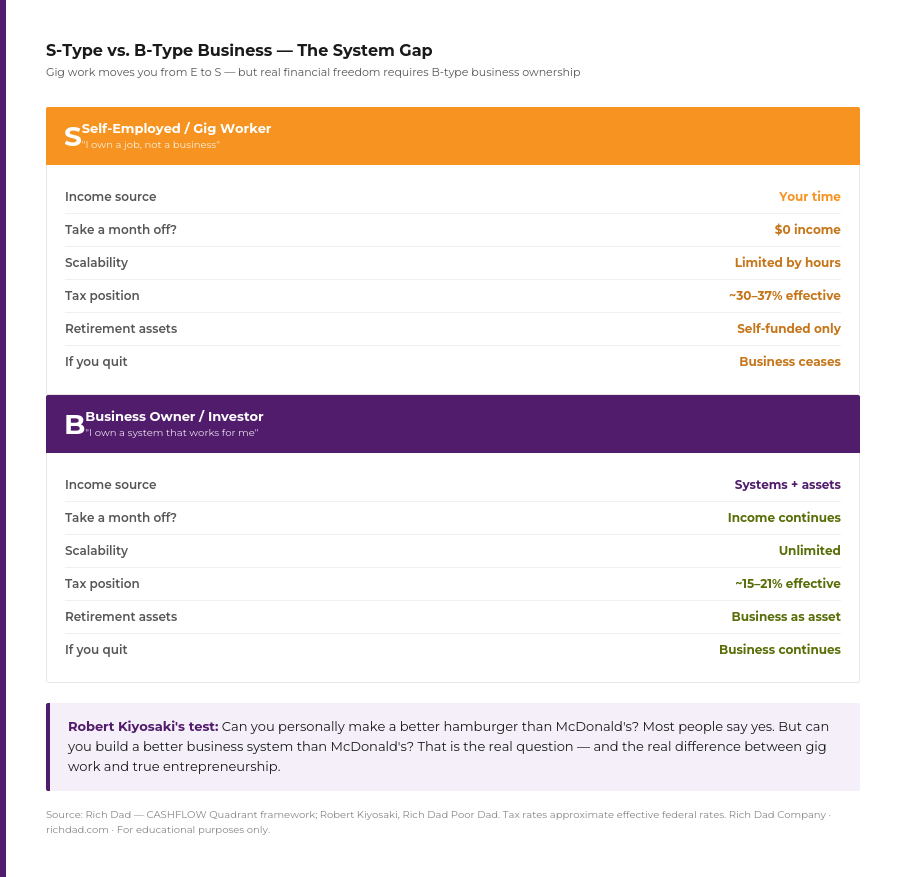
Robert Kiyosaki uses a simple test when someone asks for business advice. After about ten minutes of listening, he asks one question: “Can you personally make a better hamburger than McDonald’s?”
Nearly everyone says yes. McDonald’s burgers are not exceptional. But then comes the follow-up: “Can you build a better business system than McDonald’s?” That is a different question entirely.
McDonald’s does not sell burgers. McDonald’s sells a system — supply chains, training programs, franchise agreements, real estate, brand recognition, and digital ordering infrastructure that collectively deliver billions of meals without any single person doing all the work. That system runs whether the founder is present or not.
The same principle applies to gig work. A skilled freelance developer can write excellent code. But if they want to escape the S quadrant, the question is not how to get more clients — it is how to build a software product, a development firm, or a platform that delivers development work without requiring their personal hours on every project. The gig is not the goal. The system the gig educates them to build is the goal.
S-Type vs. B-Type: What the data says about the gig-to-entrepreneur transition
A 2025 NBER study using IRS tax return data — the largest analysis of gig-to-entrepreneur transitions ever conducted — found that gig workers are indeed more likely to become entrepreneurs than non-gig workers. The mechanism is on-the-job learning: time spent in an industry teaches market dynamics, customer behavior, and operational challenges that translate into better-informed business founders.
The same research found that gig-founded firms show 39.4% to 46.9% higher profitability relative to non-gig-founded firms, and that founders’ income grows 13.1% more over three years than non-gig entrepreneurs. The data suggests gig work can be a genuine on-ramp to entrepreneurship — for those who treat it that way.
The critical word is can. The path only opens for those using gig work deliberately as a school — not as a permanent destination. The distinction between S-type and B-type businesses remains essential: an S-type business is one where the owner is the product. A B-type business is one where the owner builds and manages the product delivery system.
How to use gig work as a launchpad instead of a landing spot
Rich Dad does not condemn gig economy jobs. The real danger is mistaking the S quadrant for a destination. Here is how to use gig work strategically within the Rich Dad framework:
1. Use gig income to fund financial education
The most valuable thing a gig worker can do with additional income is invest it in financial education — not lifestyle upgrades. Robert Kiyosaki built his wealth by learning the rules of money before deploying it. Every dollar earned from a gig is worth more if it funds financial intelligence that compounds over time.
2. Study the platform — not just the task
The NBER research shows that gig workers who become entrepreneurs tend to found businesses in the same industry as their gig experience. Someone who drives for Uber and studies logistics, surge pricing mechanics, and driver retention challenges gains business intelligence most MBAs never receive. That industry knowledge is a competitive advantage — if the person uses it to build a system rather than just log more trips.
3. Redirect cash flow toward assets, not expenses
The core Rich Dad principle applies directly here: use earned income to acquire cash-flowing assets. Gig income placed into a dividend-paying stock, a rental property down payment, or a business investment begins to generate passive income that does not require personal labor. Over time, that passive income reduces dependence on gig work itself — and begins the shift toward the I quadrant.
4. Build the system before leaving the platform
The biggest mistake aspiring entrepreneurs make is leaving the gig platform before a replacement system exists. Instead, consider building the B-I side of the quadrant while still generating E or S income. That means designing the system, testing the model, and proving the concept before cutting off stable cash flow. The B-I Triangle — mission, team, leadership, product, legal, systems, and communications — takes time to build properly.
AI, automation, and the future of gig work
There is a second reason to think carefully about long-term gig work dependency: automation. Many of the tasks performed by gig workers today — routing, matching, delivery — are precisely the functions AI and autonomous systems are being built to replace. Platforms like Uber have invested billions in autonomous vehicle research. The delivery logistics networks that currently employ human drivers are the same infrastructure being adapted for drone and robot delivery.
This is not an argument against taking gig work now. It is an argument against assuming gig platforms offer permanent economic security. The financial stress data shows that the only durable path to financial peace is building income that does not depend on continuous personal labor or on a platform’s willingness to keep your account active. The Rich Dad framework for building passive income provides the roadmap.
The gig economy is a starting line, not a finish line
Gig economy jobs are a legitimate response to a changing economy. They offer real income, schedule control, and — for the strategically minded — valuable on-the-job education in an industry a person wants to eventually systematize. The NBER research confirms what Rich Dad has taught for decades: the people who benefit most from gig work are those who use it as a school and a capital source, not a permanent career.
The CASHFLOW Quadrant question remains constant: which side do you want to be on? Moving from the E to the S quadrant by picking up gig work is a step — but it is not the destination. The destination is the B and I side: owning systems and assets that generate income whether you show up or not. A gig economy job can fund that journey. It cannot complete it.
The best use of a gig economy job is to treat it the same way Robert Kiyosaki treated every early financial lesson: not as the answer, but as the education. Every ride given, every delivery made, and every freelance project completed is a data point about how an industry works. The question is whether that data point becomes a system — or just another shift.
FAQs
Yes. In the U.S., gig workers are typically classified as independent contractors, meaning they file taxes as self-employed individuals. This means they pay both the employee and employer portions of Social Security and Medicare taxes — the self-employment tax — and are responsible for their own health insurance, retirement savings, and other benefits. From the CASHFLOW Quadrant perspective, gig workers occupy the S quadrant, not the B or I quadrants.
It can, if approached strategically. A 2025 NBER study using IRS data found that gig workers are more likely to become entrepreneurs than non-gig workers, and that gig-founded businesses generate 39–47% higher profitability. The key is using gig work as on-the-job education and capital generation, then converting that experience into a system that delivers the same value without requiring the founder’s personal labor for every task.
The core difference is systems vs. labor. A gig worker sells their personal time and skills directly. A business owner builds and manages a system that delivers value — often employing others or leveraging technology — so that income continues when the owner is not personally working. In CASHFLOW Quadrant terms, a gig worker is in the S quadrant; a business owner who has built scalable systems operates in the B quadrant.
As of 2025, more than 70 million Americans engage in some form of freelance or gig work, representing approximately 36% of the total U.S. workforce. The global gig workforce is estimated at 154 million to 435 million, depending on the definition used. The market itself is valued at over $582 billion globally and is projected to reach $674 billion by 2026.
Gig workers pay the full 15.3% self-employment tax on net earnings, in addition to income taxes. This typically results in a higher effective tax rate than a comparable W-2 position. However, self-employed workers can deduct legitimate business expenses, and the QBI deduction may allow a 20% deduction on qualifying business income. Rich Dad’s tax strategy content covers how business structure choices — S-corp election, LLC formation — can reduce self-employment tax exposure and keep more income working for you.