Retirement Savings in 2026: Record Balances, Falling Confidence
Americans are saving at a historic pace, and many still do not feel ready. Fidelity’s Q2 2026 Retirement Analysis reported record savings rates and balances at new highs, with an average 401(k) balance of $155,800 and a total savings rate of 14.4%, split between a 9.6% employee contribution and a 4.8% employer contribution.
Confidence tells a different story. The 2026 Retirement Confidence Survey from EBRI and Greenwald Research found that 61% of workers feel confident they will have enough money to live comfortably in retirement, down 6 percentage points from 2025. Among retirees, confidence fell 5 points to 73%. Only about half of workers are confident that Social Security and Medicare will deliver the same value in the future, and 65% say debt is a problem for their household.
The worry shows up in the dollar figures, too. Northwestern Mutual’s 2026 Planning & Progress Study puts the “magic number” for a comfortable retirement at $1.46 million, and 48% of Americans say it is somewhat or very likely they will outlive their savings.

Rich Dad has watched this gap open for more than a decade. In 2011, Robert Kiyosaki wrote in The Wall Street Journal that the 401(k) generation was beginning to retire and “it isn’t a pretty sight.” The balances look better on paper today. The underlying problem has not changed: a balance is not an income.
What Retirement Savings Actually Pay
The 4% rule is the usual shortcut for turning a balance into income. Morningstar’s 2026 research suggests a more conservative starting point of 3.9% for retirees who keep their spending fixed, and as much as 5.7% for those willing to adjust spending as markets move.
Apply 3.9% to the average Fidelity 401(k) balance and the result is about $6,076 a year, or roughly $506 a month. The average Social Security retired-worker benefit is $2,071 a month after the 2026 cost-of-living adjustment, or about $24,852 a year. Reaching the $1.46 million magic number would produce about $56,940 a year at the same rate.
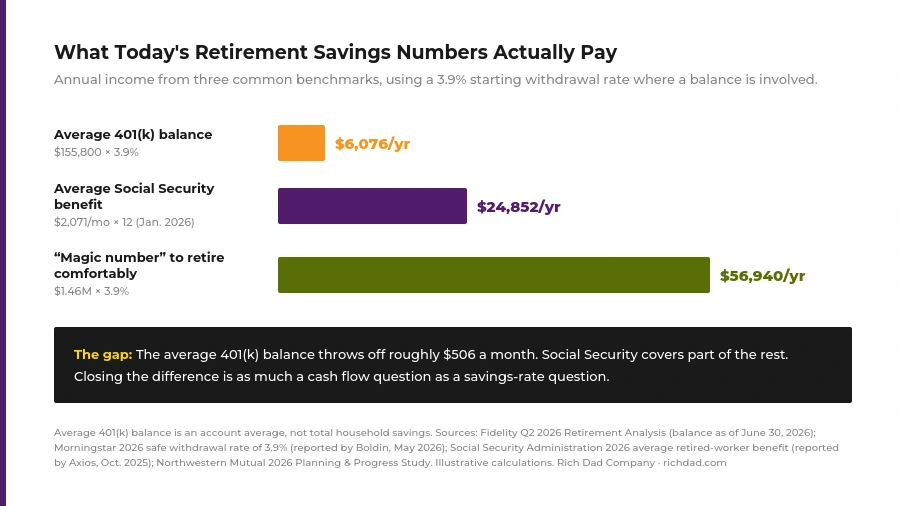
These are illustrations, not forecasts. The Fidelity figure is an average account balance, not total household savings, and withdrawals reduce principal and remain exposed to market risk. Still, the comparison changes the question. It is less about how large a balance looks and more about how much dependable income it supports, for how long, after inflation and taxes.
Why Saving for Retirement Isn’t Enough
Rich Dad has never argued against saving. The argument is that saving without a purpose is a weak retirement plan, because it relies on the one tool that teaches the least about how money works.
Inflation Quietly Shrinks Retirement Savings
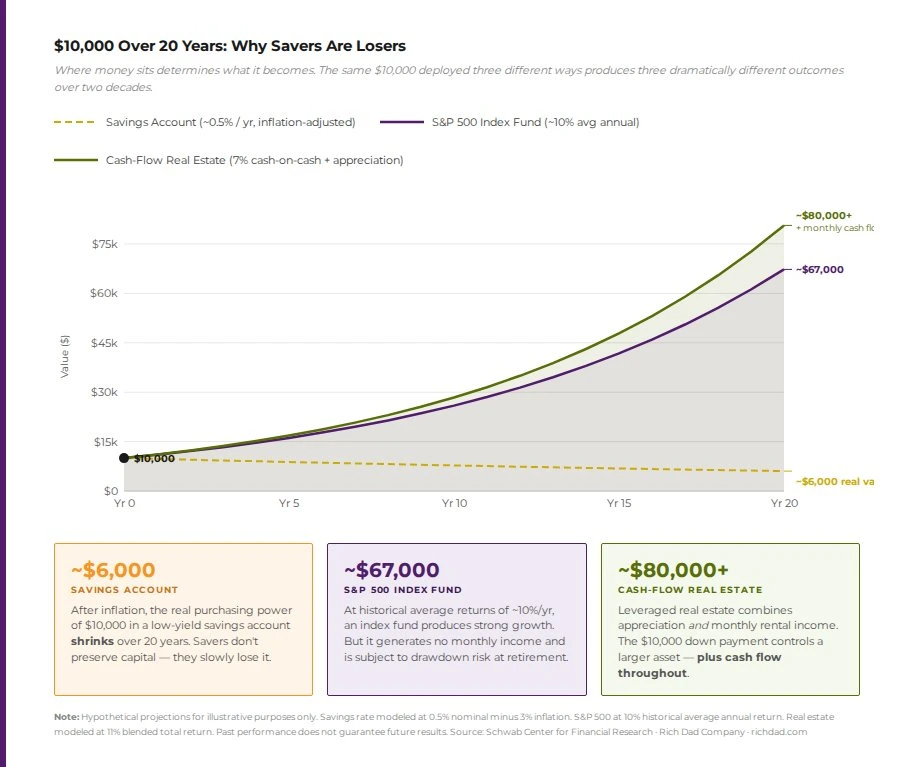
Cash in a savings account earns little, and inflation takes a share of what remains. Rich Dad calls this the reason savers are losers, and it is why Robert Kiyosaki points readers toward assets that can keep pace when inflation rises. The chart below follows a hypothetical $10,000 over 20 years under three approaches. Savings are shown after inflation, which is how a saver experiences the result.
Saving Teaches Little About How Money Works
Anyone can save. It builds a habit, but it builds no skill at judging an investment, weighing risk or reading the tax code. That is why Rich Dad’s guidance on saving keeps returning to one theme: save with the intent to invest. A balance that sits idle until age 65 cannot do the work retirement asks of it.
“Live Below Your Means” Keeps Retirement Small
Most retirement advice assumes the retiree will be poorer than the worker. It suggests cutting expenses, shrinking the lifestyle and even avoiding extra income that might push a retiree into a higher tax bracket. Rich Dad sees that as the core flaw, and calls the live below your means mindset a way of staying small. The alternative is to ask how to expand income to fit the retirement a person wants, rather than shrinking the retirement to fit the income.
How Retirement Savings Plans Took Over, and Why Control Matters
For much of the twentieth century, many American workers counted on defined benefit pensions, where the employer funded retirement and promised a lifetime income. The Employee Retirement Income Security Act of 1974 (ERISA) reshaped the rules, and the 401(k) followed after the Revenue Act of 1978. Over the next decades, employers moved from defined benefit plans to defined contribution plans, which shifted both the funding and the investment decisions onto workers.
That shift asks people with no financial education to manage their own retirement investing. Robert Kiyosaki explores how it unfolded in Who Stole My Pension?, co-written with former Securities and Exchange Commission attorney Edward Siedle.
Rich Dad points to three practical issues with a plan most workers never get to design. The first is limited control over what the account holds and how it is taxed, which this 401(k) guide covers in detail. The second is that fees compound against returns year after year. The third is that a long list of wealth-stealing forces work quietly against anyone who never learned the rules.
This is not a call to cash out. It is a call to learn before relying on any plan. Rich Dad’s position is that no one cares about a retirement as much as its owner, so the most dependable advisor is the one a person becomes. Professionals have a role on the team, but financial education is what lets an investor question their advice instead of simply trusting it.
2026 Retirement Savings Limits: Filling the Bucket
The IRS raised contribution limits for 2026, as reported by Financial Planning. Employees can defer $24,500 into a 401(k), 403(b), most 457 plans or the Thrift Savings Plan. Workers 50 and older can add an $8,000 catch-up, and those ages 60 to 63 can add $11,250. The IRA limit is $7,500, with a $1,100 catch-up for people 50 and older.
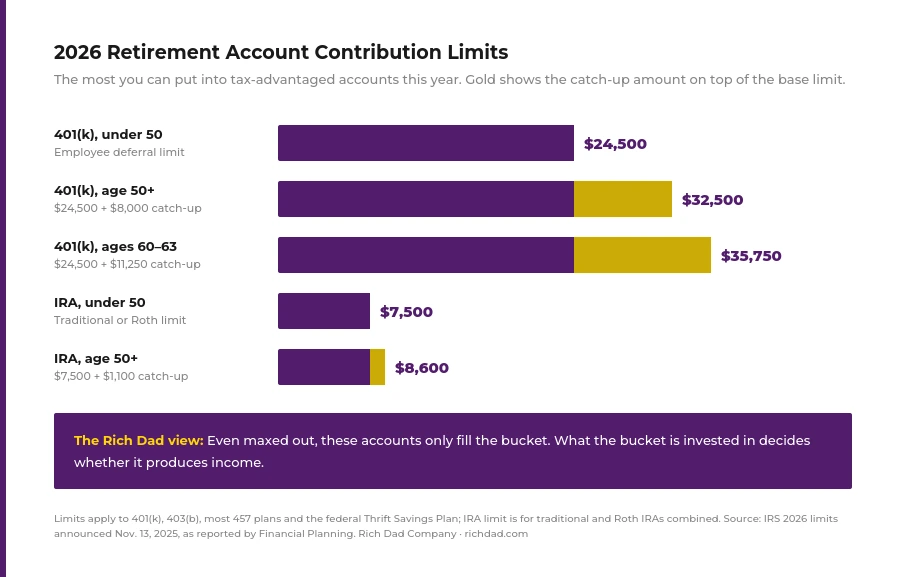
Rich Dad sees these accounts as buckets. Deciding how much to put in is worth working through with a tax professional, but what the bucket holds decides whether it produces income. A bucket full of assets the owner does not understand is still a gamble, however generous the limits.
How to Make Retirement Savings Last: The Rich Dad Approach
When Robert Kiyosaki was a boy, rich dad, his best friend’s father, taught him how to win at Monopoly: four green houses and one red hotel. The lesson was cash flow. The more income an asset produced, the stronger the position, in the game and in life. Making retirement savings last starts from the same idea.
Invest for Cash Flow, Not Just a Bigger Balance
Rich Dad defines an asset as something that puts money in your pocket. A retirement plan built on cash-flowing assets, such as rental real estate, dividend-paying paper assets and businesses, aims to cover expenses from income so the principal stays intact. Robert Kiyosaki has also described using other people’s money to pursue what he calls infinite returns.
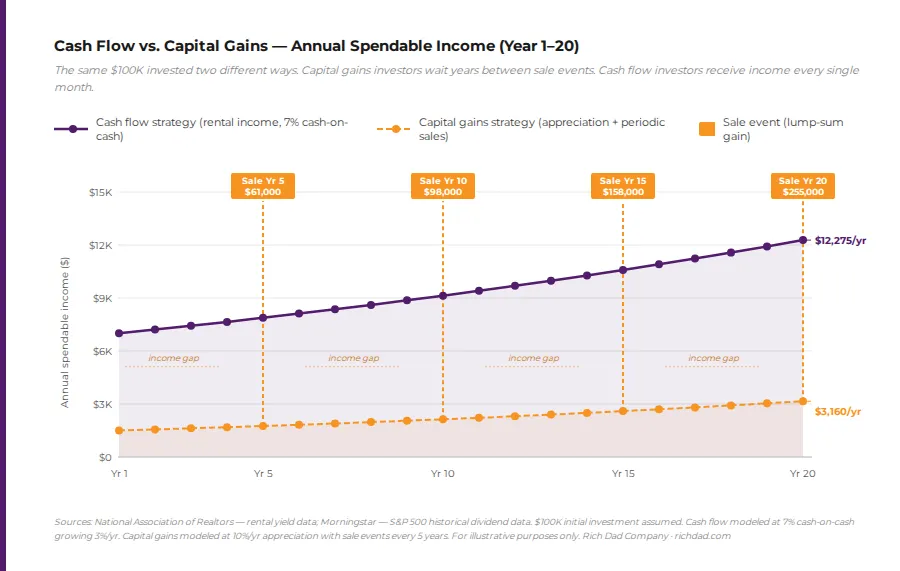
The chart above compares the same $100,000 invested two ways. The capital gains investor waits years between sale events. The cash flow investor is paid every month. The next chart shows why this matters for retirement: the amount of capital needed to reach $5,000 a month depends heavily on what the money produces.
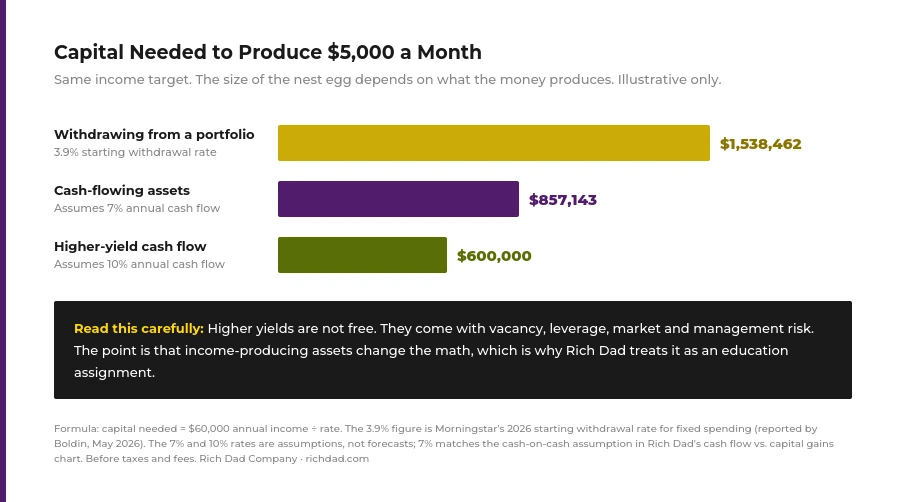
These numbers are illustrations. Cash flow investments carry real risks, including vacancy, leverage, market declines and poor management, which is why Rich Dad pairs every strategy with education and a capable team.
Choose Liquidity That Hedges Inflation
Conventional retirement planning often suggests holding three to five years of expenses in cash as a cushion against market drops. Rich Dad’s concern is what happens if inflation rises while that cushion sits idle. Robert Kiyosaki’s alternative is to keep liquidity in assets that can be sold relatively quickly and that he views as inflation hedges, such as gold, silver and oil. Rich Dad also questions handing savings to an insurer for long-term care coverage or an annuity, and prefers building assets that pay for care out of cash flow. Either path is worth weighing with a licensed professional.
Diversify Across Asset Classes, Not Just Funds
Spreading money across several mutual funds is diversification inside a single asset class. Rich Dad’s definition of true diversification is broader: paper assets, real estate, commodities, business and cryptocurrency, with the investor specializing in one or two. Most retirement plans hold only the first.
Use the Tax Code as an Advantage
In rich dad’s lesson, an employee pays taxes first and invests what is left, while a business owner buys assets first and pays taxes on what remains. In his telling, an employee could see up to half of income claimed before investing even began. His advice to the young Robert Kiyosaki was blunt: “Decide which rules you want to play by.” The takeaway is not to avoid taxes by staying poor. It is to learn how the rules reward investors who create income.
Build the Mindset First: Scarcity vs. Abundance in Retirement
Rich dad liked to say there are two kinds of money problems: not enough money, and too much money. Which one a person would rather have reveals a lot about their mindset.
A scarcity mindset worries about never having enough. Even in retirement, it fears the forces that take money away, including taxes, and it overlooks the opportunity to make more. An abundance mindset treats too much money as a good problem with creative solutions, such as investing or starting a business that defrays tax costs.
There is a price. The abundance mindset costs time, because off hours go to thinking about money and pursuing ideas rather than to television or shopping. Those who pay it tend to spend time with people who think the same way, talking about what could be rather than what is wrong.
A Five-Step Retirement Savings Checklist
- Write down your monthly expenses. That is the income a retirement plan has to replace.
- Convert every balance into income. Multiply each account by a conservative withdrawal rate such as 3.9%, then compare the result to your expenses.
- Review account limits and tax treatment with a qualified tax professional before changing contributions.
- Pick one cash flow asset class and study it before investing: real estate, paper assets, business or commodities.
- Build a team you can question. A CPA, an attorney and a broker or property manager are only useful to an investor who knows enough to evaluate their advice.
Retirement Savings Are the Start, Not the Plan
Record balances and record savings rates are good news. They do not settle the question of income. A retirement plan has to answer how much money arrives every month, whether it keeps pace with inflation and what happens to the principal.
Rich Dad’s guidance is consistent: keep saving, but save to invest, and invest with education. Moving from the old rules of money to cash flow thinking is a shift in mindset first and a shift in assets second. The best time to start building that education is long before the paychecks stop.

FAQs
Northwestern Mutual’s 2026 study puts the “magic number” at $1.46 million. Rich Dad frames the question differently: add up monthly expenses and ask whether income from assets can cover them. At a 3.9% withdrawal rate, $1.46 million produces about $56,940 a year.
Fidelity reported an average 401(k) balance of $155,800 in Q2 2026, as of June 30, 2026. That is an account average, not total household retirement savings, and at a 3.9% withdrawal rate it would pay about $6,076 a year.
Morningstar’s 2026 research suggests a more conservative 3.9% starting rate for fixed spending, and up to 5.7% for retirees who adjust spending with the market. No withdrawal rate is a guarantee, and results depend on returns, inflation and how long retirement lasts.
Rich Dad’s answer is no. Saving builds a habit but teaches little about investing, and idle cash loses ground to inflation. Rich Dad recommends saving with the intent to invest in assets that produce cash flow.
Rich Dad advises building income from cash-flowing assets, diversifying across asset classes rather than only funds, holding liquidity that can hedge inflation and learning how the tax code rewards investors. Financial education comes first, and professional advice should be something a retiree can evaluate.
The 2026 401(k) employee deferral limit is $24,500, with an $8,000 catch-up at 50 and older and an $11,250 catch-up for ages 60 to 63. The IRA limit is $7,500, plus a $1,100 catch-up at 50 and older.