What Zcash Is and How Its Privacy Works
Zcash was launched in October 2016 and built on Bitcoin’s original code by cryptographers who wanted digital cash that wasn’t going to broadcast every payment to the whole world.
Now, keep in mind that every Bitcoin transaction is public. Anyone can look up an address and trace where the coins came from and where they went next.
Zcash provides you with two kinds of addresses.
Transparent addresses work like Bitcoin and show everything on the public ledger.
Shielded addresses use math called zero-knowledge proofs. Using this the network can confirm a payment is valid without learning who paid whom or how much.
Privacy is an optional choice with Zcash.
Grayscale’s SEC filing notes that viewing keys let holders open their transaction details to an auditor or regulator when they choose. That opt-in design is why regulators treat Zcash differently from Monero (which hides every transaction by default).
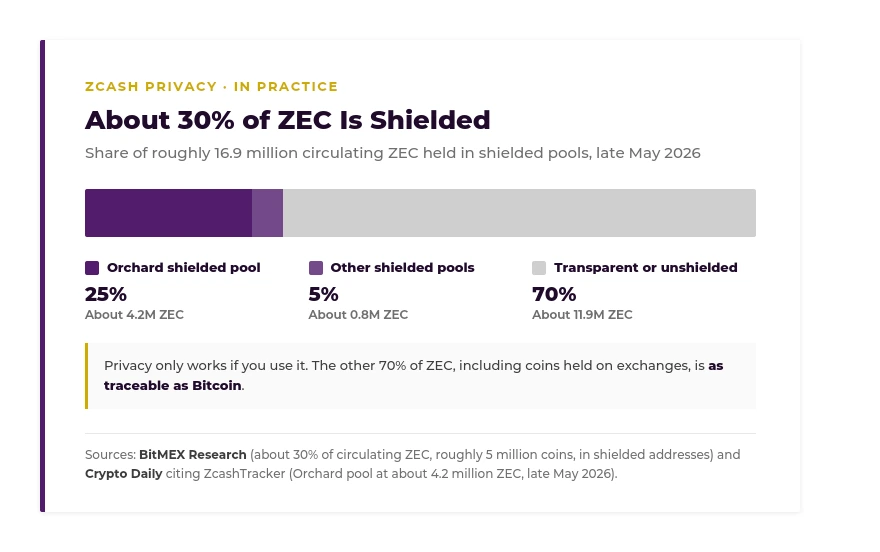
For privacy it’d take a wallet that supports shielded addresses. Sending coins from a transparent address into a shielded one is called shielding, and until you do it, your ZEC is just as traceable as Bitcoin.
Today, more people are using the private side of the network. Around 30% of all ZEC was held in shielded pools by late May 2026, about 5 million coins.
Zcash Price History, 2016 to 2026
Zcash has one of the most extreme price charts in crypto.
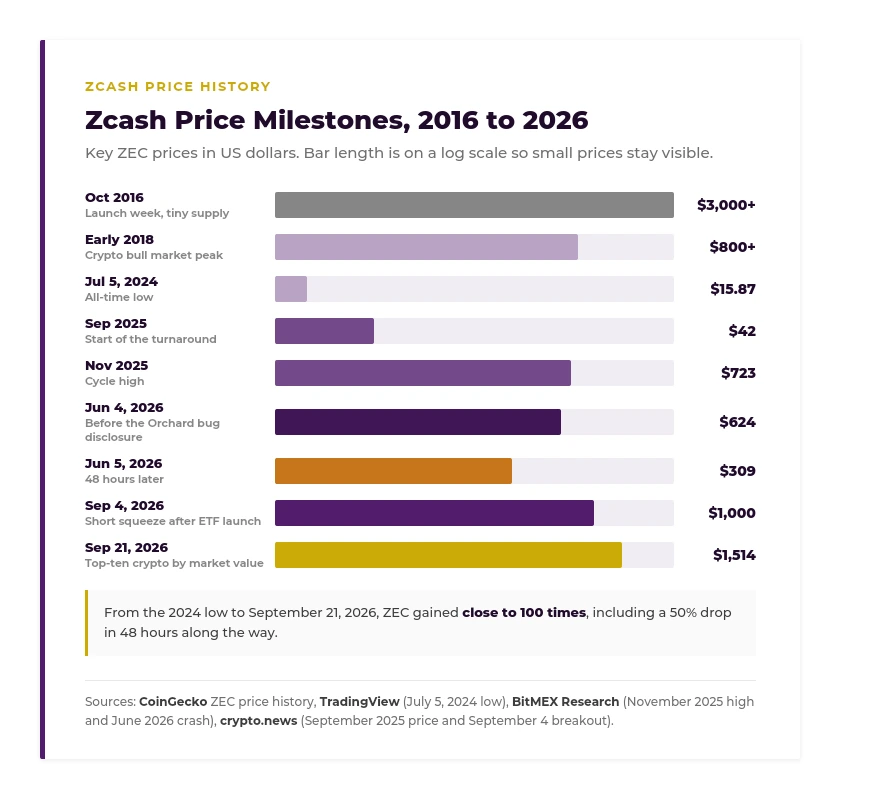
In its first early days of trading in October 2016, only a tiny number of coins existed, and ZEC briefly changed hands for over $3000 dollars. Even though it started with gusto, it spent most of the next eight years falling hard.
Along the way it traded above $800 in early 2018, but then it slid down through two bear markets and on July 5, 2024, it hit a low of $15.87.
Zcash stayed in this state for quite some time. Thing didn’t change very dramatically until 2025. ZEC traded around $42 in September 2025 and ran to a cycle high of $723 that November.
While rapid highs or lows are common in several crypto token price charts, in June 2026, ZEC fell from $624 to $309 in about 48 hours after developers disclosed a serious bug. You can find outmore about that bug below.
Then came the ETF where ZEC gained more than 55% in the days around the August 25 launch and broke through $1,000 on September 4 as a wave of short liquidations forced bearish traders out.
As of September 21, 2026, ZEC trades near $1,514 with a market value of about $25.6 billion, pushing it all the way up to earn a spot int he top ten.
Basically, that’s 100 times its 2024 low, and a 50% crash tosse dinto the middle of its run.
Zcash vs. Bitcoin
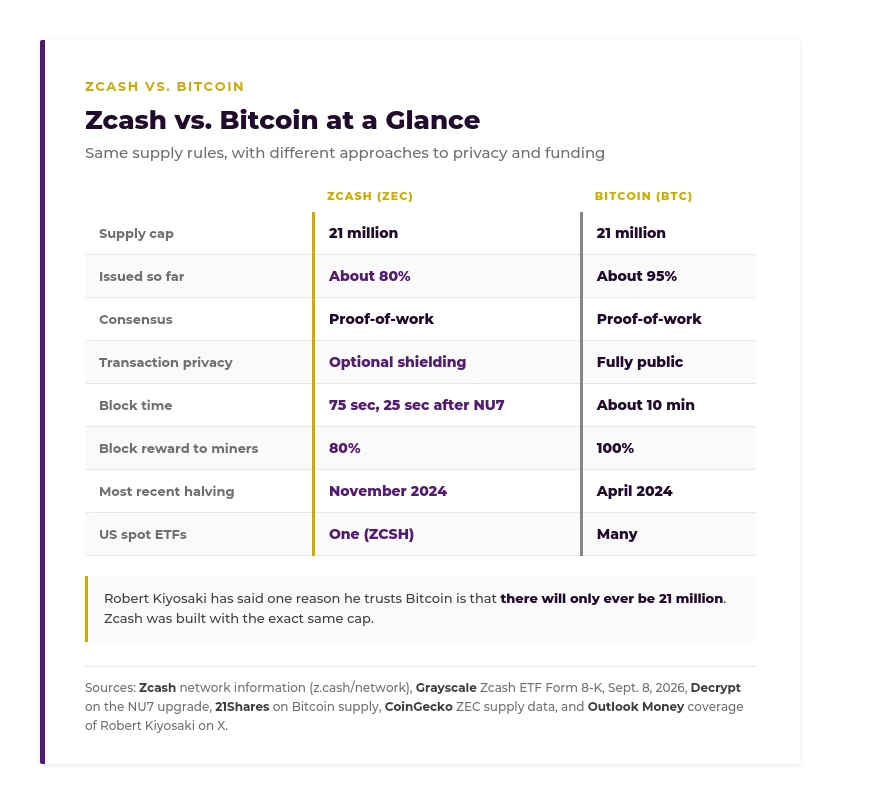
Zcash wanted to follow Bitcoin’s blueprint. Both cap supply at 21 million coins and cut the mining reward in half on a set schedule.
Zcash’s most recent halving came in November 2024. In September, 98.9% of voting coinholders chose to keep these Bitcoin-style halvings.
Robert Kiyosaki has pointed investors toward Bitcoin as protection against printed money, and Zcash shares that fixed-supply design. Past that, the two coins split in four ways.
- The first difference is privacy. Bitcoin is fully transparent, while Zcash lets you shield a payment for privacy.
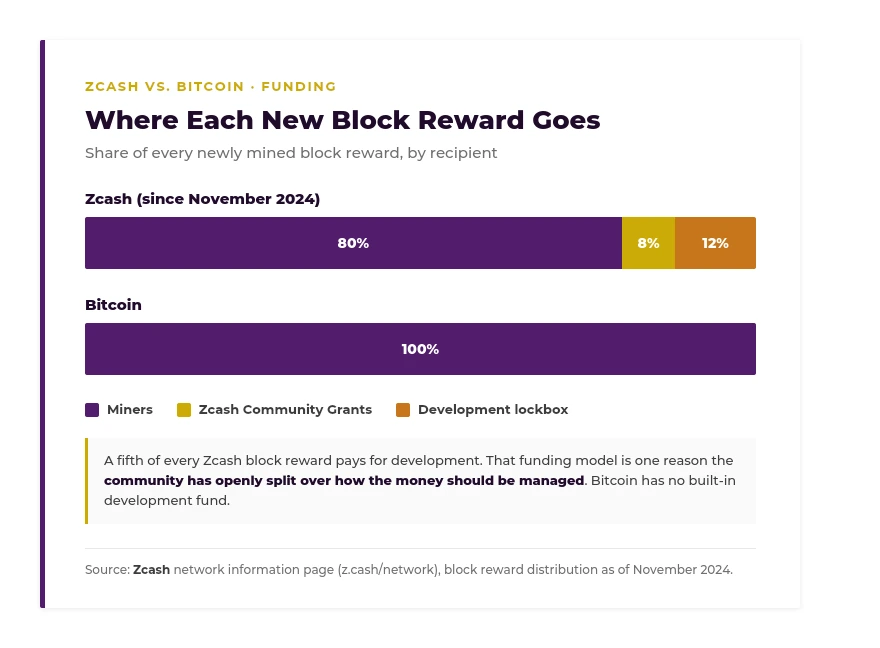
- The second is funding. Since November 2024, 80% of each Zcash block reward has gone to miners, with 8% to a community grants committee and 12% to a development lockbox. Every Bitcoin block reward goes to miners.
- The third is speed. Bitcoin produces a block around every 10 minutes and Zcash every 75 seconds, and the NU7 upgrade set for November 5 will end up cutting that to 25 seconds.
- The fourth is size. Zcash’s market value is a small fraction of Bitcoin’s, this is why it swings much harder in both directions.
Bitcoin backs a whole shelf of spot ETFs, but Grayscale’s fund is the only spot Zcash product in the world.
Investor Naval Ravikant painted it like this: Bitcoin is insurance against fiat, and Zcash is insurance against Bitcoin.
Neither coin produces any cash flow. CoinGecko recorded about $11,184 in Zcash network fees and zero project revenue over a recent 24-hour period, which means it’s price is based purely on demand.
The Pros
Optional privacy. You decide when a payment is public and when it’s shielded, and you can still prove your history to an auditor if you need to.
Bitcoin-style scarcity. The total supply is capped at 21 million coins, and around 80% of that has already been issued.
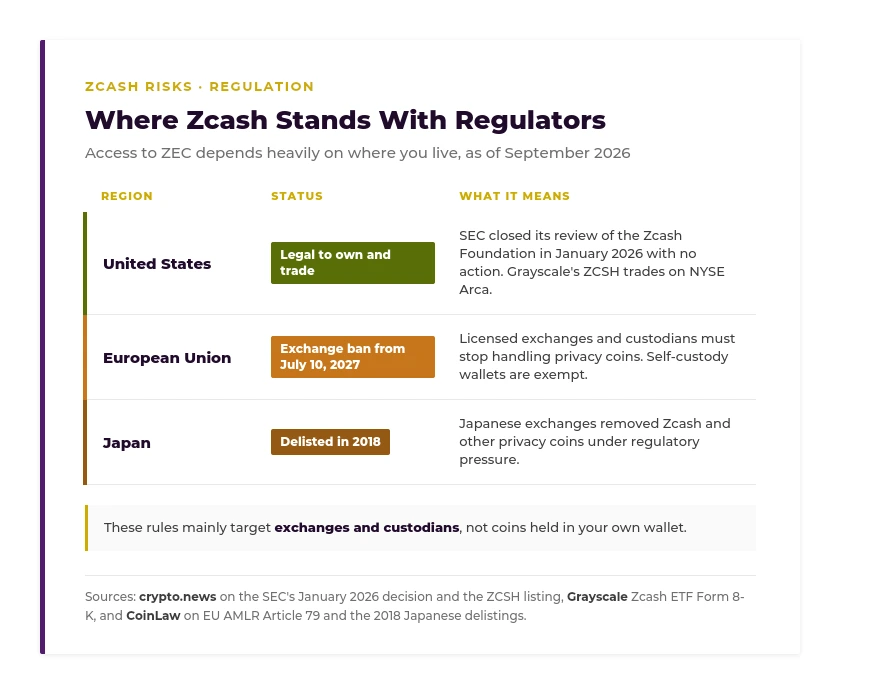
A clearer path in the US. The SEC closed its probe into the Zcash Foundation in January 2026 without taking action.
Brokerage access. Grayscale’s Zcash ETF, ticker ZCSH, passed $500 million in assets two weeks after its August 25 launch, and options on the fund began trading September 8.
Growing use of privacy. Shielded holdings reached about 30% of supply, up from roughly 8% two years earlier.
Active development. NU7 brings faster blocks and a plan to keep paying miners after 2031, when new issuance shrinks.
The Cons and Risks
The bugs you can’t see. On May 29, 2026, a security researcher found a flaw in Zcash’s Orchard privacy pool that had been there since 2022. It could have let an attacker create counterfeit ZEC inside the pool, but after the discovery it was patched within days.
Developers were honest about this, since Orchard hides transaction details, there’s no cryptographic way to prove that nobody exploited the flaw before the fix.
Extreme volatility. ZEC lost roughly half its value in 48 hours after that disclosure, then climbed nearly five times higher by September.
Leverage. Forced short liquidations pushed ZEC past $1,000 in a single session. If you’re investing into crypto right now, be very careful with leverage. The that same force that shoots prices up works just as fast on the way down.
Europe is shutting the door. From July 10, 2027, EU rules bar licensed exchanges and custodians from handling privacy coins. Personal wallets are exempt, but regulated access across Europe will likely decrease over time.
Concentration. One public company, Cypherpunk Technologies, disclosed about 1.92% of circulating ZEC in August. Big holders can trigger sharp drops, as the June sell-off showed when investor Arthur Hayes exited his position.
Less exchange support. Privacy coins are usually the first assets exchanges cut when regulators push. Binance dropped Monero in February 2024, and Japanese exchanges delisted Zcash back in 2018.
Privacy only works if you use it. Coins held on an exchange or at a transparent address carry none of the protection, so the benefit depends on how you store and send them.
Governance fights. A fifth of every block reward funds development, and the community has openly split over how that money should be managed.
ETF costs. ZCSH charges a 2.5% annual fee, far higher than the biggest spot Bitcoin ETFs.
Final Thoughts
Zcash takes Bitcoin’s supply rules and adds a privacy switch. That combination carried it from under $16 to a top-ten ranking in about two years.
The same design has it’s risks; a privacy pool can hide a bug along with your transactions, and Europe plans to push ZEC off regulated platforms in 2027.
If you decide to own it, carefully size the position so a 50% drop in two days wouldn’t change your life. That wild swing has already happened once this year.
Hold it in a wallet you control if privacy is the reason you’re buying. An ETF share gives you the price, but you recieve none of the privacy the coin was designed for.
Learn how the switch works before you pay a premium price for it.
Frequently Asked Questions
es. Owning and trading ZEC is legal in the US, the SEC closed its review of the Zcash Foundation in January 2026 without action, and Grayscale’s ZCSH trades on NYSE Arca.
Both have a 21 million coin cap and halvings. Zcash adds optional shielded transactions and a development fund paid from 20% of each block reward, and its blocks come much faster.
Developers disclosed a flaw in the Orchard privacy pool that could have allowed counterfeit ZEC. The bug was patched within days, but ZEC fell about 50% in 48 hours.
No. ZCSH gives you price exposure through a brokerage account while Coinbase holds the coins. Privacy only applies to ZEC you hold and shield in your own wallet.