Why Americans are buried in bad debt
According to the Federal Reserve Bank of New York, total U.S. household debt climbed to a record $18.8 trillion in the first quarter of 2026 — up from $17.05 trillion just three years earlier. Mortgage balances alone account for $13.19 trillion of that total, but it’s the non-housing debt — credit cards, auto loans, and student loans — that does the most damage to a household’s monthly cash flow, since none of it buys an asset that pays you back.
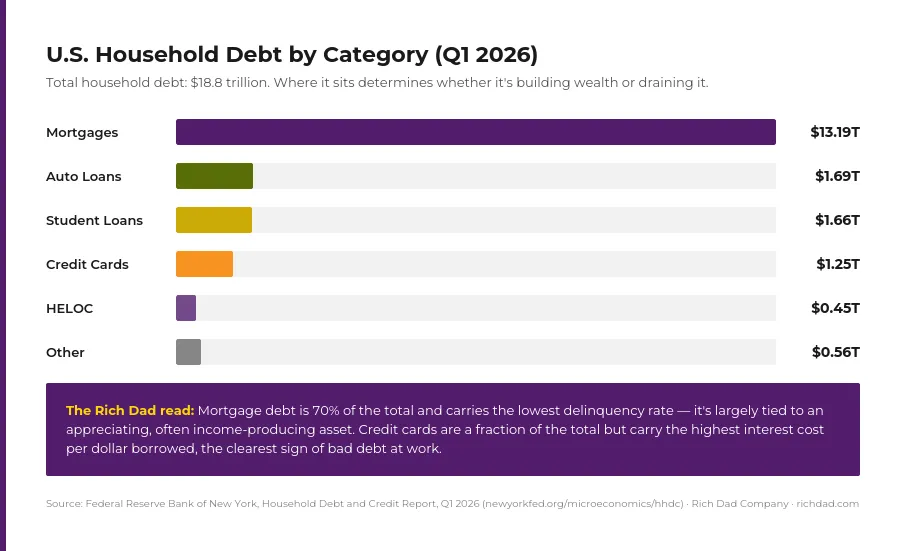
Credit cards are the most expensive piece of that picture. The average APR on accounts carrying a balance is now above 20%, according to Bankrate — meaning every dollar not paid off at the end of the month is working against you, not for you.
The sad reality is that Americans are taking on more bad debt every year, and rising balances paired with rising rates can be the canary in the coal mine for a household’s finances long before it shows up anywhere else.
The definition of poor
When discussing debt, Robert Kiyosaki’s rich dad used to say, “The more people you’re indebted to, the poorer you are. And the more people you have indebted to you, the wealthier you are. That’s the game.”
He went on to say, “We’re all in debt to someone else. The problems occur when the debt gets out of balance. Unfortunately, the poor people of this world have been run over so hard by the game that they often can’t get any deeper into debt. If you have too much debt, the world takes everything you have, including your time, work, home, life, confidence, and even your dignity.”

Debt is inevitable — but it can work to your advantage if you play your hand right. So what exactly separates the debt that helps from the debt that hurts?
Good debt vs. bad debt: The distinction that changes everything
For many people, debt is a four-letter word. Conventional wisdom says to stay away from it entirely, and entire industries have been built on decrying debt and helping people escape it.
At Rich Dad, the view is more nuanced. There’s an important distinction between two types of debt, explored further on the Debt hub: good debt and bad debt.
Bad debt is debt used to purchase liabilities — cars, vacations, clothes, even an emergency fund for things you don’t have the cash to cover. It’s called bad because it doesn’t make you richer; it makes you poorer. Liabilities take money out of your pocket every month instead of putting money in.
Good debt, on the other hand, puts money in your pocket every month. It’s used to purchase investment real estate, grow a business, or take advantage of other cash-flowing opportunities. In short, it buys assets — and the cash flow from those assets pays for the cost of the debt itself.
Most people in America are saddled with bad debt and have no idea how to put good debt to work for them. And the reality is that before good debt can become useful, bad personal debt has to be cleared first. That’s what the six steps below are designed to do.
The real cost of waiting on a balance
The math behind bad debt is brutal, and it’s the reason step one of the plan below is to stop adding to it immediately.
Take a $5,000 credit card balance at a 20% APR — right around today’s national average. According to Bankrate’s payoff calculator, making only the minimum payment stretches that single balance out for roughly 23 years and costs more than $7,700 in interest — well over the original amount borrowed. Add just a modest amount of extra principal each month, and both the timeline and the interest bill fall dramatically.
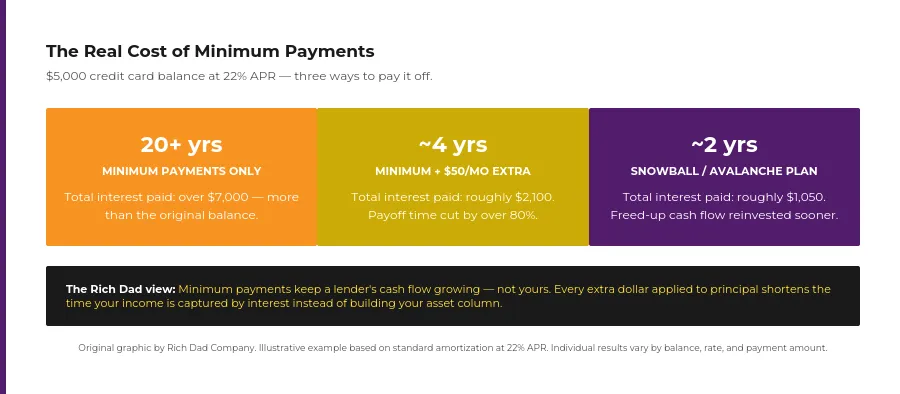
This is the trap bad debt sets: minimum payments are engineered to keep a balance alive as long as possible, because interest is the lender’s cash flow. Every extra dollar applied to principal is a dollar reclaimed from that arrangement and, eventually, redirected toward your own asset column.
The Rich Dad 6-Step Debt Freedom Plan
The following six steps can be used to eliminate personal debt. Implemented in order, and without skipping ahead, they work.
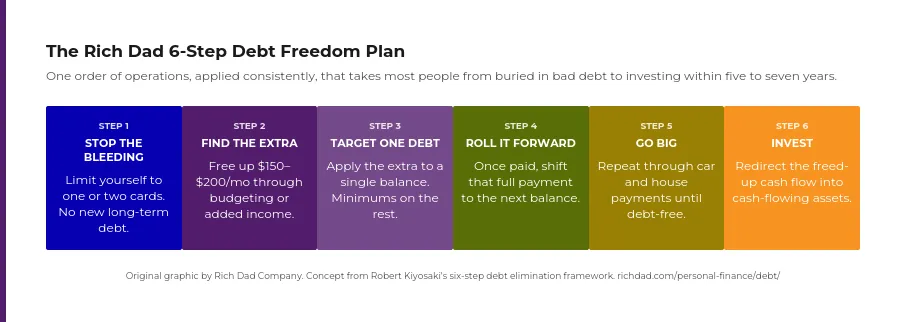
Step 1 — Limit your bad debt
If there are credit cards with outstanding balances, narrow spending down to one or two cards, and discipline yourself so that any new charges are paid off in full every month. Do not take on any additional long-term debt while working through the steps below.
Step 2 — Up the ante
Find $150 to $200 in extra monthly cash. With a solid financial education and an understanding of how to make money work harder, this is usually achievable through budgeting, cutting a handful of recurring expenses, or picking up modest additional income. If generating that extra $150 to $200 a month feels impossible, financial freedom may currently be more of a hope than a plan — which is itself useful information, and a sign to revisit the budget.
Step 3 — Focus on one debt
Apply the extra $150 to $200 to the minimum payment on a single credit card or loan. Continue paying only the minimum amount due on every other balance. Many people try to pay a little extra across all their debts at once, but those debts have a way of never actually getting paid off using that approach — concentration beats dilution.
Step 4 — Keep it rolling
Once the first balance is paid off, take the full amount that had been going toward it each month and apply that entire sum to the next debt in line. That balance now gets the minimum payment plus everything freed up from the first one. As each debt is eliminated, the monthly amount attacking the next one keeps growing.
Step 5 — Go big
Once every credit card and other consumer debt is cleared, apply the same process to a car payment and, eventually, a mortgage. Most people who follow this procedure are amazed at how quickly the timeline shrinks — many can be completely debt-free within five to seven years.
Step 6 — Invest
With all debt paid off, redirect the full monthly amount that used to service that last balance into investments. This is the moment to start building an asset column — even, eventually, using good debt as leverage.
How to avoid falling back into bad debt
Once bad debt is paid off, the habits that keep it from creeping back matter just as much as the payoff plan itself. The Urban Institute, partnering with the Arizona Federal Credit Union, studied 14,000 credit card users and distilled the results into two simple rules of thumb.
Don’t swipe the small stuff
Use cash for anything under $20. Small purchases — a coffee, a snack, a bottle of water — are easy to justify in the moment and easy to lose track of by month’s end. Paying with physical cash makes that spending visible again, and it’s often enough on its own to change habits.
Credit keeps charging
Interest compounds, and it adds up faster than it feels like it should. Carry a $1,000 balance at 20% interest for a year, and the interest owed is $200 — bringing the balance to $1,200. Carry that balance for a second year, and another 20% (now $240) brings the total to $1,440. The same untouched balance is worth 44% more after two years.
The simplest rule of all still applies: pay the full statement balance every month. Doing so means the stated APR never actually applies, since interest is only charged on balances carried past the due date. According to the Consumer Financial Protection Bureau, consumers were assessed $160 billion in credit card interest charges in 2024 alone, up from $105 billion just two years earlier — money that, dollar for dollar, could have gone toward an asset column instead.
None of this makes credit cards themselves the enemy. Used deliberately — paid in full, tracked closely, treated like a debit card rather than a loan — they’re a convenience and a credit-building tool. Treated carelessly, they’re the fastest way back into the six-step plan above.
Snowball or avalanche? Choosing the right payoff method
Step 3 above describes what’s commonly known as the debt snowball method — smallest balance first, for the psychological win of watching debts disappear quickly. Its counterpart, the debt avalanche method, targets the highest-interest balance first, which saves the most money in total interest paid.
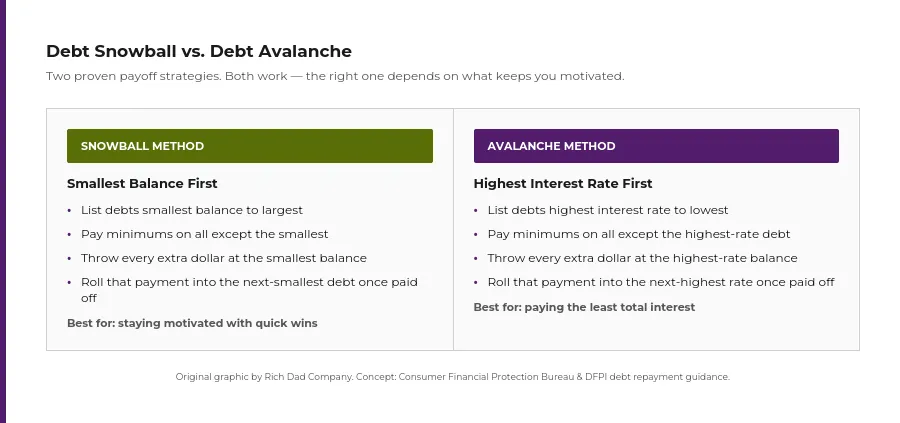
Both are variations on the same underlying principle from the six steps: concentrate extra payments on one debt at a time, then roll that payment forward. Choose the snowball method for quick, motivating wins if sticking with a plan has been the challenge in the past. Choose the avalanche method if the math of paying the least possible interest matters more. Either one beats spreading extra payments evenly across every balance, which is the approach most people try first — and the one that rarely finishes the job.
From debt-free to wealthy: Redirecting cash flow into assets
Contrary to popular belief, debt is not something to fear. It’s a powerful tool for building wealth when used correctly. Rich dad often pointed out that currency itself isn’t an instrument of equity — it’s an instrument of debt. Every dollar used to be backed by gold or silver; today, every dollar is effectively an IOU guaranteed by the taxpayers of the issuing country.
There was a time when Robert was nearly $1 million in the hole immediately after his first business failed. Despite the difficulty, he followed this same six-step sequence and eventually got out of debt entirely. It wasn’t easy, but it was simple. The process demanded real sacrifice at first, but that simple six-step outline paved the way for two decades of financial freedom that followed.
Once free of bad debt, the same discipline that paid it off can be redirected. Cash flow that used to service a credit card balance can instead fund the budgeting habits, the emergency savings, and eventually the real estate or stocks and paper assets that make good debt possible. That’s the full arc: from bad debt, to debt-free, to using good debt to build an asset column that pays for itself.
Rich Dad’s CASHFLOW board game was built to teach exactly this pattern in a simulated environment before real money is on the line — a low-stakes way to practice the habit of paying yourself first and routing freed-up cash flow into assets rather than more liabilities. For a deeper, structured walkthrough of untangling credit card debt specifically, Rich Dad’s Credit Reset course builds on the same six-step foundation.
How will you get out of debt?
Getting out of bad debt isn’t about willpower alone — it’s about following an order of operations and sticking with it, one balance at a time. Limit new debt, find the extra cash, concentrate it, roll it forward, go big, and invest. The plan is simple. It’s not always easy. But it works.
Get started today on the path to paying off bad debt, and start building the financial education that lets good debt work for you instead of against you.
FAQs
No. There is a hard line between bad debt, which is used to buy liabilities and pulls money out of your pocket every month, and good debt, which is used to buy cash-flowing assets that pay for themselves. The goal isn’t to fear all debt — it’s to eliminate bad debt and eventually use good debt strategically.
Both work, and both follow the same core principle of concentrating extra payments on one debt while paying minimums on the rest. The snowball method (smallest balance first) tends to keep people motivated with quick wins. The avalanche method (highest interest rate first) saves the most money overall. Pick whichever one you’re more likely to stick with.
Every situation is different, but many people who follow the six-step plan consistently — limiting new debt, finding extra monthly cash, and rolling payments forward from one balance to the next — become completely debt-free within five to seven years, including consumer debt, auto loans, and even a mortgage.
Two habits do most of the work: use cash for purchases under $20 so small spending stays visible, and pay the full statement balance every month so interest never applies in the first place. Together, these keep the discipline built during the six-step payoff plan from unraveling once the pressure of debt is gone.
It can help simplify multiple payments into one, and it may lower the interest rate on existing balances. But consolidation doesn’t reduce the underlying spending habits that created the debt in the first place. It works best alongside the discipline of the six-step plan above, not as a replacement for it.
Redirect the monthly amount that used to service your last debt payment into building an asset column — starting with financial education, then moving into cash-flowing investments such as real estate or paper assets. That’s the point where good debt, used to acquire assets, can start working in your favor.