
Why Taking Profits on Meme Coins Is Harder Than Buying Them
Meme coins run on attention, not cash flow. A dog-themed token does not pay monthly income, so its price depends on whether the crowd keeps showing up. Rich Dad defines an asset as something that puts money in your pocket. A token that only gains value on paper is a speculation, and speculation calls for a different discipline: an exit decided in advance.
The pressure to hold too long is real. One Rich Dad colleague put $100 into a new meme token and cashed out at $500, a $400 profit. When she shared the result in a crypto community, the reaction was disappointment: she should have invested more and held on longer. Shortly afterward the token fell further, and had she waited, her profit would have shrunk significantly. She took a gain, stayed within what she was comfortable losing, and avoided the round trip.

That restraint matters because most tokens do not hold their value. CoinGecko’s dead coins research, as reported by ForkLog in January 2026, found that more than half of all cryptocurrencies ever tracked by GeckoTerminal (53.2%) have failed, with the collapse of the meme coin sector cited as a contributing factor. In that environment, the most common planning error is an unrealistic return expectation: assuming the next token will be the one that never comes back down.
Can You Get Rich Off Meme Coins? What the Data Shows
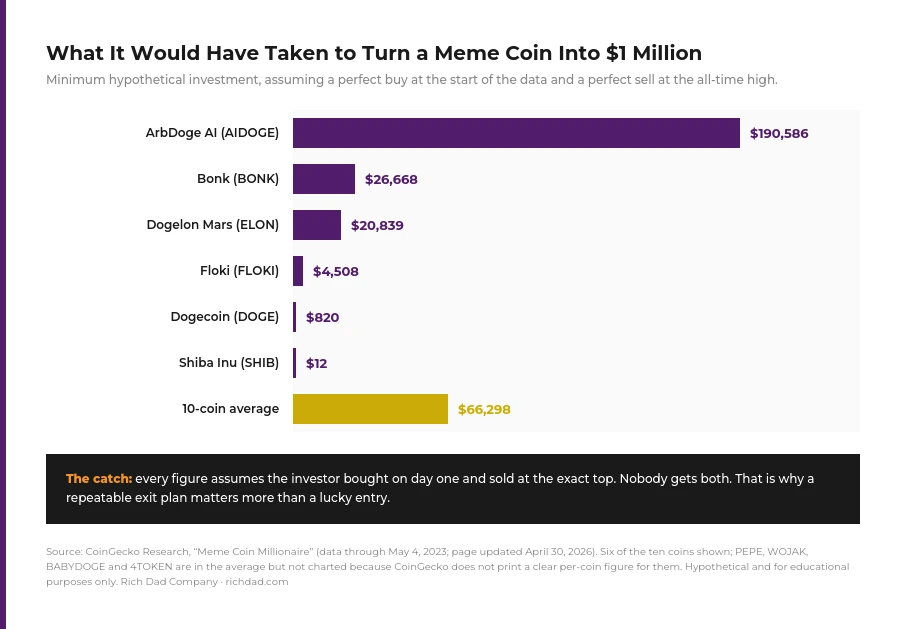
The most repeated meme coin story is the million-dollar one, so the fine print is worth reading. CoinGecko analyzed ten meme coins and calculated that an investor would have needed about $66,298 on average to turn a position into $1 million. The range was wide: $12 in Shiba Inu, $820 in Dogecoin, and about $190,586 in ArbDoge AI.
Two details matter. First, the study assumes the investor bought at the very start of each coin’s available data. Second, it assumes the investor sold at the exact all-time high as of May 4, 2023. That is perfect hindsight at both ends, and no real investor gets both.
Real-world results look different. CoinGecko’s study of Pump.fun and PumpSwap traders on Solana found that 73.28% of 3,142,559 wallets were profitable on a realized basis in April 2026. That sounds strong until the sizes are visible. Another 65.14% earned between $1 and $500, while 25.23% lost between $1 and $500, which means roughly nine in ten traders finished within $500 of breakeven. Only 5.37% earned more than $1,000.
April 2026 was also a good month. CoinGecko reports that the majority of traders lost money in every month from April 2024 through late 2025, with a low of 30.08% profitable in June 2025. The data counts realized profit and loss only, so unsold positions are excluded and losses are likely understated.
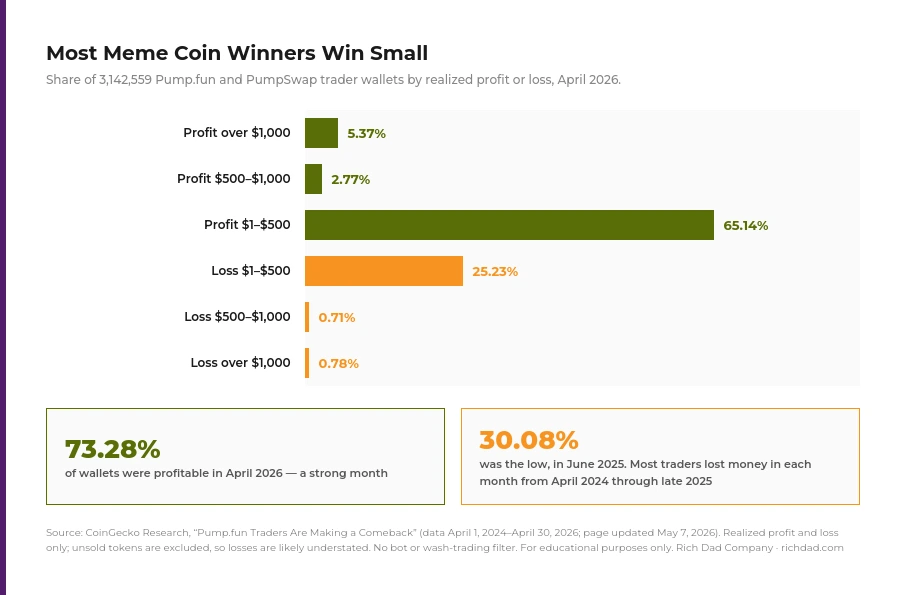
The takeaway for anyone asking whether crypto can make them rich: it can produce outsized gains, but they are rare, timing-dependent and concentrated in a small share of participants. A plan built on small positions and pre-set exits does not require being right about the next 100x.
Size the Position Before Planning the Exit
Position size is the first profit-taking decision, because it determines what a bad outcome costs. Volatility is what creates the prospect of large meme coin gains, and it is also why many investors starting out are uncomfortable with big checks. If putting tens of thousands of dollars into an unproven token does not fit an investor’s risk level, the answer is simple: do not do it. Smaller stakes can still produce some profit.
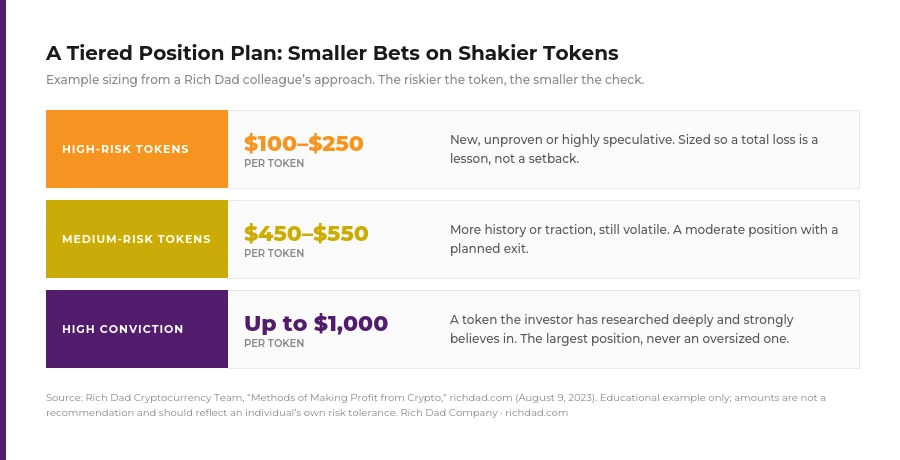
One framework from a Rich Dad colleague scales the amount to the risk. High-risk tokens get $100 to $250, medium-risk tokens get $450 to $550, and a token the investor has researched deeply and strongly believes in gets up to $1,000. The riskier the token, the smaller the check.
The same logic answers a question that comes up often: is $100 enough to start investing in crypto? Many platforms allow small purchases, and a small stake is a reasonable way to learn how the market moves and how exits work. The goal of a first position is education, not income, which is consistent with Rich Dad’s philosophy of financial education first.
Three Methods for Taking Profits on Meme Coins
Nothing is one-size-fits-all, and every investor should do their own research and plan before making investments. For educational purposes, these are three exit methods investors use. Each one is a rule set before buying, so the decision is not made in the heat of a rally.
Method 1: Sell the Double, Plus Extra
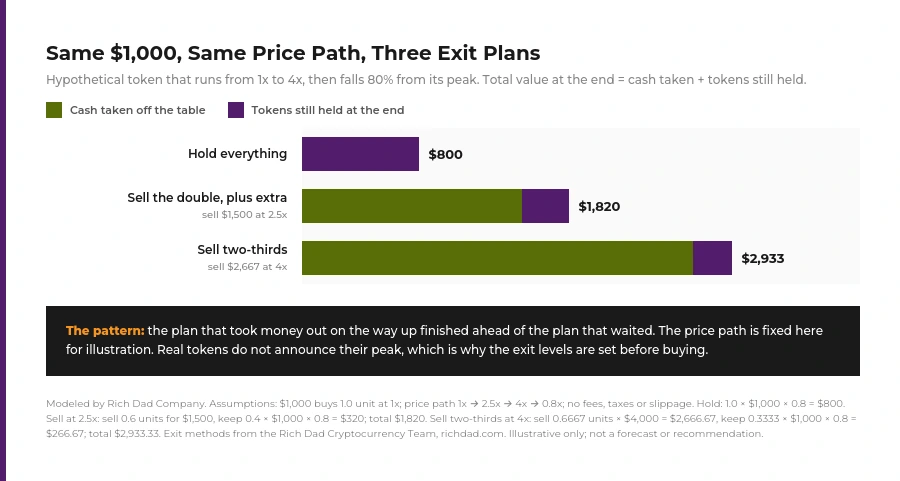
A veteran Bitcoin investor’s rule of thumb is to take profit once the original investment has been earned back, plus a little extra. For example, if $1,000 grows to $2,500, sell $1,500 and leave $1,000 invested. The sale returns the original $1,000 and locks in $500 of profit, and the “plus extra” leaves room for network gas fees. The remaining $1,000 can keep running toward a higher price or fall to a stop-loss without putting the original stake at risk.
Method 2: Take Profit on Two-Thirds and Keep the Rest Invested
Another approach sets a target multiple and sells a fixed share when it arrives. If $1,000 grows to $4,000, two-thirds of the position is about $2,666.67. Selling that amount recovers the original stake and banks roughly $1,667 of profit, while the remaining third, about $1,333, stays invested in case the run continues. That remainder is the part of the plan that can be wrong without hurting.
Method 3: Take Profit, Then Buy Back In After the Fall
A third method takes the profit, waits for a pullback, and reinvests only the original stake at a lower entry point. The investor does not put the profits back in. Profit has already been banked once, and if the token climbs back to a new high, it can be taken again. The tradeoff is patience: the dip may never come, or the token may keep falling and never offer a good re-entry.
The chart below runs the first two methods against simply holding, on the same hypothetical price path. In this example, the plans that sold on the way up finished ahead. A different path would produce different results, and a token that never falls would reward holding. The value of each method is that the rule was set in advance.
Crypto Cash Flow: Dollar-Cost Averaging, Staking and Yield Farming
Not every crypto strategy depends on selling at a peak. Some investors prefer methods that spread out entry or generate token income, which fits more closely with Rich Dad’s emphasis on cash flow:
- Dollar-cost averaging: investing a fixed amount, such as $100 a month, into tokens an investor wants more of. Some investors do this with Bitcoin. It removes the pressure of picking a single entry price.
- Staking: locking up tokens to help support a network in exchange for rewards, then taking profits when needed.
- Yield farming: supplying tokens to liquidity pools for returns. It was more profitable in 2021 and is far higher risk now. Investors who still use it often stick to single-asset farms and avoid token pairs, to sidestep impermanent loss, the value gap that opens when the two paired tokens move apart in price.
Income from these strategies has tax consequences, and the yield is only worth what remains afterward. Rich Dad’s guide to stablecoin yield shows how fees, gas costs and taxes cut into advertised returns.
What Happens to Meme Coin Profits at Tax Time
The IRS treats digital assets as property, not currency. Selling or disposing of one held for investment is a capital transaction, reported on Form 8949. Income from staking is reported separately, on Schedule 1 of Form 1040.
Holding period sets the rate. Under IRS capital gains rules, a gain on an asset held one year or less is short-term and taxed as ordinary income at graduated rates. A gain on an asset held more than one year is long-term and taxed at 0%, 15% or 20%, depending on income. Because many meme coin trades are measured in weeks or months, many realized gains will fall in the short-term category.
Reporting is also tightening. Brokers began reporting gross proceeds on Form 1099-DA for transactions on or after January 1, 2025, and began reporting cost basis on certain transactions on or after January 1, 2026. Taking profit therefore also means keeping records: purchase date, cost basis, sale date, proceeds and fees. For a broader look at how the wealthy approach taxes, see Rich Dad’s personal tax education, and consult a qualified tax professional about your own situation.
The Bottom Line: Plan the Exit Before the Entry
Meme coins can produce gains, but gains are rarely the hard part. Keeping them is. The common thread across every method above is that the decision is made before the money goes in: how much to risk, what multiple triggers a sale, how much to sell, and what to do with the rest.
That is the same principle behind Rich Dad education. The best protection in a volatile market is knowing more than the crowd. The crypto industry changes quickly, with wins and losses, highs and lows, and the best advice remains to invest in yourself: research new protocols and tokens, including digital currencies backed by physical commodities. For a sentiment gauge to use alongside a plan, see Rich Dad’s guide to the Crypto Fear & Greed Index, and explore more crypto education from Rich Dad. This article is for educational purposes only and is not financial, tax or legal advice.
FAQs
Set the rules before buying. Common methods include selling enough to recover the original stake plus a little extra when a position doubles, selling two-thirds at a target multiple, or taking profit and re-entering with only the original amount after a pullback.
There is no universal signal. A practical approach is to sell on a pre-set rule, such as reaching a target multiple, rather than on emotion, and to set a stop-loss on whatever stays invested. Sentiment gauges can be one input but are not a sell signal on their own.
A few holders have, but the best-known examples required near-perfect timing. CoinGecko’s million-dollar math assumes buying at the start and selling at the top, and in April 2026 roughly nine in ten Pump.fun traders finished within $500 of breakeven. Treat meme coins as speculation sized to what can be lost.
Many platforms allow small purchases, and a small stake is a reasonable way to learn how markets and exits work. A $100 position also limits the loss if a token fails. Fees can take a larger share of small trades, so check costs first.
Yes. The IRS treats digital assets as property. Selling at a gain is a capital transaction: short-term (one year or less) at ordinary income rates, long-term (more than one year) at 0%, 15% or 20%. Staking rewards are reported as income. Consult a tax professional.
Staking locks tokens to help support a network in exchange for rewards. Yield farming supplies tokens to liquidity pools, often in pairs, for returns, and adds risks such as impermanent loss.