The 8-step solution
None of that is a life sentence. It’s a math problem with a known solution — and it’s the same solution Robert and Kim Kiyosaki used to climb out of more than $1 million in debt, including credit cards, car loans, and a mortgage, in less than 10 years.
Step 1: Stop adding to the balance
To be clear, this philosophy has never been anti-credit-card. Robert Kiyosaki uses cards for convenience and as a record-keeping tool, but he pays them off in full every month. The distinction that matters isn’t the plastic — it’s what the debt is doing to your cash flow.
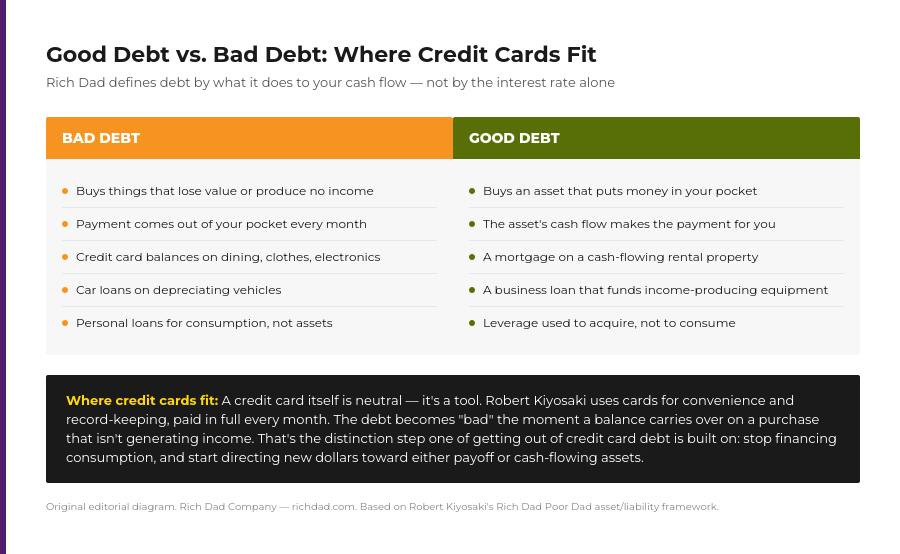
As the comparison above shows, a credit card balance itself is neither good nor bad. It becomes bad debt the moment it carries over on a purchase that isn’t building an asset — dinner out, an impulse buy, a subscription you forgot about. It’s still good debt, however, when it’s financing something that puts money back in your pocket.
So step one is a pledge, not a spreadsheet: from this day forward, don’t charge anything to a card unless you can pay it off when the statement arrives. Every dollar of new spending on a card you’re not paying in full is a dollar working against every other step in this plan.
Step 2: List every card you owe
This is usually the hardest step, especially with a spouse or partner in the picture — opening up fully about spending habits is uncomfortable, more so when you know those habits have touched someone you love. Robert and Kim started their own recovery from over $1 million in debt the same way: by listing everything, out loud, and on paper.
Open a spreadsheet or grab a notebook and write down every card. If you’re tackling all consumer debt rather than just cards, add car loans, personal loans, and any other revolving balances too — the process is identical.
Step 3: Calculate your “Month Number” for each card
Next to every card, record three numbers:
- The total balance owed
- The minimum monthly payment
- The “Month Number” — total balance divided by minimum payment, which tells you roughly how long that card would take to pay off making only the minimum
A $1,500 balance with a $25 minimum payment has a Month Number of 60. A $3,000 balance with a $90 minimum has a Month Number of about 33. This single number is what makes this method different from a plain debt snowball (which ranks by balance size) or a debt avalanche (which ranks by interest rate) — it ranks by how close each card already is to being finished.
Step 4: Choose your payoff order — avalanche, snowball, or Month Number
This is the step where most credit card debt advice diverges, and it’s worth seeing the three approaches side by side rather than picking blind:
- Debt avalanche — Pay minimums on everything, then throw extra money at the card with the highest interest rate first. This method minimizes total interest paid.
- Debt snowball — Pay minimums on everything, then throw extra money at the card with the smallest balance first. This method maximizes early wins and motivation.
- Month Number method — Pay minimums on everything, then throw extra money at the card with the lowest Month Number first. This method balances interest savings with the psychological lift of finishing an account fast.
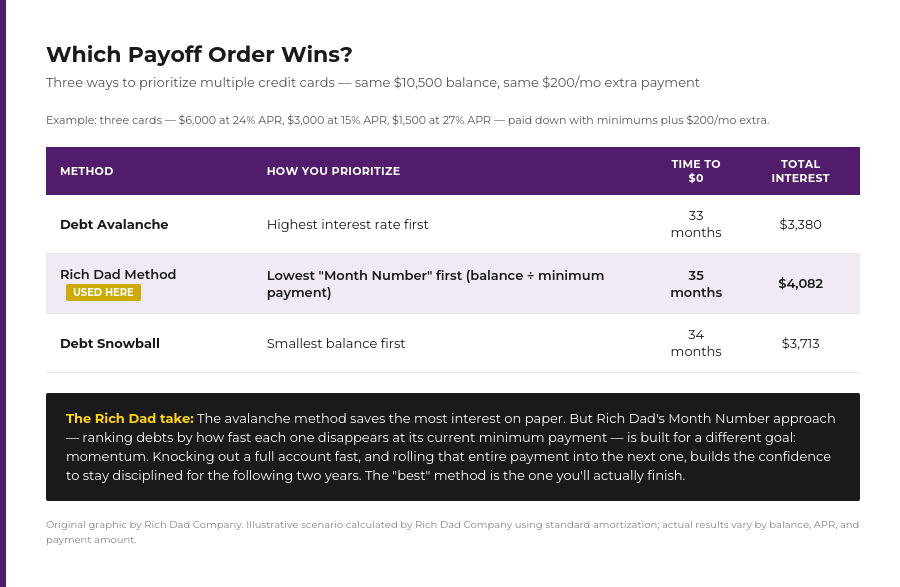
In the scenario above, the avalanche method saves roughly $700 in interest over the Month Number approach — a real, measurable difference. But the behavioral research behind the debt snowball, points to the same conclusion: a payoff plan only works if you stick with it for two or three years straight. If ranking by interest rate feels abstract, and ranking by pure balance size feels arbitrary, ranking by “how soon will this one be gone” gives you a number that’s honest about your minimum payments and still delivers a win early.
Step 5: Find an extra $150–$200 a month
This is the step that actually moves the timeline. When Robert and Kim began digging out of their debt, they knew a single job’s income wouldn’t be enough — the numbers simply didn’t work fast enough. They spent every spare hour building S-quadrant income on the side. That doesn’t mean quitting a day job to chase a dream business; it means finding an extra $150 to $200 a month, from any source, and committing every dollar of it to debt payoff.
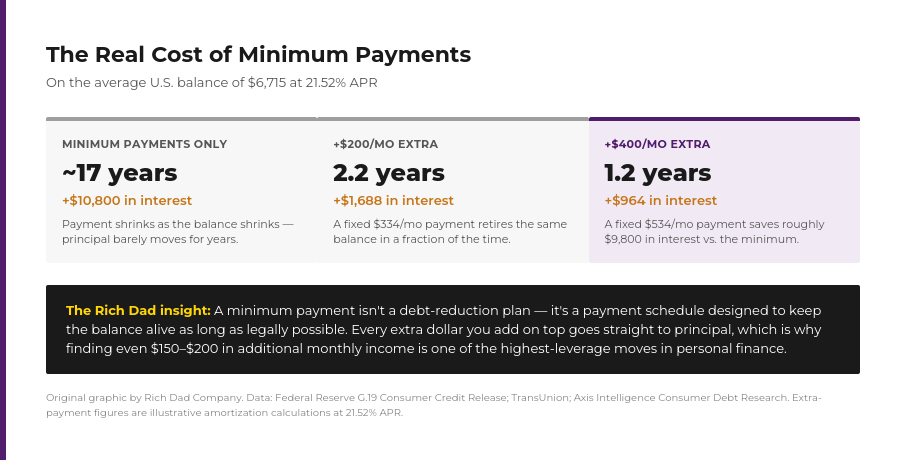
The chart above is the real argument for step five. On the average U.S. balance, minimum payments alone take roughly 17 years and add more than $10,000 in interest, according to compiled Federal Reserve and CFPB data — because the minimum payment shrinks every month right along with the balance, so very little of it ever reaches principal. Adding just $200 a month on top of the minimum cuts that same balance down to about two years. An extra $400 gets it under 15 months. If you haven’t already built a budget to find that money, this is the moment to build one.
Step 6: Attack the first card, then roll the payment forward
Take the extra money from step five and add it to the minimum payment on your first-priority card. If your Month Number 1 card has a $35 minimum and you found $200 extra, you’re now paying $235 a month on that card while continuing minimums on everything else.

Once that first card hits zero, don’t let the money disappear back into your budget. Roll the entire payment — the original minimum plus the extra — onto the next card in your order. This is the mechanic that makes all three methods (avalanche, snowball, and Month Number) accelerate over time: each payoff makes the next one faster, because the payment keeps growing while the number of cards keeps shrinking.
Step 7: Know when consolidation or a balance transfer helps
Debt consolidation and 0% balance transfer cards come up in almost every credit card payoff conversation, and they can genuinely help — with two conditions. A balance transfer only pays off if you can retire the transferred balance before the promotional rate expires, since transfer fees typically run 3–5% of the amount moved and post-promo rates snap back to the 20%+ range. A consolidation loan only makes sense if the new interest rate is meaningfully lower than what you’re currently paying, and only if you stop using the cards you just paid off. Used as a bridge inside the payoff order from step four, either tool can shorten your timeline. Used as a way to avoid making a plan in the first place, both just move the debt around.
Step 8: Celebrate the win, then keep the habit
When your first card hits zero, celebrate it — genuinely. Robert Kiyosaki has always said to celebrate every win. Paying off an entire credit card is a real one. Take your partner to dinner, buy the thing you’ve been eyeing, but pay cash. Then remember step one: the pledge doesn’t expire when the first card does. Loop back through steps four through eight until every balance reads zero, and consider directing the payment you were making toward your last paid-off card into building the kind of savings buffer that keeps you from ending up back here.
When to get outside help
If your total credit card debt is unmanageable relative to your income, or you’re already behind on payments, a do-it-yourself payoff order may not be enough on its own. The Federal Trade Commission recommends calling your card issuer directly to ask about a lower rate or a hardship payment plan before a debt collector gets involved. For a structured, professionally managed plan, the National Foundation for Credit Counseling connects consumers with certified nonprofit counselors who can negotiate directly with lenders and consolidate payments into a single, lower monthly bill. Neither option requires paying a for-profit debt settlement company upfront — a red flag worth avoiding entirely.
FAQs
At the national average balance and interest rate, minimum payments alone stretch payoff to nearly 17 years. Adding $150–$200 a month on top of minimums typically cuts that to two to three years, depending on your starting balance.
The avalanche method saves the most money in interest because it targets the highest interest rate first. The snowball method builds motivation fastest because it clears the smallest balance first. Rich Dad’s Month Number method — ranking by how close each account already is to zero — is a middle path that keeps both interest and momentum in view.
Generally, no. Closing a paid-off card can shorten your credit history and raise your credit utilization ratio, which may lower your credit score. Cutting up the physical card, or removing it from digital wallets, achieves the same “stop spending” goal without closing the account.
Both can help if — and only if — the new rate is genuinely lower and you have a firm plan to pay off the balance before any promotional period ends. Used without a payoff plan, both simply relocate the same debt.
- Stop adding new bad debt to your cards
- List every card and balance you owe
- Calculate the Month Number for each card
- Choose your payoff order — avalanche, snowball, or Month Number
- Find an extra $150–$200 a month and route it to debt payoff
- Attack the first card, then roll its full payment onto the next
- Use consolidation or a balance transfer only if it lowers your rate
- Celebrate every card you pay off, then repeat until you’re debt-free
Bookmark this plan and return to it as often as you need. A mountain of credit card debt doesn’t have to define you — it’s a math problem with a known set of solutions, and you now have three of them to choose from.