The real reason most entrepreneurs fail
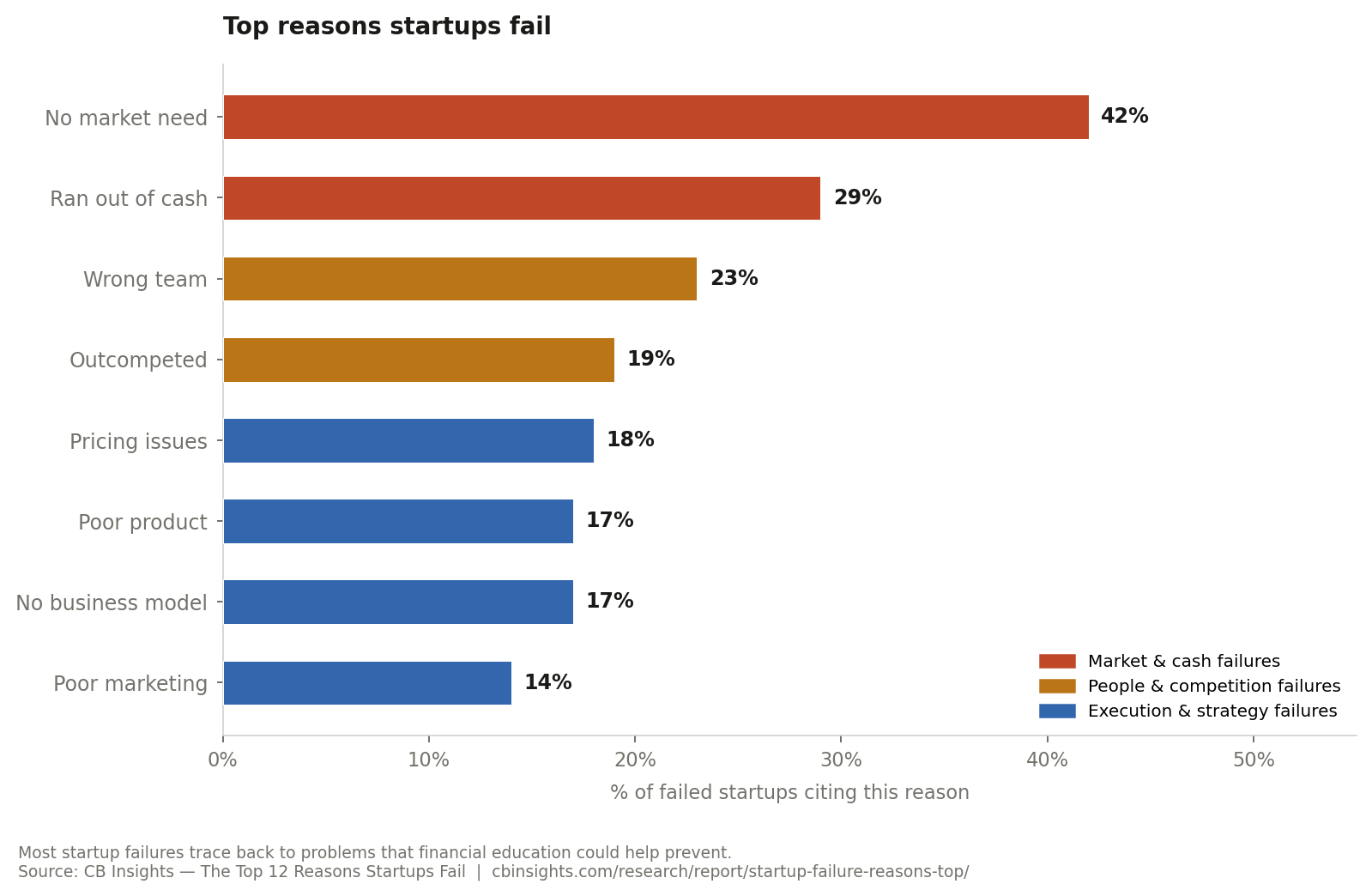
There is a persistent myth that most entrepreneurs fail because they are undercapitalized. While cash flow is always a factor, research from CB Insights analyzing more than 100 startup post-mortems tells a more nuanced story. The single most common reason businesses fail — cited by 42% of founders — is that they built something no one actually wanted.
Running out of cash came second at 29%, and the wrong team ranked third at 23%. Each failure mode points back to the same root cause: a lack of financial education and real-world business preparation. Reading about entrepreneurship is not the same as doing it.Which generation is the most entrepreneurial?
Robert has long argued that the school system trains people to be employees — not entrepreneurs. The instinct to seek a steady paycheck, avoid risk, and follow instructions runs directly counter to what is required to build and sustain a business. The two most teachable and most overlooked skills are cash flow literacy and the ability to build a team — and most business owners enter without either.
What the business survival data actually shows
The popular claim that 90% of businesses fail in their first year is false. According to 2024 data from the U.S. Bureau of Labor Statistics, 79.6% of businesses survive their first year. The more sobering reality is what happens over time.
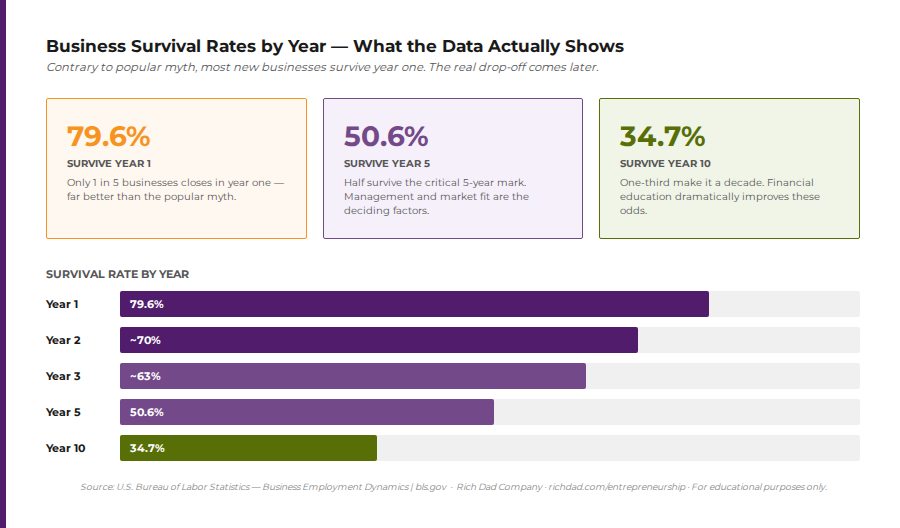
By year five, only 50.6% remain. By year ten, 34.7%. More recent LendingTree analysis tracking through 2025 shows the first-year failure rate has crept to 22.1% — up from 21.5% the prior year — with commercial bankruptcy filings rising alongside it.
These numbers are not meant to discourage. They exist because most entrepreneurs enter business without a financial education, without a clear understanding of cash flow, and without a team. Each of those gaps is closable — but only by those who stay in the game long enough to learn from the experience.
Cash flow is the skill that keeps businesses alive

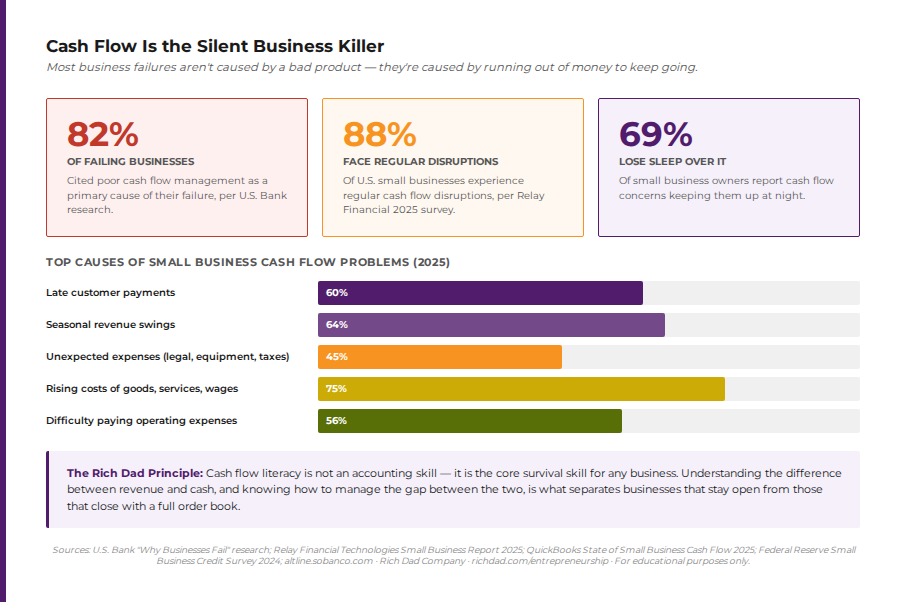
When businesses fail, cash flow is almost always involved — even when it is not the stated reason. A U.S. Bank study on business failure found that 82% of failing companies cited poor cash flow management as a primary cause of their demise. A 2025 Relay Financial survey found that 88% of U.S. small businesses experience regular cash flow disruptions.
Relay Financial Technologies Small Business Report 2025,
QuickBooks State of Small Business Cash Flow 2025,
Federal Reserve Small Business Credit Survey 2024,
2025 Small Business Credit Survey
According to the 2025 Small Business Credit Survey, 75% of small businesses cite rising costs as their top financial challenge, 56% report difficulty paying operating expenses, and 51% struggle with uneven cash flow. These are not exotic problems. They are predictable, recurring pressures that financial education — specifically, cash flow literacy — can prepare a business owner to manage.
Rich dad taught Robert to always ask one question: “Where is the cash?” Not the revenue. Not the profit margin. The cash — the money actually available in the account, today. A business can show a healthy profit on paper and still fail because its customers have not yet paid. Understanding the difference between revenue, profit, and cash is not accounting theory. It is the survival skill every business owner must develop.

The financial education gap — what business schools don’t teach
The U.S. Census Bureau recorded nearly 5.8 million new business applications in 2024 — a record. Yet business survival rates have not meaningfully improved. The problem is not the number of people starting businesses. It is the preparation they bring to it.
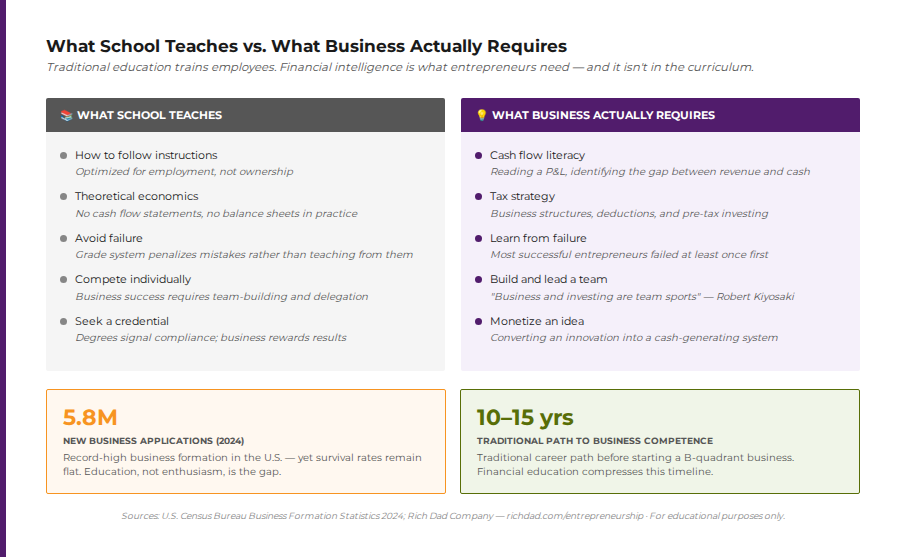
Traditional education trains people to follow instructions, avoid failure, and seek credentials. Business requires the opposite: independent judgment, tolerance for uncertainty, and the specific financial skills — reading a P&L, managing a balance sheet, understanding tax strategy — that most schools never teach. As Kiyosaki wrote, rich dad’s lesson was not about product. It was about systems and financial intelligence.
The Global Entrepreneurship Monitor 2024/2025 report notes that in roughly 84% of economies, more than 40% of people who see a good business opportunity still would not start because of fear of failure. Fear is not the core problem. The absence of financial education that would make the risk manageable is. When founders understand their numbers — when they can read a cash flow statement, structure a business entity properly, and build a team of advisors — the fear has something to push against.
Who actually builds a lasting business
The data on entrepreneurship consistently challenges popular assumptions about who succeeds. According to a report in Entrepreneur magazine by entrepreneur David Meltzer, the average age of a successful entrepreneur is 40, with at least six to ten years of relevant industry experience. The fastest-growing group of new entrepreneurs is people aged 55 to 65. A high-growth company is twice as likely to be started by someone over 55 than by someone aged 20 to 34.
This is not a coincidence. What those founders have accumulated is not just experience in their industry — it is scar tissue from real business decisions, real cash flow crunches, and the kind of street-smart financial literacy that only comes from operating a business. The Rich Dad community has always attracted people who recognize that trading time for money is a finite strategy and that building a business is how that pattern gets broken.
Rich dad’s three rules for staying in business
Robert’s rich dad offered deceptively simple advice: do more and talk less. His first rule for business success was never the most glamorous. It was this: stay in business.
Every strategy, every hiring decision, every product launch should be evaluated first through the lens of whether it keeps the business alive tomorrow. Long-term goals are irrelevant if the company does not survive the next 90 days. This is a discipline most aspiring entrepreneurs never develop because they never actually run a business long enough to need it.

Rich dad’s second rule was to understand the difference between innovation and entrepreneurship. Innovation is the act of making an idea real. Entrepreneurship is the act of monetizing it. The most successful business owners are often not the most creative people in the room — they are the best at identifying which ideas can generate consistent cash flow and then building systems to deliver that cash flow repeatedly.
The third rule is to diversify within the business itself. Rather than concentrating every resource on a single initiative, sophisticated business owners structure multiple revenue lines, knowing that if even one succeeds at scale, it can underwrite the learning costs of the others. This is a financial intelligence skill, not a personality trait.
Building the financial characteristics of a successful entrepreneur
Research from the University of Minnesota and online MBA programs consistently identifies five core characteristics shared by entrepreneurs who build lasting businesses: flexibility, self-motivation, resilience, collaboration, and a willingness to learn. Of these, resilience is the strongest predictor of survival. Rich dad called it guts.
Cash flow literacy is the financial characteristic most entrepreneurs lack at launch. The ability to read a profit and loss statement, understand the difference between revenue and cash, manage a balance sheet, and structure the business for tax efficiency are not optional. They are the line between a business that stays open and one that fails with a full order book — profitable on paper, broke in the bank.
Rich Dad’s entrepreneurship education emphasizes financial intelligence alongside real-world action, not instead of it. Robert Kiyosaki launched a wallet business early in his career and talked about it extensively. He did not do the hard work of managing its finances. The company failed. He went $1 million into debt. Rich dad did not bail him out — he gave him the painful truth that the failure was his own. That experience became the foundation for everything Rich Dad teaches about business.
Start moving toward business success right now
Being a success in business does not begin with a great idea or a perfect business plan. It begins with an honest assessment of the financial knowledge you bring to the enterprise — and a commitment to closing the gaps that the data consistently shows will sink you: no market fit, no cash flow management, no team.
Rich Dad recommends starting with the CASHFLOW board game as a practical, low-stakes simulation of business and investing decisions. Beyond that, the path requires doing: launching something, managing its finances, failing at some things, learning, and continuing. The 5.8 million Americans who filed business applications in 2024 is not the problem. What most of them lack — and what Rich Dad’s platform exists to provide — is the financial intelligence to survive long enough to succeed.
The question of how to be a success in business does not have a shortcut. The data is clear: most businesses that fail do so because of preventable problems — no market need, poor cash management, the wrong team. Each of these is addressable with the right financial education. Anyone can build a successful business. But only those who actually do the work — and learn the numbers — will find out.
Building a successful business is a mindset
Business success is not a mindset. It is not a badge. It is not something that comes from reading about other people’s companies. It comes from building your own — making financial decisions under pressure, managing cash flow, building a team, serving customers, and refusing to quit when the going gets hard.
Rich Dad has always held that the real separator between businesses that survive and those that do not is not the quality of the idea — it is the quality of the financial education the founder brings to executing it. Do more. Talk less. Learn the numbers. Stay in the game.
FAQs
CB Insights research analyzing 100+ startup post-mortems found 42% of businesses fail for lack of market need. The second most common cause was running out of cash (29%), then the wrong team (23%). Each traces back to insufficient financial education and real-world preparation.
A business can show healthy profit on paper and still fail if customers have not yet paid. When cash is not available to cover payroll or operating expenses, the business can close despite a positive P&L. U.S. Bank research found 82% of failing businesses cited poor cash flow management as a contributing cause. Understanding the gap between revenue, profit, and actual cash on hand is the core survival skill of business ownership.
Financial education — specifically, the ability to read financial statements, manage cash flow, minimize taxes through proper business structures, and build a team of advisors — is the primary determinant of whether a business survives its early years. The school system does not teach these skills. Rich Dad’s entrepreneurship platform exists specifically to close that gap.
According to research cited in Entrepreneur magazine, the average successful entrepreneur is 40 years old with six to ten years of relevant industry experience. The fastest-growing group of new entrepreneurs is 55 to 65. A high-growth business is twice as likely to be started by someone over 55 than by someone in their twenties. Experience — including real financial experience — is the variable that matters most.
There is no single timeline, but BLS data shows 50.6% of businesses are still operating at five years and 34.7% at ten years. Traditional paths to business competence took 10–15 years. Financial education — applied to real business experience — compresses that timeline by providing the cash flow, tax, and team-building frameworks that most founders learn only through costly trial and error.