Is school a scam? The short answer
Search for “is school a scam” and you will find angry opinions on both sides. The honest answer is that school is not a scam, but it is incomplete. The message behind Rich Dad’s “go to school” lesson has never been that education is worthless. It is that a good school and good grades do not, on their own, teach you what to do with money.
That distinction matters because the idea gets flattened online. Robert Kiyosaki is often described as someone who told people to skip school. In fact, he attended college and graduated from the U.S. Merchant Marine Academy at Kings Point, as you can read in his biography. What he questions is the promise that school alone is the path to financial security.
Why the “scam” label sticks
The word “scam” sticks because many people feel misled. They were told that a degree guaranteed a good job, then graduated into debt and a tight job market. Others see classmates who did everything right and still live paycheck to paycheck. Rich Dad does not dismiss that frustration. It treats it as evidence that the promise was incomplete, not that education itself is fraudulent. A promise that leaves out how debt, taxes and investing work will always disappoint some of the people who trusted it.
What Rich Dad means by “go to school”
In Rich Dad Poor Dad, the “go to school, get good grades, find a safe job” advice comes from Poor Dad, the highly educated parent who struggled with money his whole life. Rich Dad’s counterpoint was that this path is built to produce employees. It is a fine path for doctors, pilots and engineers. It is a weak plan for anyone who wants their money to work for them.

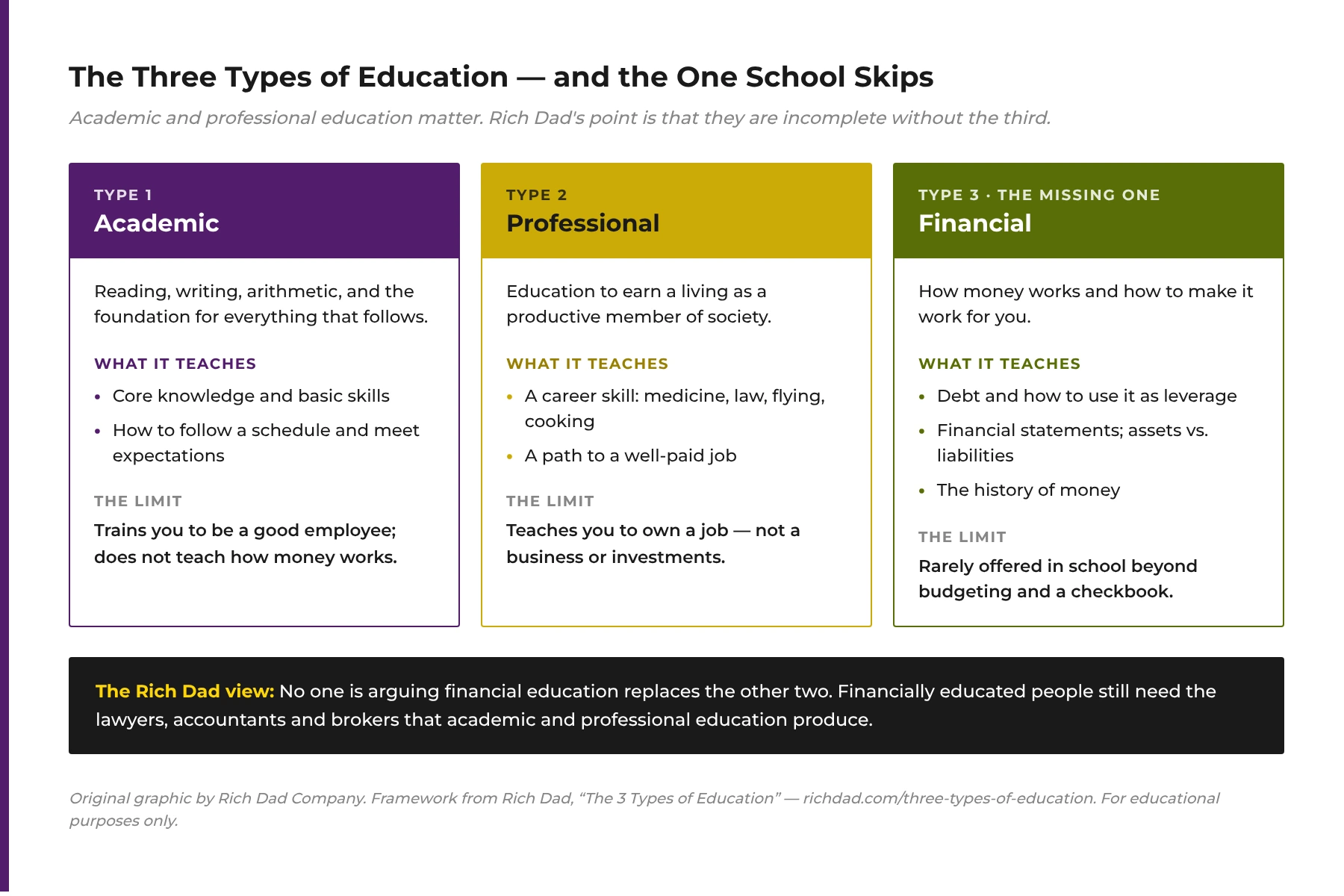
Rich Dad frames this as three types of education, which you can explore in more depth in our guide to the three types of education. Academic education teaches reading, writing and math. Professional education teaches you to earn a living. Financial education teaches how money works. School delivers the first two well and the third rarely.
Why financial education is still the missing piece
Most students leave school able to write an essay and unable to read a balance sheet. They may never be taught the difference between an asset and a liability, how debt can work as leverage or as a trap, or how taxes change what they keep. Rich Dad argues that these skills decide outcomes more than a transcript does.
No one is arguing financial education replaces the other two kinds. Financially educated people still hire the lawyers, accountants and brokers that academic and professional education produce. The claim is that all three work together.
Does education still pay? What the data says
It would be dishonest to talk about school without looking at the numbers. In 2025, full-time workers with a bachelor’s degree had median usual weekly earnings of $1,578, compared with $966 for workers with only a high school diploma, according to the U.S. Bureau of Labor Statistics. Their unemployment rate was 2.8%, against 4.3% for high school graduates. Workers with doctoral and professional degrees earned more than $2,290 a week.
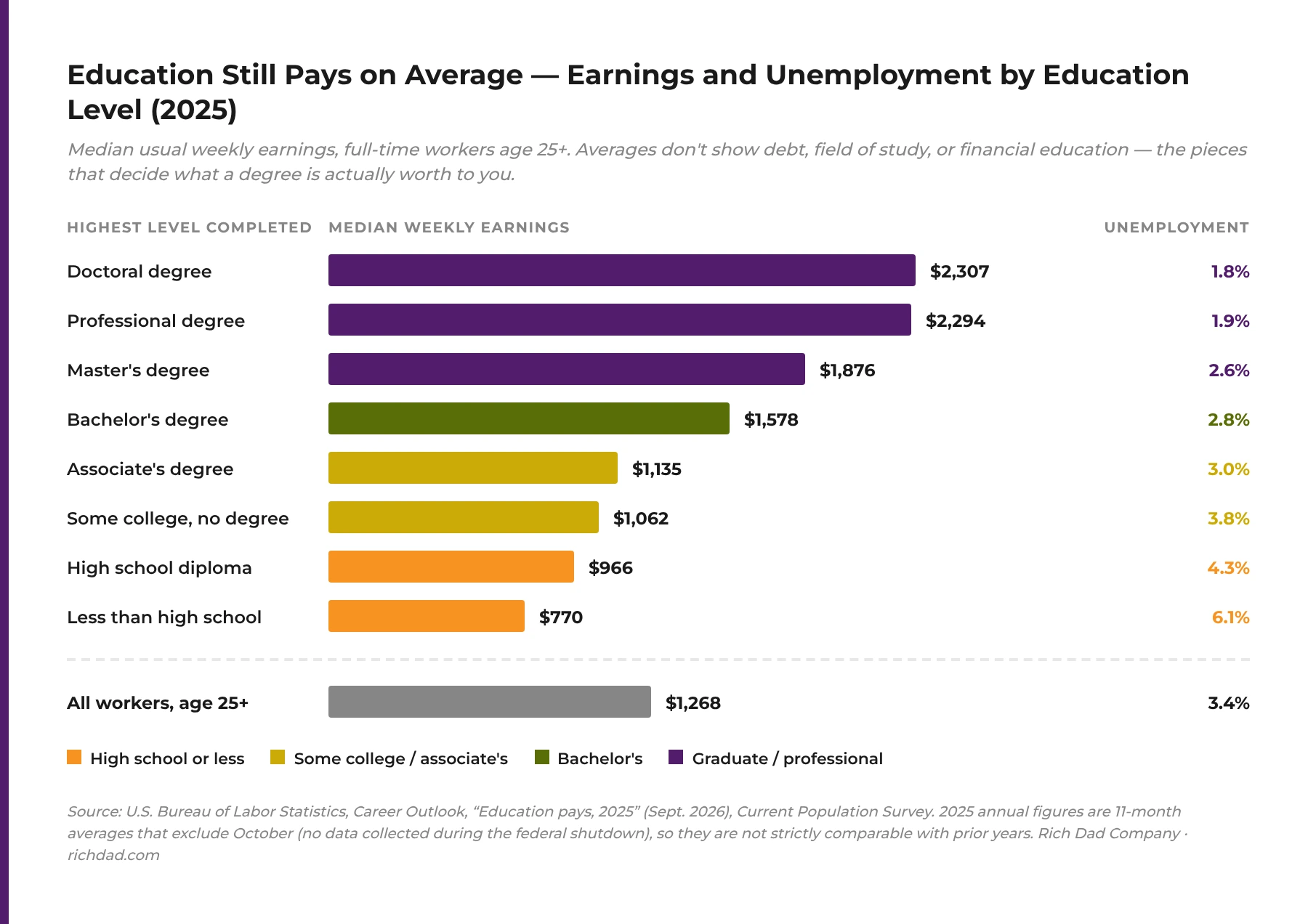
Those are averages, and averages hide a lot. They do not show how much a person borrowed, what they studied, or what they did with their income once they earned it. A high earner who spends everything and owns no assets is still dependent on the next paycheck. That is the gap Rich Dad is pointing at, and it is why “school pays” and “school is incomplete” can both be true.
The cost side: Tuition, debt and risk
The price of the investment is where the “scam” feeling comes from. The College Board reports that published tuition and fees for 2026-27 average $4,210 at public two-year colleges, $12,290 at in-state public four-year colleges and $46,350 at private nonprofit four-year colleges. After grants and tax benefits, the estimated net price is far lower: about $1,920 for in-state public four-year students and $17,280 at private nonprofit schools. At public two-year colleges, average grant aid has covered tuition and fees since 2009-10.
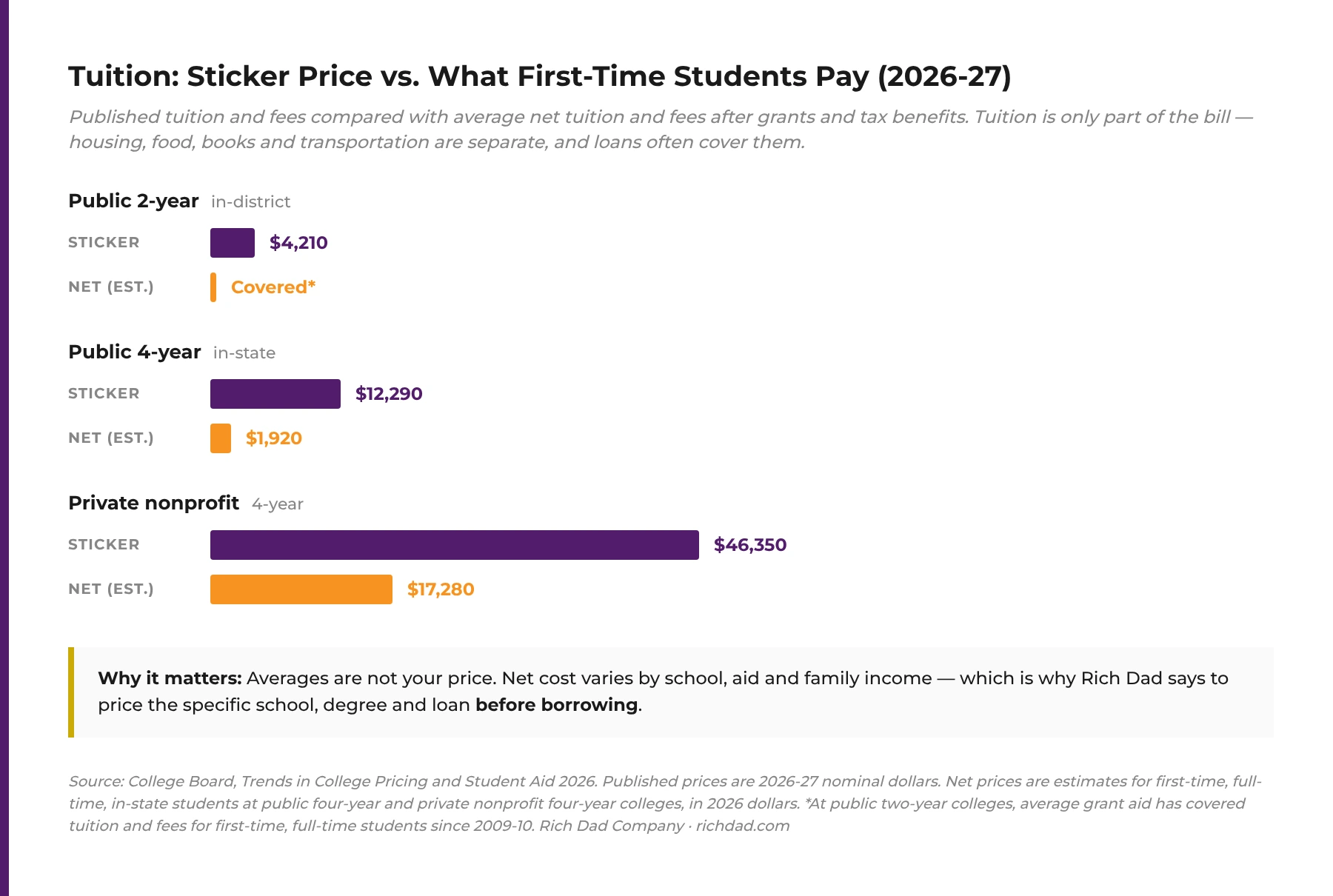
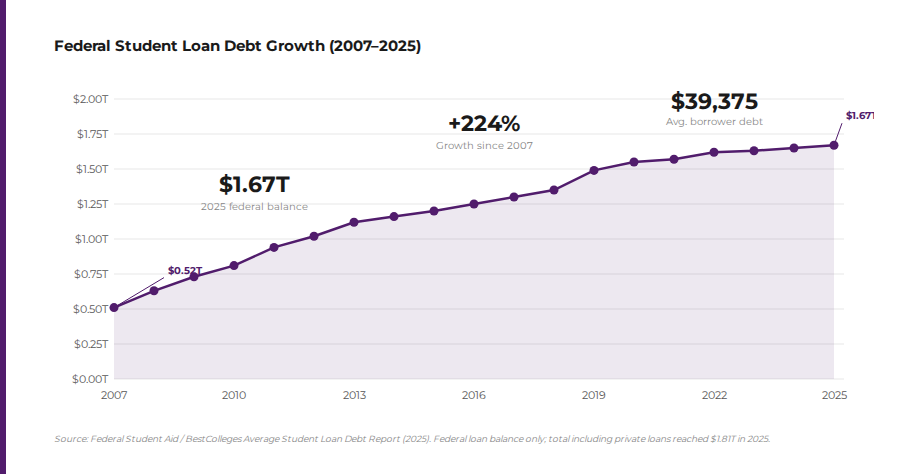
Tuition is only part of the bill, though. Housing, food, books and transportation are separate, and loans often cover them. This is where debt becomes a problem. Federal student loan debt reached roughly $1.67 trillion in 2025, up about 224% since 2007, and the average borrower owes about $39,375.
The entry-level squeeze
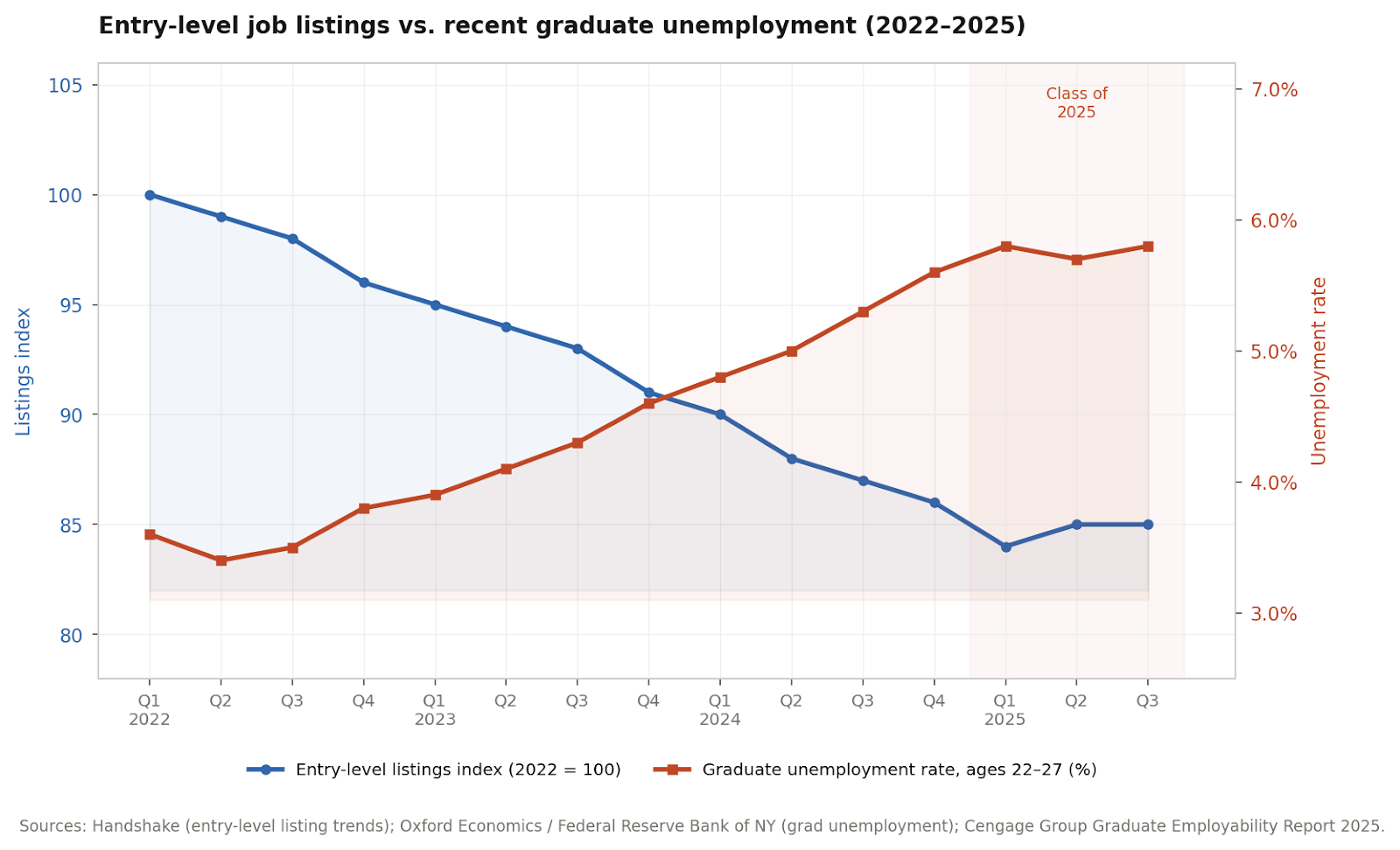
The return on a degree also depends on the job market a graduate walks into. Entry-level job listings have fallen about 15% since early 2022, while unemployment among recent graduates ages 22 to 27 has climbed from roughly 3.5% to about 5.8%. A degree is still an advantage on average. It is not a guarantee, and it carries more risk when it is paid for with borrowed money.
How to decide whether a degree is worth it
Rich Dad’s approach is to treat education like any other investment: know what it costs, what it is likely to return and what happens if it does not work out. If you are weighing a specific program, our guide on whether college is worth it walks through that decision in detail. A few questions help:
- What is the net price of this specific school and program, not the sticker price?
- What do graduates of this program typically earn, and how many find work in the field?
- How much would I borrow, and could I repay it on an entry-level salary?
- Is there a lower-cost path, such as community college first, that gets me to the same credential?
- What will I learn about money alongside the degree, and where will I get it if school does not teach it?
Building financial education alongside school
Rich Dad’s advice is not to choose between school and financial education. Keep the credential if your career requires it, and add the money skills yourself. Learn to read your own financial statements. Track whether your income is coming from a paycheck, a business or assets. Practice with small investments before you make large ones. Financial education compounds just as academic and professional education do, and you can start it at any age, with or without a degree.
The people who struggle most are not the ones who went to school. They are the ones who assumed school had already taught them everything they needed to know about money.
Conclusion
Is school a scam? No. The data shows education still pays on average, and Robert Kiyosaki himself attended college. The more useful question is whether school is enough. Rich Dad’s answer is that it is a strong foundation for earning a living and a weak foundation for building wealth, unless you add the financial education that school rarely provides. Price your education carefully, borrow with discipline and keep learning how money works.
FAQs
No. Education still pays on average, with higher earnings and lower unemployment at each higher level of attainment. Rich Dad’s criticism is that school is incomplete because it rarely teaches financial education.
Yes. Robert Kiyosaki graduated from the U.S. Merchant Marine Academy at Kings Point and later served in Vietnam as a Marine Corps pilot.
No. Rich Dad’s message is that academic and professional education are valuable but incomplete without financial education. He encourages people to be deliberate about the cost and return of a degree.
Financial education is knowing how money works: assets versus liabilities, how to read financial statements, how debt and taxes work, and how to make money work for you.
Compare the net price of the specific program with typical graduate earnings, and be realistic about how much you would borrow relative to a likely starting salary.