
What does a financial planner do?
A financial planner takes a whole-life view of money. That means building a personal financial statement, projecting retirement needs, coordinating tax strategy, structuring an estate plan, and reviewing insurance coverage — not just picking investments. A CFP typically works through a defined process: gather data, identify goals, analyze the current financial position, develop recommendations, implement them, and monitor progress over time.
This is different from what most people picture when they hear “financial guy.” A financial planner is not primarily a stock picker. Stock and portfolio selection is usually one piece of a much larger plan that also covers debt payoff order, tax-advantaged account sequencing, business entity structure for the self-employed, and what happens to assets when the planner’s client dies.
Financial planner vs. financial advisor: Why the difference matters
The terms get used interchangeably in casual conversation, and even inside the financial industry the lines blur. But the practical differences are significant enough to justify treating them as two different hiring decisions.

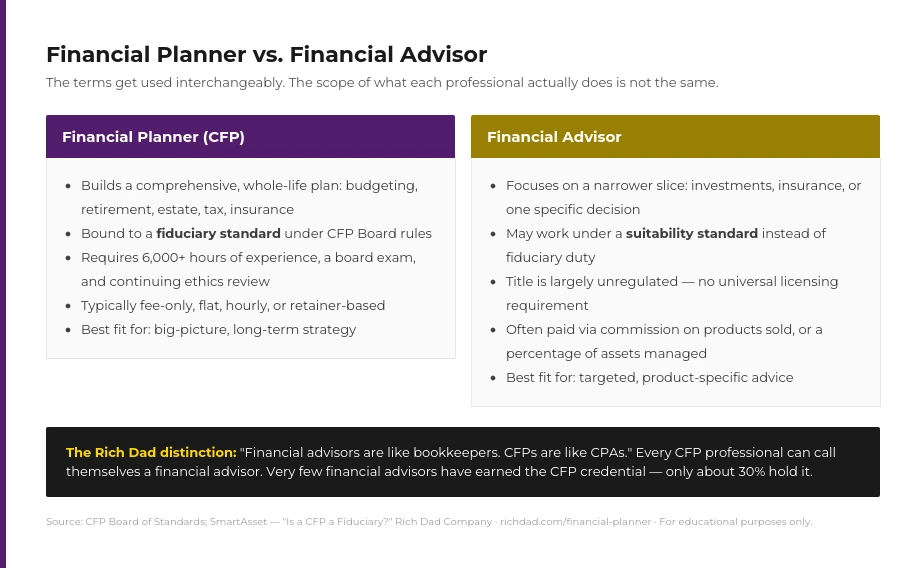
A financial advisor is a broad umbrella term. It can describe a Certified Financial Planner, a stockbroker, an insurance agent, or a bank representative selling in-house mutual funds — all under the same title, with wildly different obligations to the person paying them. A Certified Financial Planner has cleared a specific bar: a bachelor’s degree, a comprehensive board exam, 6,000 hours of professional experience (or 4,000 hours under an approved apprenticeship), and an enforceable commitment to the CFP Board’s fiduciary standard. Roughly 230,000 people hold the CFP mark worldwide, with more than 100,000 in the United States — a small fraction of the estimated 330,000-plus personal financial advisors working in the country.
Every CFP professional can accurately call themselves a financial advisor. Very few financial advisors have earned the CFP credential. That asymmetry is exactly why verifying the credential matters more than trusting the job title on a business card.
Fiduciary vs. suitability: The standard that actually protects you
This is the single most important distinction in the entire hiring decision. A fiduciary is legally required to act in the client’s best interest, full stop, even when a better-paying option exists for the advisor. A non-fiduciary financial advisor may only be held to a “suitability” standard — meaning a recommendation just has to be appropriate for the client, not necessarily the best available option.
In practice, suitability standards create room for an advisor to recommend a fund that pays them a higher commission over a comparable fund that pays them nothing extra, so long as both funds are “suitable.” A fiduciary cannot do that. CFP professionals are contractually and ethically bound to fiduciary duty under the CFP Board’s Standards of Conduct — one more reason the credential is worth confirming before a first meeting, not after.
What a financial planner costs in 2026
Fee structure shapes incentives as much as the dollar amount does. Four models dominate the profession, and each creates a different relationship between what the planner gets paid and what actually happens to a client’s money.
The assets-under-management (AUM) model — still the industry default — charges roughly 0.96% of managed assets annually, according to the 2026 State of Financial Planning Fees study from Envestnet | MoneyGuide. On a $1 million portfolio, that is about $9,600 a year, rising automatically as the account grows, regardless of whether the underlying workload grows with it. Flat-fee planning, increasingly common among fee-only fiduciaries, averages $2,926 for a standalone comprehensive plan. Hourly engagements average $307 per hour and suit narrow, one-off questions rather than ongoing management. Retainer or subscription models — paid whether or not assets are under the planner’s management — average $6,815 per year.
None of these numbers determines value on its own. A $15,000 annual retainer that restructures a business sale, sequences a decade of Roth conversions, and coordinates a client’s CPA and attorney can be a bargain. A 1% AUM fee on a simple, static portfolio that needs almost no ongoing attention can be expensive for what it delivers. The fee model is worth negotiating on its own terms, separate from whether the planner is worth hiring at all.
The B.E.A.R. Trap: How the rich go broke
Certified Financial Planner John MacGregor spent decades advising wealthy clients before writing “The Top 10 Reasons the Rich Go Broke: Powerful Stories that will Transform Your Financial Life…Forever”, a collection of failure stories rather than success stories — because, as MacGregor puts it, real learning happens in the mistakes, not the wins.
One story from the book illustrates the pattern clearly. Luke and Sue moved to San Diego in the 1990s after Luke landed a well-paying corporate promotion, with stock options, bonuses, and a company pension on top of a six-figure monthly income. They were relatively well positioned for retirement — until the dot-com boom convinced them to abandon MacGregor’s advice, disregard his caution about companies with no real assets and no earnings to justify their valuations, and put nearly their entire savings into tech stocks on their own. When the bubble burst, they lost most of it. When Luke’s employer was hit hard following 9/11, he lost his job, his remaining stock options went worthless, and the pension he had built his retirement around dissolved with the company.
Run through the B.E.A.R. framework, their story reads as almost inevitable. Belief: “My company will take care of me.” Excuse: “As long as I have my job, I’ll be fine.” Action: no planning for a downside scenario, and a decision to override a fiduciary planner’s caution in pursuit of a speculative bubble. Result: a six-figure monthly income evaporated within a matter of months, with no cash-flowing assets left standing to replace it.
How to choose the right financial planner
Vetting a planner before hiring one is not optional due diligence — it is the entire point of hiring a fiduciary in the first place. Five questions do most of the work.

Start with fiduciary status, and get the answer in writing inside the engagement letter, not as a verbal assurance in a first meeting. Confirm CFP certification directly through the CFP Board’s free verification tool at cfp.net rather than taking a business card at face value. Ask for a complete breakdown of how the planner is compensated — fee-only, fee-based, or commission — since each creates a different set of incentives. Ask about specialty and track record, since a planner who mainly serves retirees drawing down a portfolio is not necessarily the right fit for a real estate investor building one. And ask how the planner works with the rest of a financial team — a CPA, an attorney, an insurance specialist — since the best planners coordinate rather than operate in isolation.
Financial planning 101: The foundation under every recommendation
No financial planner, however qualified, can build a sound plan on a client’s misunderstanding of basic terms. Luke and Sue repeatedly told MacGregor they were financially secure because they owned two condos and a house. What they had not grasped is the difference between an asset and a liability: an asset puts money into a pocket every month; a liability takes money out. Their real estate holdings were not paid off, generated no monthly income, and required cash out of pocket to maintain — the textbook definition of a liability, however valuable the properties looked on paper.
This distinction is the foundation any financial planner should be working from, whether the client is evaluating a rental property, a whole life insurance policy, or a primary residence. A planner’s job is to help build a plan around cash-flowing assets, not to validate the belief that accumulating expensive things is the same thing as building wealth.
Being an employee is riskier than it looks
Luke and Sue’s story also illustrates a point Rich Dad has made for decades: undying faith in employer-provided security is itself a financial risk. Being an employee is not necessarily safer than the alternatives — it simply concentrates risk in a single source of income that an employer, not the employee, ultimately controls. When hard times arrive, employers protect the business first. A financial plan built entirely around continued employment and an employer-funded pension has no backup when that assumption fails, which is precisely what happened to Luke.
A financial planner worth hiring will stress-test that assumption directly — running “what if this income stopped tomorrow” scenarios rather than simply optimizing an investment mix around the assumption that it won’t.
Make the right hire
Hiring a financial planner is a decision with real leverage: get it right, and a qualified fiduciary can prevent the exact kind of collapse that ended Luke and Sue’s comfortable retirement. Get it wrong — hire based on title alone, skip the fiduciary and credential check, or hand over decision-making without understanding the fee structure — and the professional relationship can accelerate the same mistakes it was supposed to prevent. The five-question filter, the fiduciary standard, and a clear understanding of the difference between a financial planner and a financial advisor are the tools that make the difference. John MacGregor’s book offers ten more stories in the same vein, each one a cautionary tale worth reading before, not after, choosing who gets a hand on the wheel.

FAQs
A financial planner — typically a Certified Financial Planner (CFP) — builds a comprehensive plan across budgeting, investing, taxes, and estate planning, and is bound to a fiduciary standard. “Financial advisor” is a broader, less regulated title that can apply to anyone offering financial guidance, including those held only to a suitability standard rather than a fiduciary one.
Costs vary by fee model: assets-under-management fees average 0.96% annually (about $9,600 a year on a $1 million portfolio), flat-fee comprehensive plans average $2,926, hourly rates average $307, and retainer or subscription models average $6,815 per year, according to the 2026 State of Financial Planning Fees study from Envestnet | MoneyGuide.
Yes. The CFP Board’s Standards of Conduct require every certified CFP professional to act as a fiduciary when providing financial advice, meaning they are legally and ethically bound to put a client’s interests ahead of their own compensation.
Not necessarily for investment selection alone, but a financial planner adds the most value in areas outside day-to-day portfolio management: tax strategy across income types, estate planning, insurance review, and coordinating a broader financial team. Self-directed investors evaluating specific asset classes may get more value from targeted financial education than from a full planning engagement.
The CFP Board offers a free verification tool at cfp.net that confirms whether an individual currently holds an active CFP certification in good standing, rather than relying on a title printed on a business card or website.
At minimum: whether they are a fiduciary (get it in writing), whether they hold the CFP certification (verify independently), exactly how they are compensated, what their specialty and track record look like, and how they coordinate with the rest of a client’s financial team — a CPA, attorney, or insurance specialist.