
Why financial literacy for kids still starts at home
According to the TIAA Institute and the Global Financial Literacy Excellence Center (GFLEC), which have tracked adult financial literacy every year since 2017, U.S. adults correctly answered just 47% of questions on the 2026 P-Fin Index — the lowest score in the survey’s ten-year history. Gen Z, the generation now moving through high school and into early adulthood, answered only 38% of questions correctly, the weakest showing of any generation measured.
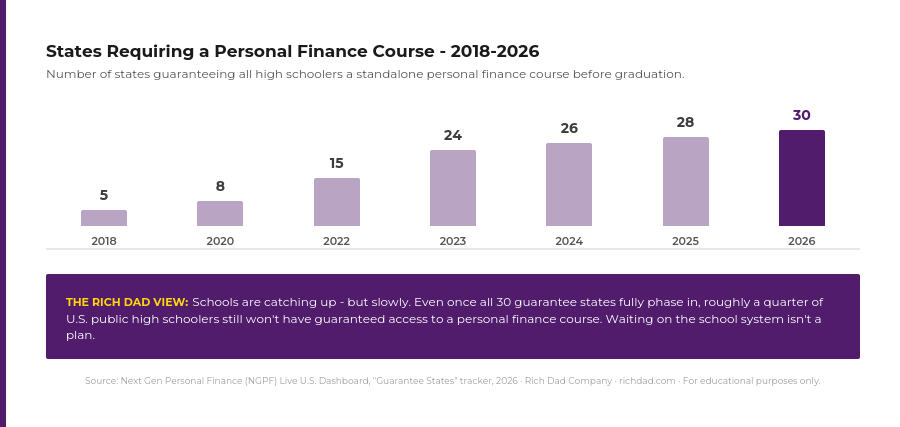
The slow rollout of personal finance education in schools hasn’t kept pace with the problem. As of 2026, 30 states guarantee high schoolers a standalone personal finance course before graduation, according to the Next Gen Personal Finance Live U.S. Dashboard — up from just 5 states in 2018. The Council for Economic Education’s 2026 Survey of the States counts an even broader 39 states requiring personal finance in some form. Either way, once every current law fully phases in, roughly three in four U.S. public high schoolers will be required to take a course — leaving one in four without one.Financial literacy in the United States
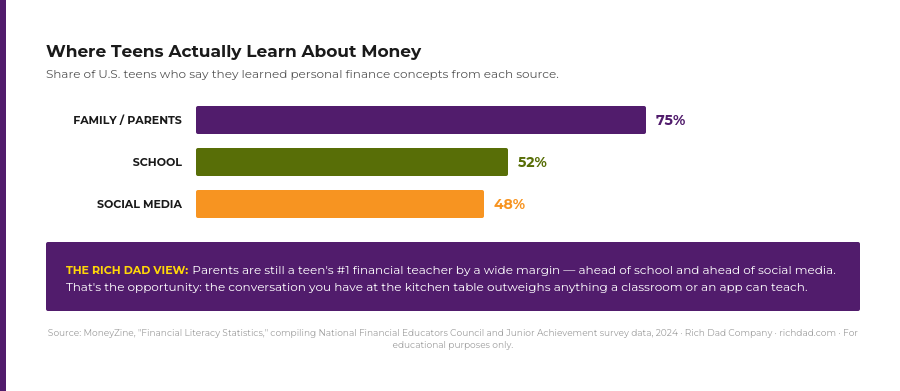
Even where schools do their part, most kids still aren’t learning about money in a classroom in the first place. Family conversations remain a teenager’s single biggest source of financial knowledge — well ahead of school and social media.
The trouble is that most parents wait too long to start. In a T. Rowe Price survey of over 1,000 parents, only 4% had discussed money with their kids before age 5, while 30% waited until their child turned 15 or older — and 14% never had the conversation at all. Warren Buffett has pointed to this exact pattern as the single biggest mistake parents make: waiting until the teen years instead of starting in preschool, when researchers say children are already capable of grasping basic money concepts. By age 7, the habits that shape lifelong financial behavior are largely in place.
The four foundations of financial literacy for kids
Rich Dad has been teaching the same four foundational concepts for decades. None of them require a textbook — they require a parent willing to explain them consistently, using real examples from everyday family life.
1. Understand the difference between an asset and a liability

This is the core of the entire Rich Dad philosophy, and it’s the first thing kids should learn. An asset is something that puts money into your pocket. A liability takes money out of it. Many adults get this wrong — including the common assumption that a home is automatically an asset. As has been long explained, a house is a liability as long as it comes with a mortgage, insurance, and upkeep; it only becomes an asset once it generates income, such as rent from a tenant that covers the expenses. Teaching a child to ask “does this put money in my pocket, or take money out?” about every purchase, gift, or allowance dollar builds the single most important financial habit of their life.
2. Cash flow vs. capital gains
Kids should understand early that these two ways of making money are not the same thing. Capital gains — profit from selling something for more than you paid — depend on guessing correctly about a future price, which can be closer to gambling than investing. Cash flow, by contrast, is money that shows up on a regular schedule — rent collected after expenses are paid, a dividend, or profit from a small business — regardless of what happens to the asset’s price. A lemonade stand that nets $10 in profit every Saturday is teaching a child cash flow. A pack of trading cards bought hoping to resell it later for more is teaching them capital gains speculation. Both are useful lessons, but kids should learn to tell them apart.
3. Get rich by using debt and taxes — not by fearing them
Financially literate kids learn that debt and taxes aren’t inherently bad — they’re tools that behave differently depending on how they’re used. Bad debt finances things that lose value and never pay for themselves, like a car loan on a depreciating vehicle. Good debt finances things that put money in your pocket, like a rental property whose tenant covers the mortgage. Tax codes work the same way: they’re written to reward specific behaviors — building housing, hiring employees, saving for retirement — and the earlier a child understands that taxes are a set of incentives rather than a punishment, the better equipped they’ll be to use that system instead of just paying into it.
4. Own your financial decisions
One of the most damaging financial habits a child can develop is outsourcing decisions to whoever is loudest — friends, advertisers, or social media trends. Financial literacy for kids has to include the confidence to think independently about money. Kids who are taught to ask questions, compare options, and make their own calls — even small ones, like whether to spend an allowance now or save it for something bigger — grow into adults who don’t need someone else to make their financial decisions for them.
Teaching kids the CASHFLOW Quadrant
Once a child understands assets, liabilities, and cash flow, the natural next lesson is Robert’s CASHFLOW Quadrant — a simple way of showing where income actually comes from. The quadrant has four letters: E for employee, S for self-employed, B for business owner, and I for investor. The left side of the quadrant (E and S) trades time directly for money and carries the highest tax burden. The right side (B and I) is built on assets and systems that can generate income without trading additional hours for it.
School generally prepares kids exclusively for the left side of the quadrant — “go to school, get good grades, get a good job” — without ever mentioning the right side exists. Kids don’t need to master entrepreneurship or investing by age twelve. They just need to know, early, that more than one path is available, and that the goal is to move from the left side of the quadrant toward the right.

Age-by-Age: How to teach financial literacy for kids at every stage
Financial literacy for kids isn’t a single conversation — it’s a series of age-appropriate lessons that build on each other over years.
Ages 3–6: Build the vocabulary
At this age, the goal is simple exposure, not instruction. Let kids see and handle money, count coins, and hear the words “spend,” “save,” and “give” in everyday conversation. A three-jar system — one for spending, one for saving, and one for giving — turns an abstract concept into something a preschooler can physically sort.
Ages 7–11: Introduce assets, liabilities, and choice

Elementary-age kids are ready for the asset-vs-liability conversation in concrete terms: a toy that just sits in a closet is a liability; a lemonade stand or a dog-walking gig that brings in money is an asset. This is also the age to introduce an allowance tied to chores — separate from unconditional allowance — so kids connect earning with effort. Games built specifically for this age group, like CASHFLOW® for Kids, turn these lessons into play instead of lecture.
Ages 12–17: Practice with real stakes
Teenagers can handle real budgeting, a first bank account, and a first job or side hustle. This is the age to walk through a real household bill together, explain how a paycheck differs from a business’s or investor’s income, and introduce the CASHFLOW Quadrant directly. Free tools like CASHFLOW® Classic, the online version of Rich Dad’s investing game, let teens practice buying assets and managing cash flow with zero real-world risk before they ever put actual money on the line.
Make it a game: Teaching financial literacy for kids through play
Because playing games is one of the most effective ways for kids — and adults — to learn, Rich Dad has built its financial education tools around play rather than lectures:
- CASHFLOW® for Kids (recommended for ages 6–14) teaches children how to acquire assets and build cash flow through hands-on gameplay.
- CASHFLOW® Classic is the free online version of Rich Dad’s flagship investing game, ideal for tech-savvy teens who want to practice with a global community of players.
- Rich Dad Poor Dad for Teens adapts Robert Kiyosaki’s core lessons — assets, entrepreneurship, and financial confidence — for a teen reading level.
- Rich Kid Smart Kid gives parents a guide for raising a child’s financial IQ from the ground up.
For a deeper look at the specific challenges — rising college debt, inflation, and an aging population — that today’s kids will inherit, see Rich Dad’s guide to how to teach kids about money management using the CASHFLOW Quadrant.
Get started today
Your child’s financial education is going to come from one of two places: their own mistakes, or you. Since the foundations of financial education aren’t guaranteed in most schools, the responsibility — and the opportunity — belongs to parents. Start with one conversation this week: pull up a real household expense, like the electric bill or a grocery receipt, and walk your child through where that money came from and where it’s going. That single conversation is a bigger head start than most kids get in a full semester of school.
From there, build toward the bigger goals: teaching the difference between saving and investing, showing how budgeting works with a real allowance, and eventually introducing investing and entrepreneurship as paths worth exploring — not just a job. The earlier a child starts, the more of Rich Dad’s philosophy becomes second nature by the time they’re making real financial decisions on their own.
FAQs
As early as preschool. Researchers cited by Warren Buffett have found that children can grasp basic money concepts by ages 3–4, and that the financial habits shaping future behavior are largely established by age 7. Waiting until the teen years — the most common approach among U.S. parents — means missing the years when habits form most easily.
Use the Rich Dad definition: an asset puts money in your pocket, and a liability takes money out of it. A savings account that earns interest or a lemonade stand that turns a profit are assets. A video game console or a pair of shoes are liabilities — not because they’re bad purchases, but because they cost money without generating any.
It depends on the state. As of 2026, 30 states guarantee high schoolers a standalone personal finance course before graduation, and a broader count from the Council for Economic Education puts the number of states requiring some form of personal finance instruction at 39. That still leaves a meaningful share of U.S. students without any guaranteed exposure to financial education in school.
The CASHFLOW Quadrant is Robert Kiyosaki’s framework for the four ways people earn income: employee, self-employed, business owner, and investor. Teaching it to kids early helps them understand that a traditional job is only one of several paths to financial security — and that the business owner and investor sides of the quadrant offer income that doesn’t depend entirely on trading hours for dollars.
CASHFLOW® for Kids and the free online CASHFLOW® Classic both teach children to build assets and manage cash flow through gameplay. For reading, Rich Dad Poor Dad for Teens adapts the original book’s lessons for a teen audience, while Rich Kid Smart Kid is written directly for parents looking to raise their child’s financial IQ.