What “Investing for Cash Flow With Stocks” Actually Means
One of the things that makes The Rich Dad Company different from other financial educators is that we don’t tell people what to buy. We teach why an opportunity is good, and we show how many different vehicles exist for building wealth. Real estate is a great fit for many investors, but not all. The same is true of stocks. A good investment vehicle needs to fit an investor’s lifestyle, personality, and philosophy — there’s no single vehicle that works for everyone.
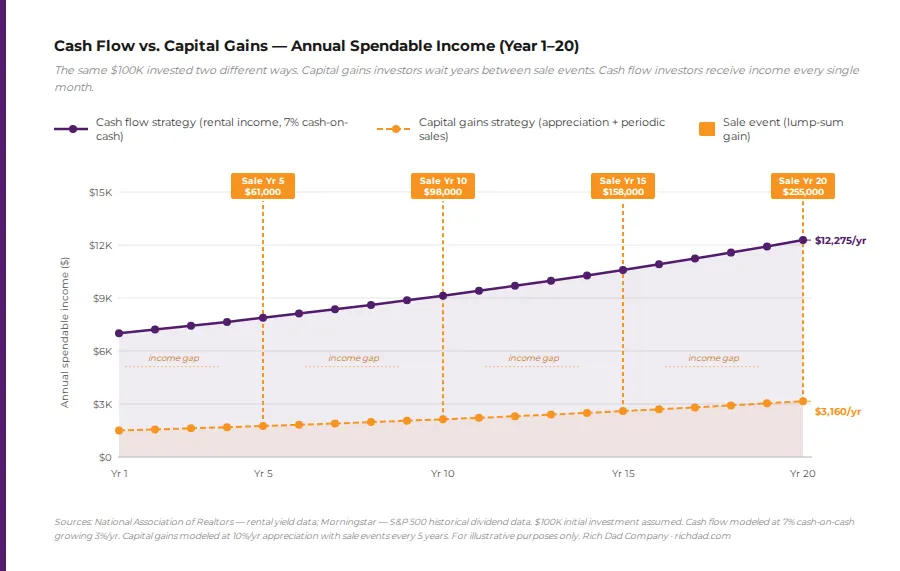
What doesn’t change, regardless of vehicle, is the distinction between cash flow and capital gains. Capital gains investors buy an asset hoping to sell it later for more than they paid — the classic “buy low, sell high” approach. Cash flow investors buy an asset and hold it, collecting income from it month after month, year after year, regardless of whether the underlying price goes up or down.

Cash flow beats capital gains for three reasons. It’s resilient to market swings, since the investor isn’t forced to sell into a downturn to realize a return. It puts real money in an investor’s pocket on a regular basis, rather than “paper wealth” that only exists on a brokerage statement. And it’s generally taxed at a lower rate than short-term trading profits.
Most people assume stocks can only deliver the first kind of return — capital gains — because that’s how stock investing gets talked about on financial television and in most 401(k) advice. But an educated stock investor knows how to generate cash flow from the stock market too, using tools most casual investors have never been taught.
Method 1: Investing for Cash Flow With Stock Dividends
The most direct way to cash flow with stocks is dividends. A dividend is a share of a company’s profits paid out to shareholders, at the discretion of the company’s board of directors. If a company declares a $0.50 per-share dividend for the quarter and an investor owns 100 shares, that investor receives $50 — cash, deposited directly, with no need to sell a single share.
Buying stocks that pay regular dividends means buying assets that add to cash flow. Build up enough of these assets and, eventually, the income can cover living expenses — the definition of financial freedom Rich Dad teaches.
Dividend investing does come with real limits. Dividends are entirely at the board’s discretion — an investor has no control over whether a dividend gets paid, raised, cut, or eliminated, and no influence over the underlying company’s performance. And at today’s valuations, dividend yields are thin. The S&P 500’s current dividend yield sits near 1.06% — well below its 30-year average of 1.76% and far below the long-run median of over 4%. That means a $10,000 index position generates roughly $106 a year in dividend income alone.
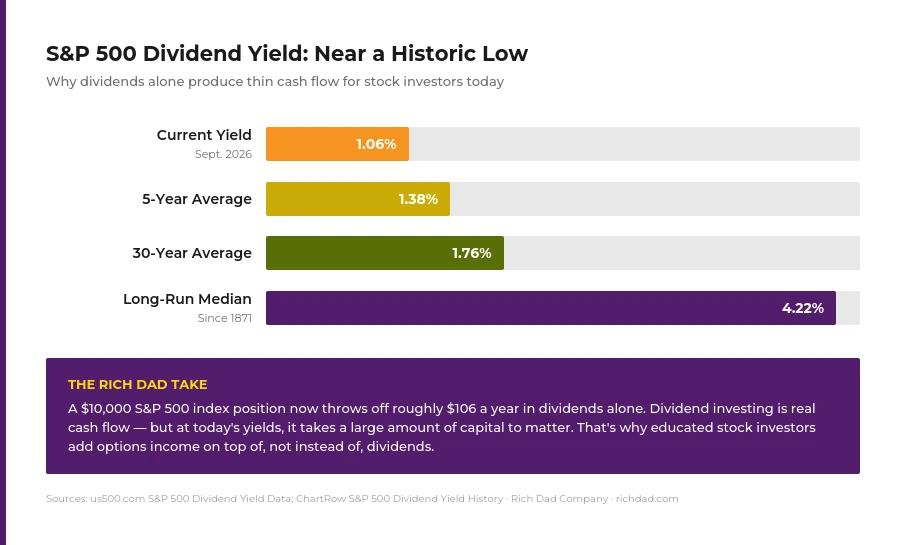
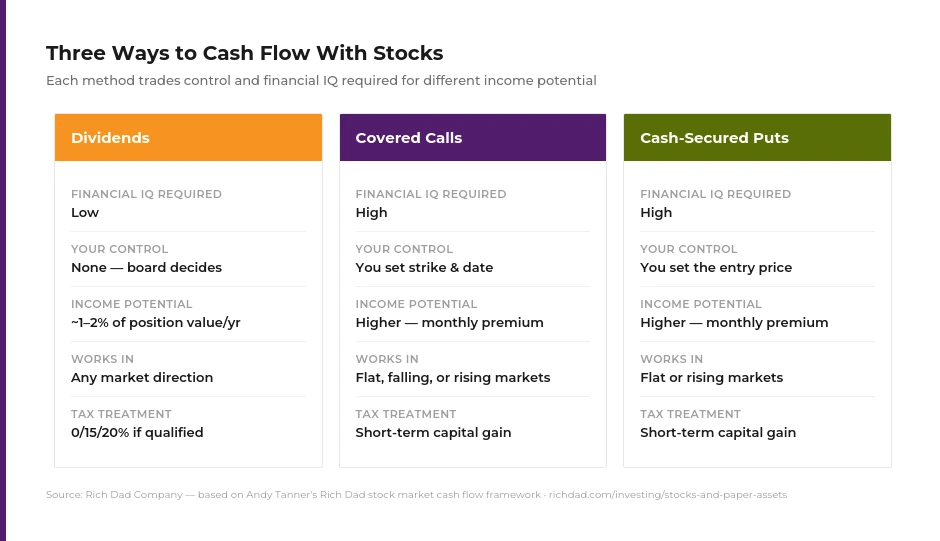
Dividends take the lowest level of financial intelligence of any cash flow strategy on this list. That’s exactly why the returns are also the lowest.
Method 2: Investing for Cash Flow With Covered Calls
The covered call strategy requires a much higher level of financial intelligence — and the potential returns are higher too. Rich Dad Advisor on stocks Andy Tanner describes an option as a promise to sell a certain stock at an agreed-upon price until a certain date. In exchange for that promise, the seller receives a premium as income, paid not for the movement of the stock price but for the movement of time.
The mechanics make more sense through a real estate comparison. Picture a landlord who owns a rental house and finds a family willing to lease it for three years with an option to buy at an agreed-upon price at the end of the term. While the lease runs, the landlord collects rent — income earned purely from the passage of time, regardless of whether the house’s value rises or falls. If the house’s value climbs above the agreed price, the family got a good deal, but the landlord still got exactly the price they wanted. If the value falls, the family likely won’t exercise the option, and the landlord keeps the house — free to lease it out again.
A covered call works the same way, applied to a stock an investor already owns:
- The investor owns shares of a stock.
- The investor sells an option obligating them to sell those shares, after a set amount of time, at an agreed-upon price.
- At expiration, the investor keeps the option premium regardless of what happens.
- The investor either sells the stock at the agreed price or keeps the shares.
- Repeat.
Andy Tanner has taught this concept using a real trade from the 2008 subprime meltdown. He bought 500 shares of the SPDR S&P 500 ETF (SPY) and committed to holding the position for a full year, regardless of where the price went — the same commitment a real estate investor makes when holding a rental property through a down market. He then sold five one-month covered call contracts against those shares at a premium of $2.15 per share, granting the buyer the right to purchase his SPY shares at $154, a price above what he’d paid. Whichever direction the stock moved, the trade was structured to generate income: if the stock rose past $154, he’d profit on the shares themselves; if it stayed flat or fell, the option expired worthless and he kept the full premium — $1,075 before fees on that contract cycle, or a net $1,061 after commissions. He repeated the trade monthly for a full year, collecting income the entire time even as the underlying shares lost value, the same way a landlord keeps collecting rent on a house whose market value has temporarily dropped.

That’s the core insight behind cash flow investing, whether the underlying asset is a house or a share of stock: the asset’s price can fall while the income it produces stays consistent.
Covered calls do have a real trade-off. Selling a call caps the upside — if the stock rallies well past the strike price, the covered call seller doesn’t participate in gains above that level. And selling a “qualified covered call” (out of the money, expiring more than 30 days but less than 33 months out) matters for tax purposes, since an improperly structured covered call can cancel the qualifying holding period for the dividend on the underlying stock, pushing it back to ordinary tax rates.
Method 3: Investing for Cash Flow With Cash-Secured Puts
A third method — one that pairs naturally with covered calls — is the cash-secured put. Where a covered call generates income on shares an investor already owns, a cash-secured put generates income on shares an investor wants to own.
Here’s how it works: an investor sets aside enough cash to buy 100 shares of a stock at a price below where it currently trades — a price the investor considers a fair entry point. The investor then sells a put option at that price and collects a premium immediately, just like the premium collected on a covered call. If the stock stays above that price through expiration, the put expires worthless and the investor keeps the premium, free to repeat the trade. If the stock falls to or below that price, the investor is obligated to buy the shares — at the price they’d already decided was a good deal, with the premium already collected effectively lowering the purchase price further.
Investors who run covered calls and cash-secured puts together — selling puts to acquire shares, then selling calls against those shares once assigned — are running what options traders call “the wheel,” a continuous cycle of premium income regardless of which direction the underlying stock moves.
Which Method Fits You?
None of these three methods is inherently “better” — they fit different investors at different stages of financial education, the same way Rich Dad teaches that real estate, business, and stocks each fit different investors differently. Dividends require the least effort and the least skill, and they pay accordingly. Covered calls and cash-secured puts require real study — understanding strike prices, expiration dates, assignment risk, and how time decay works — but they open the door to meaningfully higher income from the same shares.
The Stocks and Paper Assets section covers the fundamental and technical analysis skills that make all three methods safer and more effective.
How Stock Cash Flow Gets Taxed
Tax treatment is one of the most overlooked differences between these three methods, and it’s worth understanding before committing real capital to any of them.
Dividends can qualify for the same preferential tax rates as long-term capital gains — 0%, 15%, or 20%, depending on income — but only if the underlying stock is held for more than 60 days during the 121-day period surrounding the dividend’s ex-dividend date. Dividends that don’t meet this holding-period test are taxed as ordinary income, at rates as high as 37%.
Option premium income — from both covered calls and cash-secured puts — is generally treated as short-term capital gain, taxed at ordinary income rates, regardless of how long the position was open. That’s a meaningfully higher tax burden per dollar of income than qualified dividends, which is part of why covered calls and cash-secured puts need to generate materially more income to make sense on an after-tax basis.
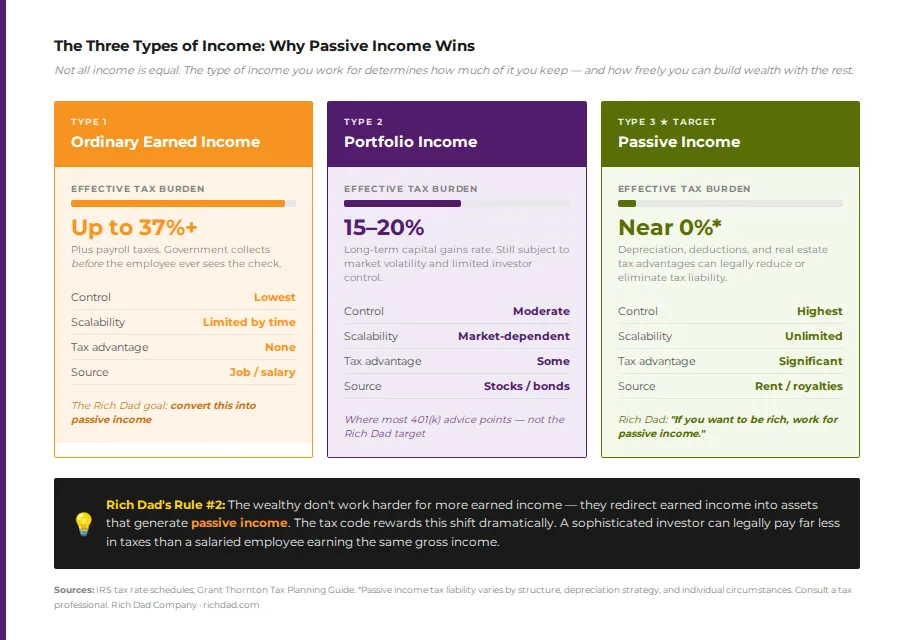
None of this is tax advice — consult a tax professional before building an options income strategy, since account type (a taxable brokerage account versus an IRA) changes the calculation substantially.
The Risks of Cash Flowing With Stocks
Every cash flow strategy carries risk, and stocks are no exception.
Dividend cuts happen — a board can reduce or eliminate a dividend at any time, particularly during a recession or a company-specific downturn, and dividend investors have no control over that decision. Covered call sellers give up upside: if a stock rallies sharply past the strike price, the seller’s gains are capped at that level no matter how far the stock keeps climbing. Cash-secured put sellers take on the obligation to buy a falling stock, even if it later falls well below the price they agreed to pay. And every method still carries the underlying market risk of owning stocks in the first place — a company can decline in value, cut its dividend, and see its options premiums shrink all at the same time in a genuine bear market.
None of this makes stock cash flow strategies bad ideas. It makes financial education essential before using them. The Stocks and Paper Assets hub and Rich Dad’s broader financial education resources are built to close exactly that gap.
Stock Investing and the Rich Dad Philosophy
Most people think stock investing is at odds with the Rich Dad philosophy of investing for cash flow, because they think of stocks purely as a “buy, hold, and pray” capital gains game. If that’s what stock investing meant, the assumption would be right.
But an educated stock investor knows how to cash flow the stock market using dividends, covered calls, and cash-secured puts — three tools that turn a portfolio of paper assets into a source of real, recurring income. The vehicle was never the problem. The missing piece was always the education.
FAQs
No. Capital gains investing means buying a stock hoping to sell it later at a higher price. Cash flow investing means buying a stock and holding it while it generates recurring income through dividends or options premiums, regardless of whether the price rises or falls.
Dividend investing generally requires the least financial education and carries the least complexity, since it doesn’t involve options contracts, strike prices, or assignment risk. It also produces the lowest income relative to capital invested.
Yes. A covered call caps the upside on a stock’s price appreciation, and if the underlying stock falls in value, the investor still owns shares that have lost value — the premium collected only partially offsets that loss. Covered calls reduce risk relative to owning stock outright, but they don’t eliminate it.
A cash-secured put is an options contract where an investor agrees to buy a stock at a specific price if it falls to that level by a set date, in exchange for an upfront premium. The investor sets aside enough cash to cover the purchase if assigned.
Yes. Qualified dividends can be taxed at long-term capital gains rates as low as 0%, 15%, or 20%. Premium income from covered calls and cash-secured puts is generally taxed as short-term capital gain at ordinary income rates, which are typically higher.