
What OPM Really Means — and Why It’s the Line Between Quadrants
OPM is exactly what it sounds like: using money that belongs to someone else — a bank, a private investor, a business partner, a brokerage firm — to invest in and control an asset. The benefit is leverage. An investor with $10,000 can put that $10,000 directly into the stock market and control $10,000 worth of assets, full stop. That’s leverage-free investing. But if that same investor uses the $10,000 as a 10% down payment on a property and finances the rest with a mortgage — OPM, in this case — she now controls a $100,000 asset. The cash flow potential of a $100,000 asset is substantially larger than what a $10,000 position alone could generate, and the $10,000 did the same job it would have done on its own, just with ten times the leverage behind it.
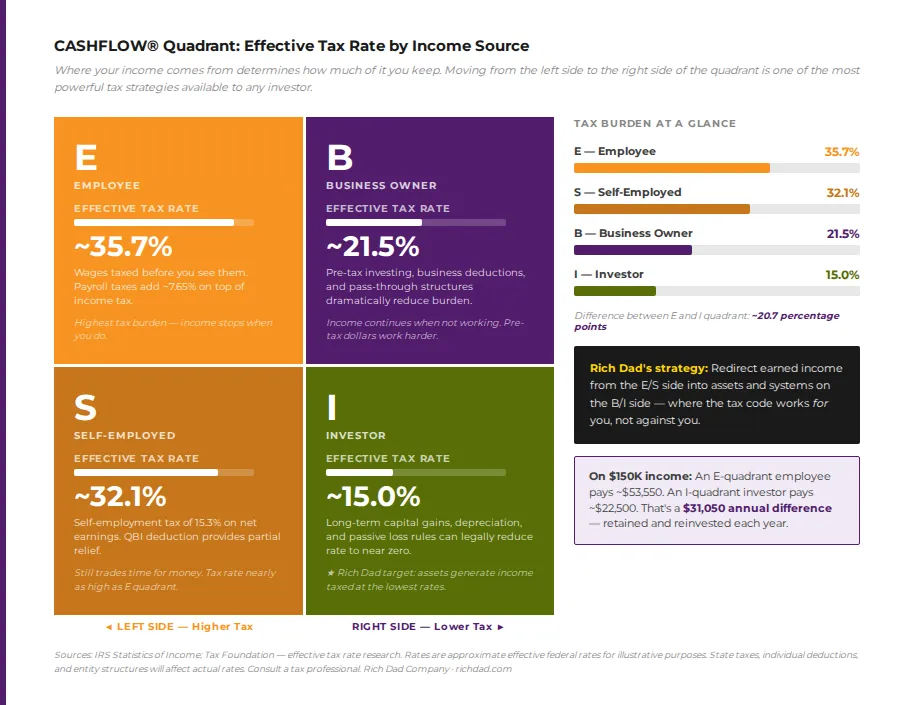
This is also the mechanical difference between the left and right sides of the CASHFLOW Quadrant. Employees and the Self-Employed generally can’t invest pre-tax dollars and have limited access to institutional leverage — their income is capped by hours worked. Business Owners and Investors routinely use OPM to acquire assets, and the tax code treats debt-financed, income-producing assets far more favorably than earned income.
Three Places Investors Find OPM
OPM isn’t a single financing product — it’s a category that looks different in every asset classes. The three most common entry points are paper assets, real estate, and business capital, and each has its own mechanics, its own risk profile, and its own audience of lenders or investors.
Paper assets
In the stock market, OPM most often takes the form of margin — borrowing against an existing portfolio to buy more securities — or options, which use a small premium to control a much larger position in the underlying stock. Margin debt in U.S. brokerage accounts has been climbing sharply: FINRA-reported debit balances in investor margin accounts decreases slightly to $1.45 trillion in August 2026, up more than 50% from a year earlier. See Stocks and Paper Assets for how Rich Dad approaches cash-flow strategies like covered calls without taking on unmanaged margin risk.

Real estate
Mortgages, hard money, private lenders, and seller financing all let an investor control a property worth far more than their available cash.
Business capital
Entrepreneurs raise OPM through bank loans, SBA-backed financing, credit lines, and outside investors to fund equipment, inventory, and growth. SBA lending alone guaranteed roughly 85,000 loans totaling $45 billion in fiscal year 2025, a record and about 20% more than the year before — capital that funded expansion smart entrepreneurs couldn’t have self-financed at the same pace. Business Financing Strategies: How Smart Entrepreneurs Use OPM goes deep on structuring business debt the way the rich do — for income-producing assets, not overhead.
The Seesaw Principle: Why leverage multiplies outcomes
Robert Kiyosaki’s rich dad used to say that leverage is the reason some people become rich and others don’t — and that fewer than 5% of Americans understand how to use it, which tracks closely with how concentrated wealth actually is. Picture a playground see-saw: a small child on one end can’t lift a much larger child sitting at the far end. But move the small child closer to the center — the fulcrum — and suddenly a small amount of weight can lift a much larger one. OPM works the same way. A modest amount of your own capital, placed at the right point in a deal’s capital stack, can control and lift an asset many times its size.
Not all borrowing accomplishes this. There’s bad debt — a credit card balance for a restaurant meal, a payment plan on a depreciating toy — that produces no cash flow and simply drains it. And there’s good debt: OPM used to acquire an asset that puts money in your pocket every month, like a rental property or production equipment that increases a business’s revenue. The distinction isn’t the size of the loan. It’s whether the asset on the other end of it pays for itself — a test covered in more detail in Rich Dad’s Good Debt vs. Bad Debt guide.
The other side of leverage: Why OPM cuts both ways
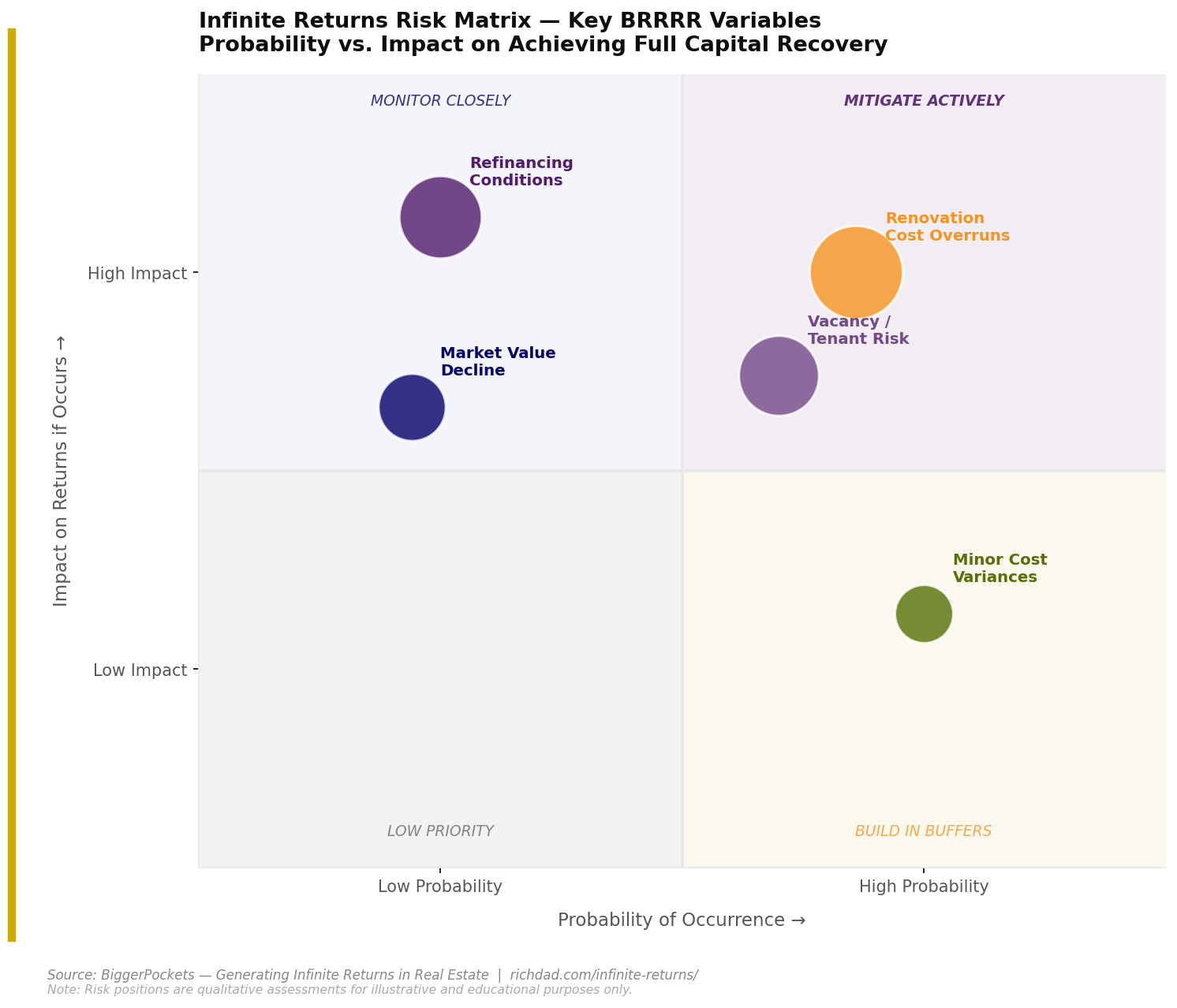
Every OPM guide talks about upside. Far fewer talk about the mechanics of downside, and that omission is what gets new investors into trouble. Leverage doesn’t just magnify returns — it magnifies losses by the same multiple, and unlike a loss on cash invested, a loss on borrowed capital still has to be repaid on schedule, regardless of whether the underlying asset is producing income. A margin call, a vacancy that outlasts a loan’s reserves, or a business downturn that hits right after a large draw on a credit line can turn a leveraged position from an accelerant into a liability almost overnight.
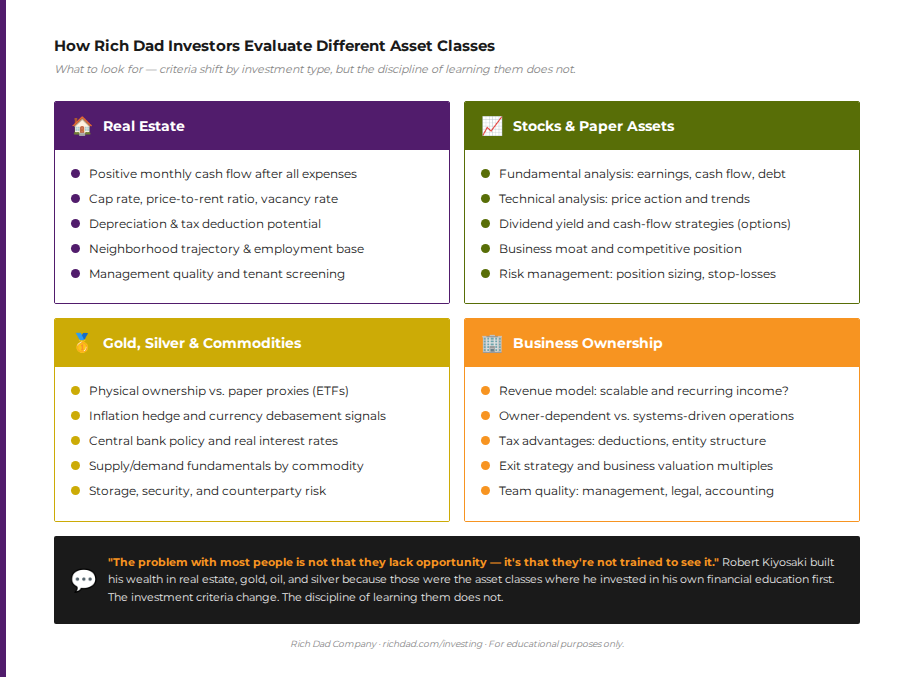
The specific risks vary by asset class, but they cluster into a few repeatable categories: market or asset-value decline that erodes the equity cushion behind the loan, financing conditions (rate resets, balloon payments, called lines of credit) that change the terms mid-hold, and operational risk — vacancy, a lost customer, a stalled renovation — that interrupts the cash flow the debt service depends on. None of these make OPM a bad tool. They make it a tool that needs a plan for what happens if the deal doesn’t perform exactly as modeled.
The Rich Dad Filter: 5 questions before using anyone’s money but your own

Before bringing OPM into any deal — a mortgage, a margin position, an investor’s check — Rich Dad’s approach is to run it through five questions. If any of them can’t be answered with confidence, that’s not necessarily a “no.” It’s a flag that more financial education is needed before the money changes hands.
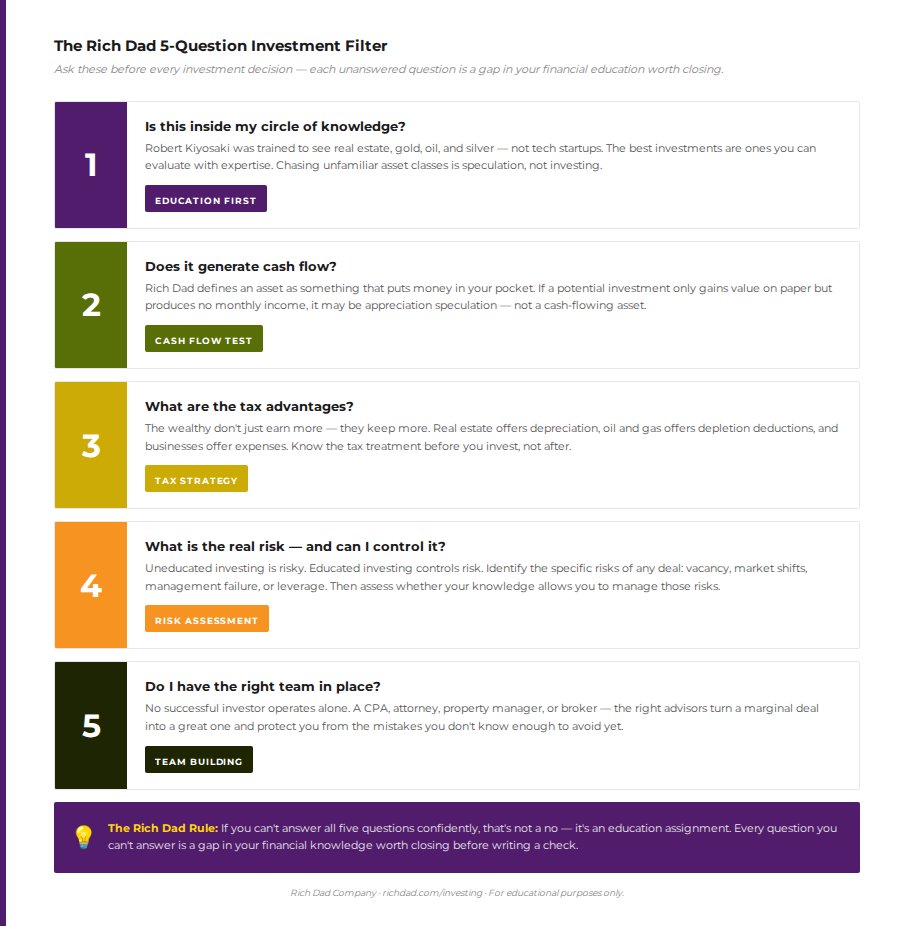
- Is this inside my circle of knowledge? The best investments are ones you can evaluate with real expertise. Borrowing to chase an unfamiliar asset class is speculation, not investing.
- Does it generate cash flow? If the asset can’t cover its own debt service each month, the OPM is working against you, not for you.
- What are the tax advantages? Depreciation, interest deductions, and business expenses change the real return on a leveraged deal. Know the tax treatment before you borrow, not after.
- What is the real risk, and can I control it? Vacancy, market shifts, rate resets, management failure. Identify each one and decide whether your knowledge lets you manage it.
- Do I have the right team in place? A CPA, attorney, property manager, or broker turns a marginal deal into a good one and catches the mistakes you don’t know enough to avoid yet.
What a lender or investor actually wants to hear
Anyone putting up OPM — a bank, an angel investor, a private lender — is ultimately asking one question: if I give you this money, how much do I get back, and when? Presentations that answer this clearly and honestly tend to outperform longer, more polished ones, because brevity signals that the person raising money actually understands the deal. Four factors drive that confidence.
- Project — What exactly is the investment or business, and what makes it a stronger bet than the alternatives a lender or investor could put their money into instead?
- Partners — Who’s involved, and what’s their track record? Experience is often what separates a funded deal from a passed-on one.
- Financing — How much is being raised, where the rest of the capital is coming from, what the terms are, and exactly how the money will be used. Money earmarked for a founder’s salary is a common reason deals get declined; investors want their capital going into the asset, not overhead.
- Management — Who runs day-to-day operations, and what’s their track record under pressure? “Money follows management” is one of the oldest sayings in raising capital for a reason.
For rental property specifically, management is often the deciding factor — the day-to-day operations of a rental home, a retail space, or an apartment building are what separate a cash-flowing asset from a liability with a mortgage attached.
Where OPM actually comes from
Across asset classes, the common sources of OPM include bank and conventional loans, private and hard money lenders, peer-to-peer lending platforms, angel investors and venture capital, credit lines, and creative or seller-financed structures. Each source trades speed, flexibility, and cost differently — a hard money lender moves fast but charges a premium for it; a bank loan is cheaper but slower and more selective; a private lender in an investor’s own network may offer the best terms of all, precisely because the relationship, not just the collateral, is doing some of the underwriting. The right source depends less on which one sounds most sophisticated and more on what the specific deal needs: speed, low cost, flexible terms, or a lender who understands the asset class well enough to move quickly.
In summary: Use OPM without letting it use you
Other People’s Money is one of the fastest ways to move from the E/S side of the CASHFLOW Quadrant to the B/I side — it’s how a modest amount of personal capital ends up controlling assets many times its size. But the investors who build lasting wealth with OPM are the ones who treat leverage as a multiplier of whatever decision it’s attached to, not a shortcut around due diligence. Run every OPM opportunity through the same five questions, know the difference between good debt and bad debt before signing anything, and be honest about what happens to the deal if it underperforms the model. Get those right, and OPM becomes the tool that separates working for money from putting money — and other people’s money — to work.
FAQs
Not necessarily in the way most people think about debt. Bad debt reduces cash flow and pays for something that loses value. OPM used well is good debt — it’s borrowed capital deployed into an asset that produces enough income to cover the debt service and still generate a profit.
It varies by asset class and lender. Conventional real estate financing often starts around a 10–20% down payment; hard money and private lenders vary widely; margin accounts have regulatory minimums; SBA and bank business loans typically expect some owner equity in the deal. The common thread is that lenders want to see the borrower has skin in the game, not just access to someone else’s capital.
That leverage magnifies losses as reliably as it magnifies gains, and borrowed money still has to be repaid even if the asset underperforms. A deal that only works if everything goes as modeled isn’t ready for outside capital.
Beginners can and do use OPM — a first mortgage is technically OPM — but the more novel or aggressive the leverage (margin, hard money, investor capital), the more financial education should come first. The five-question filter above is a useful gut check before scaling into more complex OPM sources.
Not necessarily long or elaborate, but it should clearly cover the project, the partners involved, how the money will be used, and who’s managing operations. A short, confident, honest pitch that addresses those four points tends to outperform a longer one that doesn’t.