
The Word “Staking” Is Doing Too Much Work
USDT and USDC are both stablecoins. Many platforms are offering stablecoin yield, and some people can confuse this with “staking”. Neither USDT nor USDC runs a proof-of-stake network with its own validators, so you cannot stake them the same way you stake Ethereum, Solana, or Cardano.
Some of the main DeFi yield-earning platforms for stablecoins such as Tether’s USDT and Circle’s USDC include Aave, Maple, and Compound.
Those platforms can pay a return, but the money comes from lending on Aave, institutional credit through Maple, or a protocol savings product. Calling all of it staking makes the process sound cleaner than it really is.
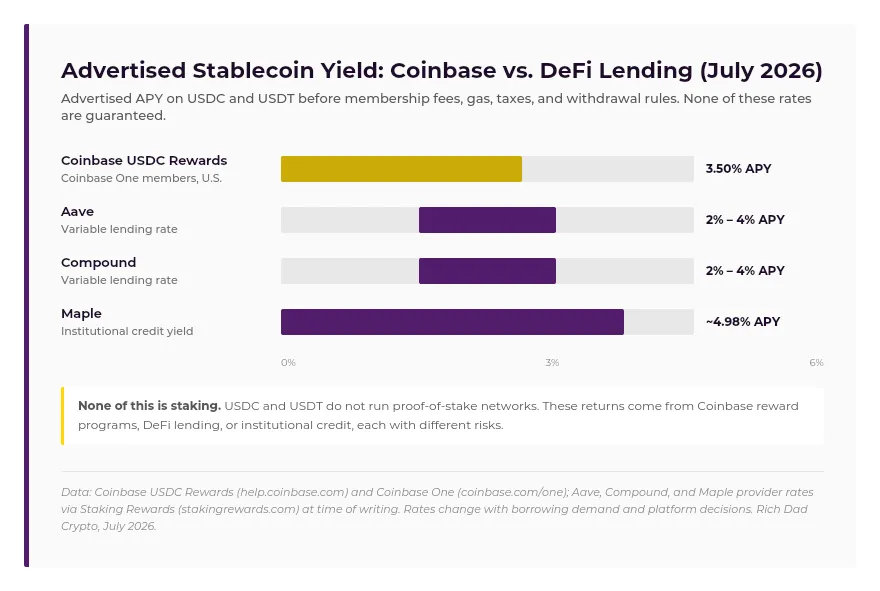
At the time of writing this, Aave, Maple and Compound offer between 2-4% APY. These rates move with borrowing demand, pool conditions, and platform decisions.

The label says “staking,” but your money is usually lent or routed into another strategy.
What Most People Use: Coinbase USDC Rewards
Most American readers are not going to bridge money into three protocols to squeeze another percentage point out of a stablecoin. They are more likely to open Coinbase, buy USDC, and use the reward that already appears in the app.
Coinbase currently advertises 3.50% APY on USDC for eligible Coinbase One members in the United States. You need at least $1 of USDC, the rate can change, and the program is available only in supported regions.
Rewards accrue daily. Coinbase’s current help page says distributions are typically made weekly, while its US user agreement still describes monthly rewards paid within five business days after the next month begins. Check the schedule shown inside your account because Coinbase can change the payout pace.
If you keep the USDC on Coinbase and there is no on-chain gas fee. You still carry platform risk, and the balance is not a bank deposit.
The Membership Cost Changes the Amounts
Coinbase One starts at about $4.99 a month. Adding things up, that works out to $59.88 a year. At a steady 3.50% APY, you would need roughly $1,711 in USDC just to earn back that membership cost, before tax, if the reward were the only reason you joined.
$1,000 in USDC earns about $35 over a full year at 3.50%. $5,000 earns about $175. The rate could move during the year, so these are examples rather than promises.The Word “Staking” Is Doing Too Much Work
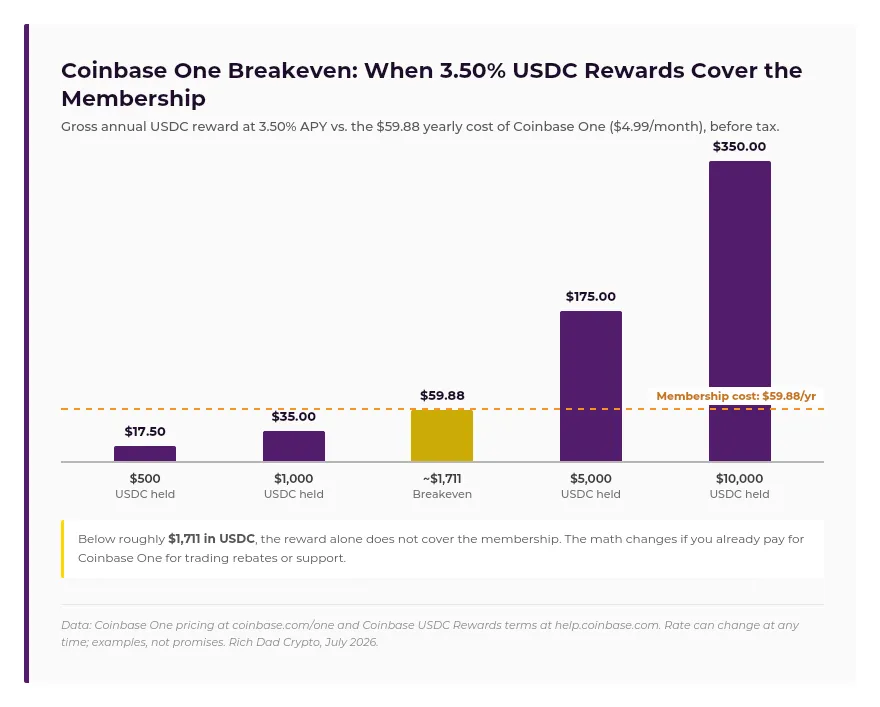
A person already paying for Coinbase One for trading rebates, support, or account protection sees the cost differently. Someone only joining for USDC rewards needs to run the math first.
Buying USDC Is Usually the Cheap Part
Coinbase says standard USD-to-USDC conversions do not face its special processing fee until net conversions exceed $5 million in a rolling 30-day period. Funding methods, withdrawals, and other trades can still carry charges. Coinbase One also warns that zero-fee simple trades can include a spread, while Advanced and decentralized exchange fees sit outside the zero-fee benefit.
For a basic USDC reward user, the biggest visible cost may be in the membership. The hidden cost is giving up access to the cash while it sits on a crypto platform without FDIC or SIPC insurance.
DeFi Can Pay More, but the Meter Starts Running
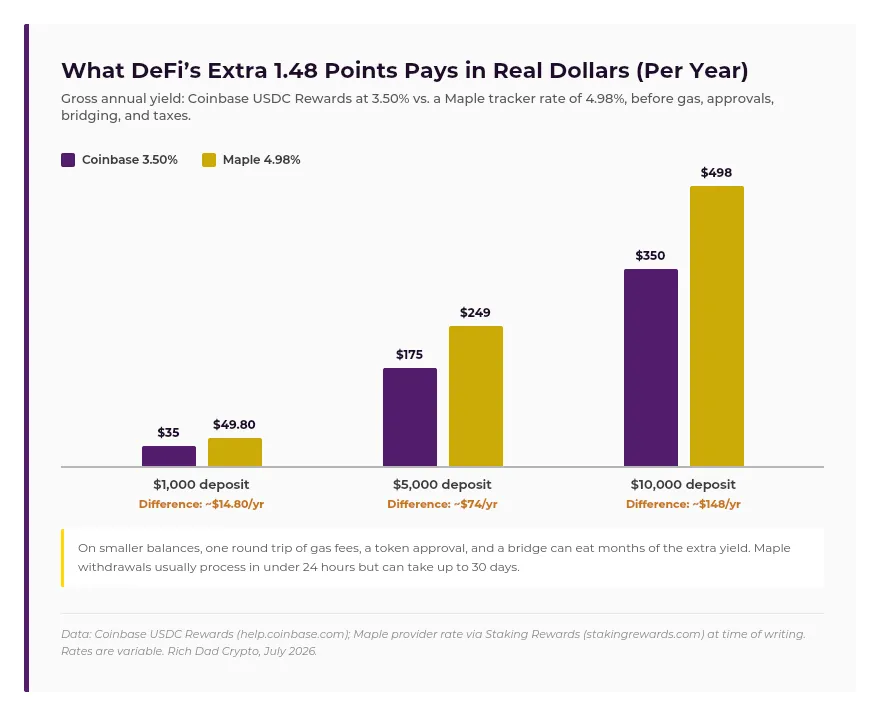
DeFi becomes a very attractive option when a rate tracker shows 4.98% beside Maple and 3.50% beside Coinbase. The extra 1.48 percentage points sounds great until you compare it with the size of the deposit.
On $1,000, that difference is about $14.80 over a year. On $10,000, it is about $148. A wallet transfer, token approval, bridge, deposit, and later withdrawal can take a bite out of that advantage.
Aave and Compound
Aave and Compound pay suppliers from interest charged to borrowers and the rate changes with utilization. Aave says withdrawals depend on available unborrowed liquidity, so an app showing a balance does not guarantee that every dollar can leave at the same moment.
The transaction itself may confirm in seconds or minutes, especially on Base, Arbitrum, or another lower-cost network. You still pay the network gas fee, and the first deposit may require a separate approval transaction. Ethereum mainnet fees can rise sharply during busy periods.
If all of these things sound confusing, avoid DeFi. It’s very important to be knowledgable about basic DeFi safety and self-custody wallet usage before using these platforms.
Maple
Maple looks more like on-chain private credit. Its yield comes mainly from short-duration loans to institutional borrowers and other managed strategies. Maple says most withdrawals process in under 24 hours, but some can take up to 30 days.
Spark
Spark lets users move USDC into products such as sUSDS. Its documentation says supported swaps can avoid slippage and protocol fees, but users still pay network gas. You also end up holding a different token and depending on the rules behind that savings product.
Before Moving On-Chain
Check the network, expected gas, bridge route, withdrawal rules, and wallet security. Small amounts might not be worth earning a yield from in DeFi since it can take months earning back the cost of entering and leaving.
A higher APY can be a worse deal once the route to reach it gets expensive.
The CLARITY Act Could Change the Reward Screen
Two laws are getting mixed together in crypto conversations.
The GENIUS Act became law in July 2025. It basically prohibits a permitted stablecoin issuer from paying interest or yield solely for holding, using, or retaining a payment stablecoin. The law’s main effective date is January 18, 2027, unless final regulations trigger it earlier.
That issuer rule does not fully settle what an exchange such as Coinbase can pay from its own pocket. This is one on the reasons the Digital Asset Market Clarity Act has become a fight between banks and crypto platforms.
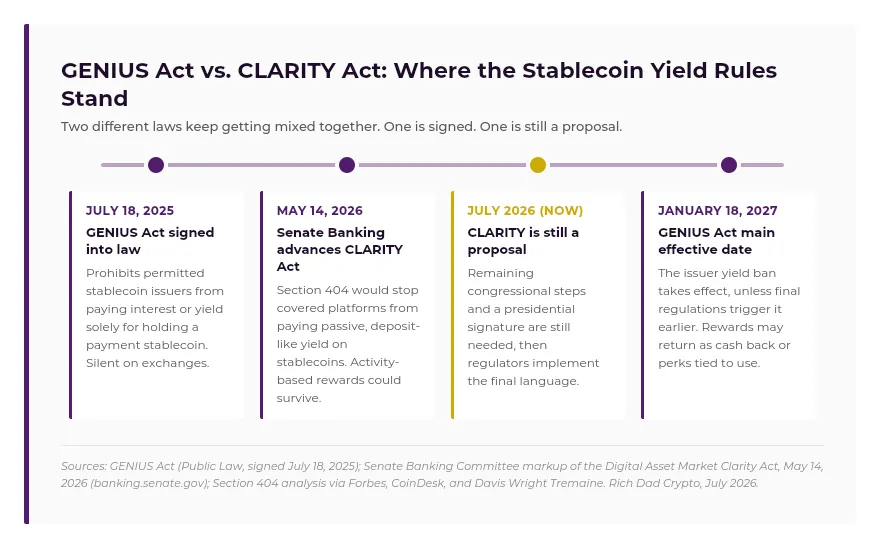
The Senate Banking Committee advanced its version of the CLARITY Act on May 14, 2026. Section 404 would stop covered digital asset service providers from paying passive, deposit-like yield solely for holding a payment stablecoin. Rewards tied to payments, transfers, loyalty activity, or other qualifying use could still survive.
As of July 2026, the CLARITY Act is just a proposal. It still needs the remaining congressional steps and a presidential signature. Regulators would then need to implement the final language.

Coinbase rewards are not guaranteed to vanish tomorrow. A future program may look more like cash back, a membership benefit, or a reward tied to spending.
The law may change the wrapper before it removes the reward.
The Crypto Tax Rumor Never Became Law
A claim has circulated since the 2024 campaign that President Trump would remove capital gains tax from crypto, sometimes only for coins issued by U.S. companies. The dates kept changing from 2025 to 2026 as posts repeated the story.
There is no blanket federal crypto capital gains exemption for either year. No official White House order, signed law, or IRS rule created one. The IRS still treats digital assets as property and specifically includes stablecoins
Stablecoin rewards are generally taxable income when you receive control of them. If Coinbase credits you $35 in USDC rewards, that $35 is income. It also becomes your basis in those 35 USDC.
Redeem the 35 USDC later for exactly $35 and there may be no capital gain. Sell it for $35.02 and you may have a small gain. Swap it after a depeg at $34.98 and you may have a small loss.
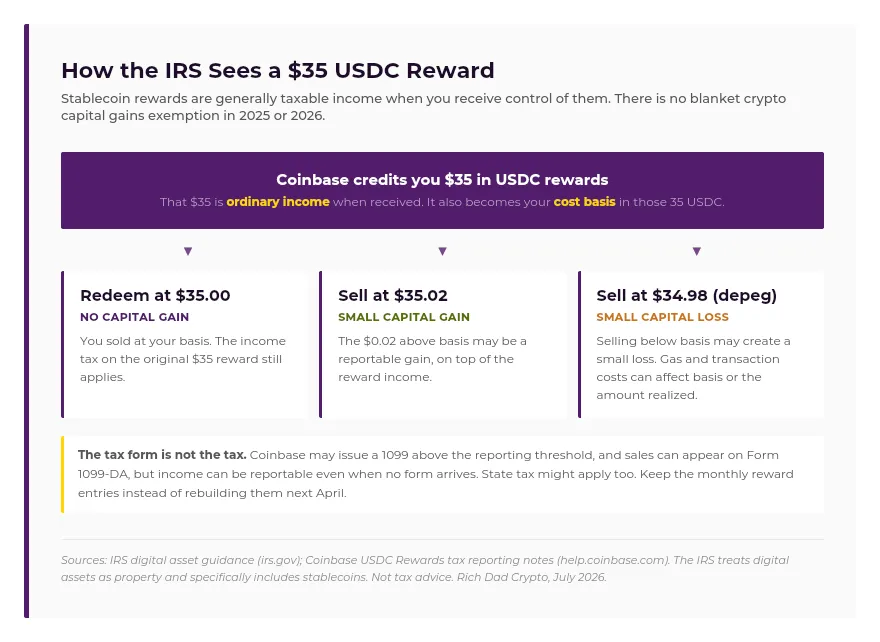
The tax form is not the tax. Coinbase may issue a 1099 when your activity crosses the reporting threshold, but any income can still be reportable even when no form arrives. Sales and exchanges may also appear on Form 1099-DA.
State tax might apply as well. Keep the monthly reward entries, transfers, and conversion records instead of trying to rebuild them next April. Gas and transaction costs can affect basis or the amount realized, depending on the transaction.
The Rich Dad View: Follow the Net Cash Flow
Robert Kiyosaki teaches people to ask where cash flow comes from and who receives it. Stablecoin yield gives us a pretty good case study.
The APY is the ad, and the net return is the answer.
Tether and Circle earn from the reserve assets behind their tokens. Circle reported $653 million in reserve income for the first quarter of 2026. Tether reported about $1.04 billion in quarterly profit and roughly $141 billion in direct and indirect Treasury exposure.
Coinbase can share part of the economics with users. Aave or Compound can lend your stablecoins to borrowers. Maple can route them into institutional credit. Each option puts a different agreement between you and your dollar.
Start with the job you gave the money. If it is emergency cash, a crypto reward program brings platform risk and no federal deposit insurance. If it is a small on-chain position, gas may erase the extra return. A larger balance can make the same costs easier to absorb.
Use the net figure after membership, gas, taxes, and the cost of getting out. That is the number going into your pocket.
- Count every cost before calling the reward income.
- Keep cash reserves separate from yield experiments.
Final Thoughts
Stablecoin yield has become a product by category, but the word staking has made it harder to see what people are truly buying.
For most U.S. readers, Coinbase USDC rewards are the easiest place to start. The current 3.50% APY comes with a Coinbase One membership, a payout schedule that can change, taxes, and platform risk.
DeFi can pay out higher yields, but it also introduces gas fees, smart contract risks, withdrawal conditions, and wallet errors that Coinbase users never face.
The CLARITY Act may change passive rewards in the future, but it has not become law. Crypto capital gains also remain taxable. No 2025 or 2026 Trump exemption removed them.
Chasing another one percent makes little sense when fees and taxes take the advantage back.
Count what reaches your pocket, then decide if the return earns its place.
FAQs
USDT cannot be staked natively because Tether does not run a proof-of-stake blockchain with validators. Sites often use “staking” as a broad label for lending USDT through Aave, Maple, Spark, or another provider.
USDC also has no native staking. You can earn a Coinbase reward for holding it or lend it through DeFi, but those are separate products with separate risks.
Coinbase currently advertises 3.50% APY for eligible Coinbase One members in the United States. The rate and eligibility can change.
Coinbase says rewards accrue daily. Its public help page currently describes weekly distributions, while its U.S. agreement describes monthly payouts. Use the schedule displayed in your account.
For U.S. taxpayers, rewards are generally taxable income at their fair market value when received. A later sale or exchange can create a capital gain or loss.\
Coinbase does not apply its special USDC processing fee to ordinary USD conversions below the $5 million rolling threshold. Membership, funding, withdrawal, spread, or other trading costs can still apply.
Yes. Wallet approvals, deposits, withdrawals, swaps, and bridges can each require a network transaction. Fees are usually lower on Layer 2 networks than Ethereum mainnet, but they move throughout the day.
The Senate proposal would restrict passive yield paid solely for holding payment stablecoins while preserving some activity-based rewards. As of July 2026, it is not federal law.