

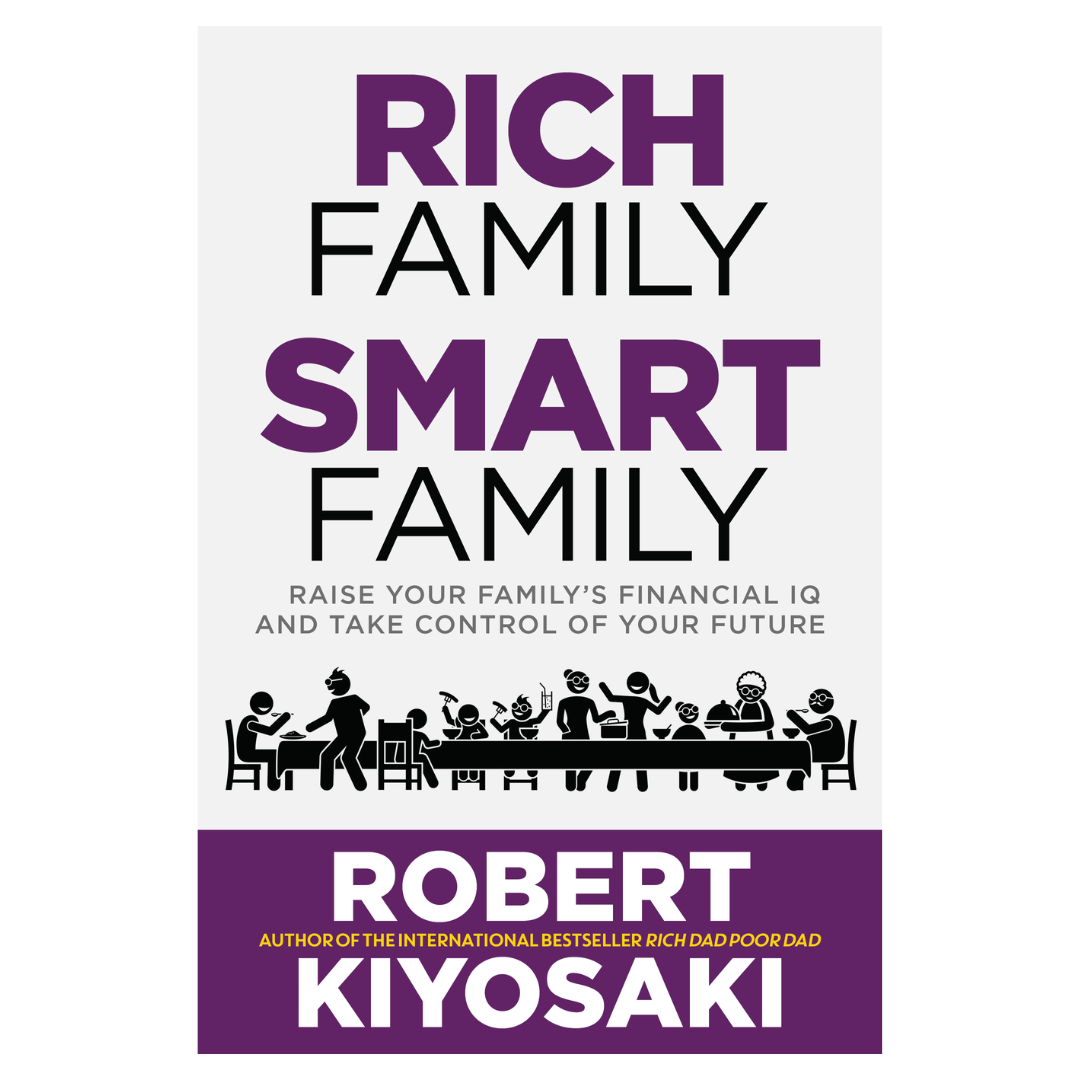
The Book in Brief
Rich Family Smart Family is Robert Kiyosaki’s practical, easy-to-follow guide for raising a financially intelligent household. Drawing on lessons found throughout the Rich Dad philosophy, it helps parents, grandparents, mentors and caregivers teach children the real-life money skills that schools still do not teach. The book’s starting point is simple and direct: financial education must begin at home, because if you do not teach your kids about money, someone else will.
The book is organized around the building blocks of financial IQ, offered in a form that adults can pass along to young people. Each chapter is described as filled with stories, exercises and distinctions that make complex concepts simple for young minds to understand. The goal is to help families create financially confident children who can navigate the fast-changing Information Age with clarity and purpose.
Why Financial Education Starts at Home
The main argument is that the household is the most influential classroom a child will ever have. Children learn about money long before they open a textbook. They watch how adults earn, spend, argue about bills, celebrate purchases and react to uncertainty. Those observations become beliefs. If nobody intentionally teaches them how money works, children absorb a patchwork of attitudes from family habits, friends, advertising and social media.
Robert Kiyosaki’s response is to encourage parents to take charge of that process. Schools, he has long argued, prepare students for jobs but rarely teach money, investing or entrepreneurship. Rather than waiting for the education system to change, families can fill the gap themselves. This message appears throughout the Rich Dad library, and Rich Family Smart Family turns it into a guide for action, written for the whole household rather than just the parent.
A Book for the Whole Family Circle
The book speaks to a broad audience: parents, grandparents, teachers and mentors. That inclusiveness is intentional. Financial lessons often pass between generations, and grandparents and other trusted adults can play a major role in a child’s development. By addressing all of them, the book treats financial education as a shared family project and not as a task for one person.
This also reflects the practical reality that many adults feel unsure about money themselves. The book does not assume expertise. It invites adults to learn alongside the children, using the same stories and exercises, which can make the process more comfortable and effective.
The Building Blocks of Financial IQ
The book breaks financial intelligence into building blocks that adults can teach one piece at a time. Among the ideas described in the product information are the three types of income, how money really works and the critical thinking skills that help children make smarter financial decisions as they grow.
The three types of income are a hallmark of Rich Dad teaching. As the Rich Dad materials describe them, they are earned income from working, portfolio income from investments such as stocks and bonds, and passive income from assets such as rental real estate or royalties. Understanding the differences helps children see why the type of income matters as much as the amount, including how it is taxed and how much time and effort it requires. A child who knows these categories early is better prepared to ask where a family’s income comes from and how it might change.
Teaching the Difference Between Assets and Liabilities
The distinction between assets and liabilities, the central lesson of Rich Dad Poor Dad, is a core piece of the family curriculum. An asset puts money in your pocket, and a liability takes it out. For children, this can be made tangible with everyday examples: a toy that is bought and forgotten versus a small business that earns money, or a savings jar that never grows versus an item that can be rented or sold.
The point is not to make children anxious about spending but to give them a way to think about it. When a child can look at a purchase and ask which column it belongs in, they are building a habit that can last for decades.
Understanding Income, Investing and Money Mindsets
The book helps kids understand income, investing and money mindsets. Income is introduced as something that can be created through effort, ideas and ownership. Investing is explained as putting money to work, with attention to knowledge and risk. Mindset is treated as a foundation: beliefs about money shape behavior, and those beliefs can be examined and changed. A child who hears “we can’t afford that” repeatedly may develop a different outlook than a child who is asked, “How could we afford that?” The book encourages families to consider the language they use.
Hands-On Learning with Real Experiences and Games
One of the book’s most practical recommendations is to use real-life experiences and games to reinforce financial lessons. Children learn through doing. A trip to the store can become a lesson in comparing prices. A lemonade stand can teach revenue, costs and profit. A family game night can introduce the language of assets, liabilities and cash flow. The Rich Dad CASHFLOW games, including the version designed for kids, were created with this goal in mind.
Hands-on learning has a second benefit: it makes mistakes affordable. A child who loses a few dollars in a small project learns far more than one who simply hears a lecture about risk. The book encourages parents to allow small, safe mistakes and to discuss them afterward.
Building Confidence Through Curiosity, Mistakes and Growth
Confidence is a central goal. The book encourages families to nurture curiosity, welcome questions and treat mistakes as part of growth. Children who feel safe asking about money are more likely to keep learning. Those who are punished or shamed for errors may avoid the subject altogether. By creating an environment in which exploration is encouraged, adults help children develop the resilience that financial success requires.
Critical Thinking for the Information Age
The book highlights critical thinking as a key skill in the Information Age, when children are exposed to constant streams of information, advertising and opinion. Teaching them to ask who is speaking, what they want and how a claim can be checked is a form of financial protection. The Rich Dad philosophy places great value on independent thinking, and this book translates it into habits for younger learners.
What Families Will Learn
- How to raise a child’s financial IQ through hands-on learning
- How to teach the difference between assets and liabilities
- How to help kids understand income, investing and money mindsets
- How to use real-life experiences and games to reinforce financial lessons
- How to build lifelong confidence by encouraging curiosity, mistakes and growth
Family Activities to Try
The book’s themes suggest simple activities that families can adapt:
- Hold a monthly family money talk where everyone shares one thing they learned about money.
- Ask each child to sort household items into assets and liabilities.
- Help a child start a tiny business and track income, expenses and profit.
- Play a financial education game together and discuss the decisions afterward.
- Make a habit of asking, “How could we afford that?” before saying no.
These are applications of the book’s approach rather than a list taken from it, and families can adjust them to the ages and interests of their children.
Where It Fits in the Rich Dad Library
Rich Family Smart Family belongs with the family and education titles, including Rich Kid Smart Kid, Why “A” Students Work for “C” Students and Escape the Rat Race. It draws on timeless wisdom from Rich Dad Poor Dad and offers a roadmap for sharing that wisdom with the next generation. Families with teens can pair it with Rich Dad Poor Dad for Teens.
Who Will Get the Most From It
- Parents who want to teach children about money at home
- Grandparents and mentors who want to support young people
- Teachers looking for accessible financial lessons
- Families who want to play and learn together
Starting Small: A First Family Conversation
For families unsure where to begin, the book’s approach suggests starting with a single question at dinner: where does our family’s money come from, and where does it go? Even a short, honest answer introduces income, expenses and choices to children in a natural way. From there, adults can invite children to suggest one change, such as turning an unused item into income or setting a family goal. The point is not to deliver a perfect lesson but to make money a normal, curious topic of conversation.
Takeaway
Rich Family Smart Family makes the case that financial education is a family responsibility and a gift. By offering clear concepts, stories and exercises, it helps adults pass on the habits and mindset that lead to financial freedom. Whether you are a parent, grandparent or mentor, it offers practical ways to start today and the encouragement to keep going.
Product Reviews
Joseph Ciavarelli
Opened my mind / eyes..Educating myself and my family to reach for our financial freedom.
SJ
I've read this book and very inspiring and got lot of Great information. When I read this book I would lay it done and process all of the information in Each Chapter. It's Definitely worth Reading. Robert Kiyosaki won't disappoint. I'm Currently Reading RICH DAD POOR DAD RIGHT NOW. I plan getting more books written by RTK
Amy Ma
Haven’t opened yet but delivery was fast
LaSchelle Quarterman
I purchased CASHFLOW to play with my three grandchildren, ages 12, 12, and 11, and they absolutely LOVE it! What surprised me the most is that they were able to learn and enjoy the adult version of the game. One of my 12-year-old grandsons has already made it out of the Rat Race and onto the Fast Track!
Playing CASHFLOW has become part of our nightly routine. After the kids take their showers and get ready for bed, we sit down and play for about an hour. Believe it or not, this game has even made bedtime routines easier! They are so excited to play that they stay on task and get everything done without me having to constantly remind them.
Initially, I was concerned that the game might be too complicated for their ages. However, by the third night, they had caught on and were playing with confidence. I even ordered the children's version because I thought the adult version would be too difficult, but now I'm not sure we'll even need it!
Our CASHFLOW game has become a permanent fixture on the dining room table! We leave the board set up with everyone's pieces in their spaces, along with their financial sheets and money, so we can pick up right where we left off the following evening.
I also highly recommend watching the YouTube tutorial on how to play CASHFLOW. It was extremely informative and helped us understand the game much better.
As a grandmother, I love that my grandchildren are having fun while learning valuable lessons about money, investing, financial decisions, and building wealth. These are life skills that I believe children should be introduced to at an early age.
I highly recommend CASHFLOW to families with children! Don't underestimate what kids can learn when they're engaged and having fun. This has turned into much more than just a board game for our family. It's become quality time together, a learning experience, and something we all look forward to every evening!
Erik Navarro
I like very very much! go to my freedom