

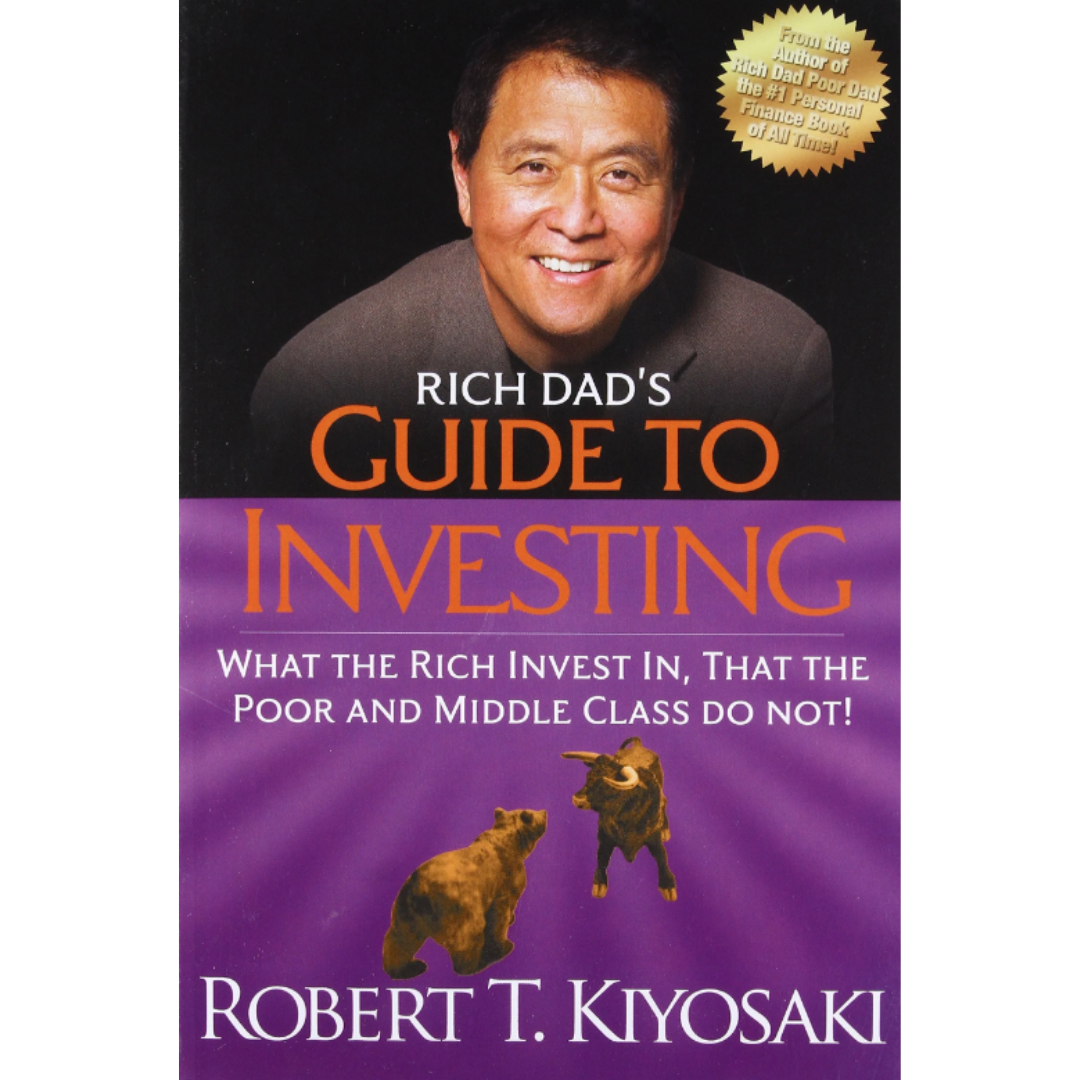
The Book in Brief
Most people invest and hope things work out. The rich invest with a plan. That contrast is the starting point for Rich Dad’s Guide to Investing, in which Robert Kiyosaki teaches the mindset, strategies and financial education principles behind how wealthy investors build assets, create businesses and make money work for them. It is not a book about chasing hot stock tips or gambling in the market. It is a practical guide to understanding how sophisticated investors think, how they lower risk through education, and how they use businesses, assets and systems to grow wealth over time.
Unlike traditional investing books that focus only on stocks or retirement accounts, this book teaches a broader strategy: build knowledge, build assets and build cash flow. The aim is to help readers move from working for money to learning how money can work for them.
Investing Is a Plan, Not a Product
The first big idea is that investing is a plan, not a product. Many people think of investing as buying a particular stock, fund or property, as though the product itself were the strategy. Rich Dad’s view is that products come and go, while a plan is what carries an investor through different markets and circumstances. A plan includes goals, education, an understanding of risk, a team of advisors and a method for evaluating opportunities.
This framing has a practical consequence. An investor who focuses only on the product is vulnerable to hype, fashion and fear. An investor who has a plan can evaluate each opportunity against criteria they already understand. They can say no to opportunities that do not fit and stay calm when markets move.
How Financial Literacy Reduces Risk
Risk is a central theme, and the book’s position is clear: financial literacy can reduce investing risk. The Rich Dad argument is that much of the risk people associate with investing comes from not understanding what they are doing. An investor who cannot read financial statements, evaluate a business, estimate cash flow or understand tax consequences is more likely to make costly mistakes than one who can.
This does not mean that investing becomes risk-free. Markets can fall, businesses can fail and properties can lose value. But education changes the nature of the risk. Instead of relying on luck or on someone else’s promises, the investor makes informed decisions and understands what could go wrong. As Rich Dad has long said, education is the best way to control risk.
Average Investors and Wealthy Investors
The book contrasts average investors with wealthy investors. Average investors, in this framework, tend to hand their money to others, invest passively in products they do not fully understand, and hope that markets will rise over the long term. Wealthy investors take an active interest in how their money is used. They seek control, look for opportunities that produce cash flow, and often have businesses or advisors that give them an edge.
This is not a claim that one approach is always right and the other always wrong. It is a description of a difference in attitude. The wealthy investor treats investing as a skill to be mastered, while the average investor often treats it as a task to be delegated. The book encourages readers to move toward the first approach.
Why Building a Business Can Create Investment Opportunities
One of the more distinctive ideas in the book is that building a business can create investment opportunities. A successful business generates cash that can be reinvested in real estate, in paper assets or in other businesses. A business owner also learns to read financial statements, manage people and evaluate deals, skills that transfer directly to investing. In the CASHFLOW Quadrant, the B and I quadrants are neighbors for a reason: business owners often become investors.
This offers an encouraging message for readers without large savings. Rather than waiting until they have enough capital to start investing, they can build a business, develop skills and use the profits to build an investment portfolio.
How Assets Produce Income and Cash Flow
The book returns repeatedly to the Rich Dad definition of an asset: something that puts money in your pocket. Investing, from this perspective, is about acquiring assets that produce income and cash flow, not only assets that might rise in price. Cash flow is regular income from rent, dividends, royalties or business profits. Capital gains, by contrast, come only when an asset is sold at a higher price.
Rich Dad’s framework identifies several asset classes: businesses, real estate, paper assets such as stocks and bonds, and commodities such as gold and silver. Each has its own rules, risks and tax treatment, and the book encourages readers to learn deeply about one or two before expanding. The Rich Dad website’s sections on real estate, stocks and paper assets, and cryptocurrencies are extensions of this approach.
The Role of Mindset in Becoming Financially Free
The book emphasizes that mindset is as important as technique. Investors with a scarcity mindset may avoid opportunities out of fear. Investors with an abundance mindset look for ways to make deals work. The book argues that financial freedom is not only a matter of numbers but of attitude: a willingness to learn, to tolerate uncertainty and to take responsibility for outcomes.
This connects to Rich Dad Poor Dad, where the shift from “I can’t afford it” to “How can I afford it?” begins the journey. In investing, a similar shift moves a person from passive hope to active planning.
Thinking Long Term Instead of Emotionally
Emotions are a major source of investing mistakes. Fear can lead to selling at the worst time, and greed can lead to buying at the top. Rich Dad’s Guide to Investing encourages readers to think long term and to rely on education and a plan instead of feelings. A well-defined plan serves as a guide when emotions run high, and a trusted team of advisors can provide perspective.
The book also highlights that wealthy investors tend to look for opportunity when others are fearful, though this requires knowledge and discipline. It is not a call to be reckless, but an invitation to prepare so that fear does not dictate decisions.
Opportunity, Control and Education
Three words capture the book’s investing philosophy: opportunity, control and education. Opportunity refers to the ability to find and recognize deals others overlook. Control refers to having influence over outcomes, whether through management of a property, ownership of a business or understanding of tax and legal structures. Education is the foundation that makes both possible. Together they form a framework for deciding where to invest time and money.
What Readers Will Learn
- Why investing is a plan, not a product
- How financial literacy can reduce investing risk
- The difference between average investors and wealthy investors
- Why building a business can create investment opportunities
- How assets produce income and cash flow
- The role of mindset in becoming financially free
- How to think long term instead of emotionally
- Why the rich focus on opportunity, control and education
Questions to Ask Before You Invest
The book’s themes suggest a set of practical questions that readers can use to test any opportunity:
- Does it fit my plan and goals?
- Do I understand how it makes money?
- Does it produce cash flow, or does it rely only on price increases?
- What are the tax implications?
- What are the specific risks, and how much control do I have?
- Who is on my team, and what experience do they have?
These questions are not an official checklist from the book but a way of applying its principles. They show how a plan-based approach works in everyday decision-making.
Where It Fits in the Rich Dad Library
Rich Dad’s Guide to Investing is the main investing title in the Rich Dad library. It follows Rich Dad Poor Dad and the CASHFLOW Quadrant, which introduce the concepts of assets and the I quadrant, and it links to Rich Dad’s Who Took My Money?, which explores the speed at which money moves. Readers interested in specific asset classes can explore the investing section of the Rich Dad website.
Who Will Get the Most From It
- Beginners who want to understand investing basics
- Entrepreneurs building long-term wealth
- Readers of Rich Dad Poor Dad looking for the next step
- People seeking financial independence and passive income
- Anyone tired of traditional money advice
Takeaway
Rich Dad’s Guide to Investing teaches that successful investing starts with education, a plan and a focus on cash flow. By shifting attention from products to principles, it helps readers see investing as a skill that can be learned. It is an educational resource, not personalized advice, and readers should consider their own circumstances and consult qualified professionals. For those who want to understand how the wealthy think about investing, it is a strong place to begin.
Product Reviews
Joseph Ciavarelli
Opened my mind / eyes..Educating myself and my family to reach for our financial freedom.
SJ
I've read this book and very inspiring and got lot of Great information. When I read this book I would lay it done and process all of the information in Each Chapter. It's Definitely worth Reading. Robert Kiyosaki won't disappoint. I'm Currently Reading RICH DAD POOR DAD RIGHT NOW. I plan getting more books written by RTK
Amy Ma
Haven’t opened yet but delivery was fast
LaSchelle Quarterman
I purchased CASHFLOW to play with my three grandchildren, ages 12, 12, and 11, and they absolutely LOVE it! What surprised me the most is that they were able to learn and enjoy the adult version of the game. One of my 12-year-old grandsons has already made it out of the Rat Race and onto the Fast Track!
Playing CASHFLOW has become part of our nightly routine. After the kids take their showers and get ready for bed, we sit down and play for about an hour. Believe it or not, this game has even made bedtime routines easier! They are so excited to play that they stay on task and get everything done without me having to constantly remind them.
Initially, I was concerned that the game might be too complicated for their ages. However, by the third night, they had caught on and were playing with confidence. I even ordered the children's version because I thought the adult version would be too difficult, but now I'm not sure we'll even need it!
Our CASHFLOW game has become a permanent fixture on the dining room table! We leave the board set up with everyone's pieces in their spaces, along with their financial sheets and money, so we can pick up right where we left off the following evening.
I also highly recommend watching the YouTube tutorial on how to play CASHFLOW. It was extremely informative and helped us understand the game much better.
As a grandmother, I love that my grandchildren are having fun while learning valuable lessons about money, investing, financial decisions, and building wealth. These are life skills that I believe children should be introduced to at an early age.
I highly recommend CASHFLOW to families with children! Don't underestimate what kids can learn when they're engaged and having fun. This has turned into much more than just a board game for our family. It's become quality time together, a learning experience, and something we all look forward to every evening!
Erik Navarro
I like very very much! go to my freedom