

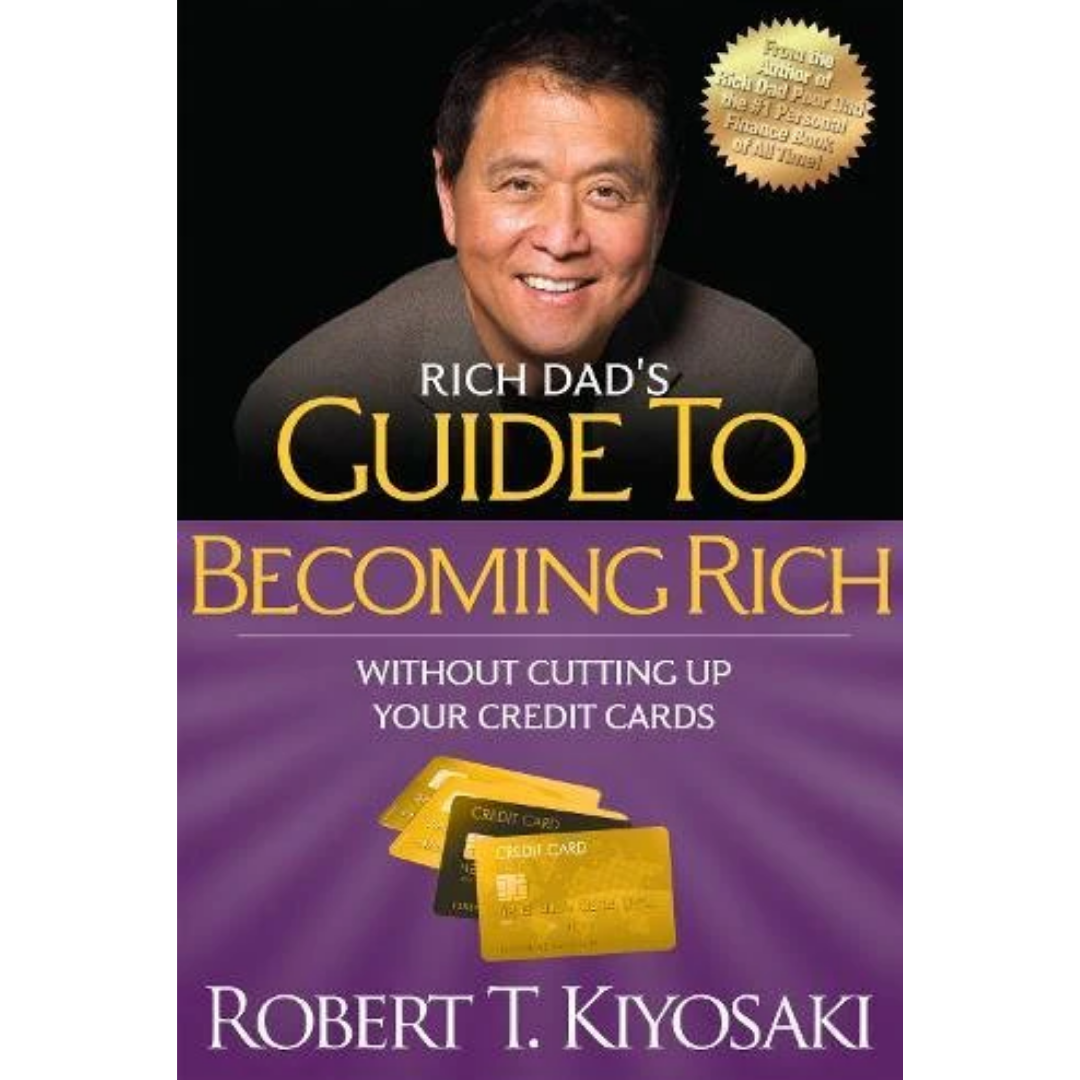
The Book in Brief
Most people are taught a single message about debt: avoid it, fear it, cut up your credit cards, pay everything off and hope that alone makes you financially secure. Rich Dad’s Guide to Becoming Rich Without Cutting Up Your Credit Cards offers a different lesson. Robert Kiyosaki argues that the real problem is often not debt itself but financial illiteracy. Used carelessly, debt can trap you. Used wisely, it can help you acquire assets, create cash flow and build long-term wealth.
The book challenges outdated money advice and shows how financially educated people think differently about borrowing, investing and opportunity. Rather than preaching restriction, it focuses on education, strategy and the idea that money should be a tool, not a burden. It is aimed at readers who are tired of paycheck-to-paycheck stress and want a smarter plan than simply cutting back.
The Problem Is Not Debt. It Is Financial Illiteracy.
The book’s central claim is that most financial trouble stems from a lack of financial education. A person who does not understand how debt works can be harmed by a credit card, a car loan or a mortgage. But a person who understands the mechanics, costs and risks can use the same tools very differently. Robert Kiyosaki compares this to any powerful instrument: a tool that can build or destroy, depending on the skill of the person holding it.
This perspective shifts the question from “Should I have debt?” to “Do I understand what I am doing with debt?” It places responsibility on learning, not on fear, and it encourages readers to measure their own knowledge honestly before borrowing.
Good Debt and Bad Debt
The signature distinction of the book is between good debt and bad debt. In the Rich Dad framework, bad debt is borrowing used to buy things that take money out of your pocket, such as consumer goods, depreciating items or lifestyle expenses. Good debt is borrowing used to acquire assets that put money in your pocket, such as an income-producing property or a business, where the income covers the cost of the loan and leaves something extra.
A common way to express the idea is to ask who pays the debt. If you pay for it from your own earned income, it is likely to be bad debt. If an asset pays for it, it is more likely to be good debt. The distinction is not a guarantee, because assets can fail and markets can change, but it provides a practical test that readers can apply before taking on a loan.
Why Cutting Up Credit Cards Does Not Solve Money Problems
The title makes a provocative promise, and the book explains it carefully. Cutting up a credit card removes a temptation, but it does not teach anyone how money works. A person who cuts their cards and continues to spend beyond their means will find other ways to fall short. A person who understands cash flow, on the other hand, can use credit deliberately, with clear limits and a plan.
The book does not suggest that credit cards are harmless. Rather, it argues that treating them as the root of the problem misses the larger point. Spending habits, lack of financial knowledge and the absence of assets are what keep people stuck. Reducing debt may help, but without education and income-building, the cycle often returns.
How Financially Educated People Use Leverage
Leverage is the use of borrowed money to control an asset larger than you could buy with your own cash alone. Rich Dad’s lessons emphasize that financially educated people use leverage strategically. A real estate investor, for instance, may use a loan to purchase a rental property and rely on the rent to cover the payments. A business owner may borrow to fund growth that is expected to increase income.
The book is careful to note that leverage cuts both ways. Borrowed money can magnify gains, but it can also magnify losses. That is why financial education is central: understanding risk, cash flow and exit options is essential before using leverage. The skills described in Rich Dad’s Guide to Investing and Rich Dad’s Increase Your Financial IQ support this decision-making.
Assets, Not Liabilities, Create Freedom
The book returns to a core Rich Dad principle that assets, not liabilities, create freedom. A person with many liabilities and few assets is always one setback from trouble. A person with growing assets that produce income has options. The book encourages readers to look at their balance sheet, identify which debts support assets and which support only consumption, and begin to shift the balance.
This ties debt management directly to wealth building. Paying down bad debt frees cash flow, and that cash flow can be directed toward acquiring assets. Over time, the assets generate income that supports a more secure and flexible life.
How Fear Keeps People Stuck
Fear is a major theme. Many people fear debt because they have seen it cause harm, and that fear is understandable. But the book argues that fear can also keep people from learning. A person who avoids anything involving borrowing may also avoid the opportunity to learn how investors and entrepreneurs use credit constructively. In this view, fear without education leads to avoidance, and avoidance can keep a person on the sidelines for decades.
The antidote is knowledge and gradual experience. Readers are encouraged to start small, learn the rules and build confidence through practice, rather than leaping into complex deals or staying away entirely.
Why Traditional Advice Misses the Bigger Picture
Traditional advice about debt tends to focus on reducing it. That makes sense for many people, especially those with high-interest consumer debt. But Robert Kiyosaki argues that such advice rarely explains how debt can be used to build wealth, nor does it cover how taxes and inflation interact with borrowing. By focusing only on restriction, the advice can leave people with less risk but also less opportunity.
The Rich Dad approach aims to give readers a bigger picture: how income, expenses, assets, liabilities, taxes and debt fit together. This is a broader lens than “spend less, save more,” and it is the reason the book speaks to people who want more than a budget.
Improving Your Financial Report Card
The book encourages readers to improve their financial report card over time. In the Rich Dad system, a person’s financial statement acts like a report card, showing how they are actually doing with money rather than how they think they are doing. Reviewing it regularly reveals whether income is growing, whether expenses are under control and whether the asset column is expanding. The book suggests using that feedback to guide decisions.
The practical tip is simple. Review your numbers each month, ask what each debt is buying and set small goals for increasing assets and reducing bad debt.
Smarter Decisions Matter More Than Earning More
The book makes a final point that earning more money does not by itself solve financial problems. Without better decisions, higher income can simply fund higher spending and more debt. Smarter decisions, informed by education, matter more than the size of the paycheck. That is why the book emphasizes thinking and strategy over tactics for cutting back.
What Readers Will Learn
- The difference between good debt and bad debt
- Why cutting credit cards alone does not solve money problems
- How financially educated people use leverage strategically
- Why assets, not liabilities, create freedom
- How fear keeps many people financially stuck
- Why traditional advice often misses the bigger picture
- How to improve your financial report card over time
- Why smarter decisions matter more than simply earning more
Where It Fits in the Rich Dad Library
This book complements Rich Dad’s Increase Your Financial IQ and Rich Dad’s Who Took My Money?, which also address money management and velocity. It builds on Rich Dad Poor Dad, which introduced the asset and liability distinction. Readers who want the broader picture of how the rich invest can continue to Rich Dad’s Guide to Investing. The Debt section of the Rich Dad website offers additional articles on the topic.
Who Will Get the Most From It
- People carrying debt who want a better plan
- Readers tired of paycheck-to-paycheck stress
- Beginners learning how money really works
- Entrepreneurs and investors seeking leverage strategies
- Fans of Rich Dad Poor Dad wanting deeper lessons
A Note on Responsible Use
The ideas in this book involve borrowing, and borrowing carries risk. The book is educational and is not personalized financial advice. Readers should learn the rules, consider their own circumstances and consult qualified professionals before taking on debt. As the book itself stresses, the aim is not to borrow more but to understand money well enough to make better choices.
Takeaway
Rich Dad’s Guide to Becoming Rich Without Cutting Up Your Credit Cards reframes debt as something to understand rather than simply fear. Its message is that financial education, not restriction, is what turns debt from a burden into a tool. For readers who want to stop fearing debt and start understanding money, it offers a clear and thoughtful next step.
Product Reviews
Erik Navarro
I like very very much! go to my freedom
Richard
Me llegaron ambos productos, de muy buena calidad, me gustó mucho q volvieron a los billetes en sus 12 denominaciones, lo q si vi q cambio bastante fue el cashflow for kids, ahora es mas sencillo ya que las cantidades solo son por multiplos de 100 entiendo q lo hacen para hacilidad en el calculo con los niños, sin embargo an la antigua version habian triangulos azules q representaban los ingresos ganados cosa q extrañe mucho ya q con ello podia ver la diferencia con los ingresos pasivos….gracias
Angelo Galante
Greatest game for children. I love teaching them all this good stuff
Johnny Midas
This is not some cheap off-brand board game. It’s as high quality as anything you’d buy from Parker Brothers, and after a few games my 13 year old is understanding financial statements better than I did in college! This should be a required purchase for all parents. Hint: play the kids version first. It is fast, fun, and just as educational.
Logan Manzanares
Love the trilogy