

The Book in Brief
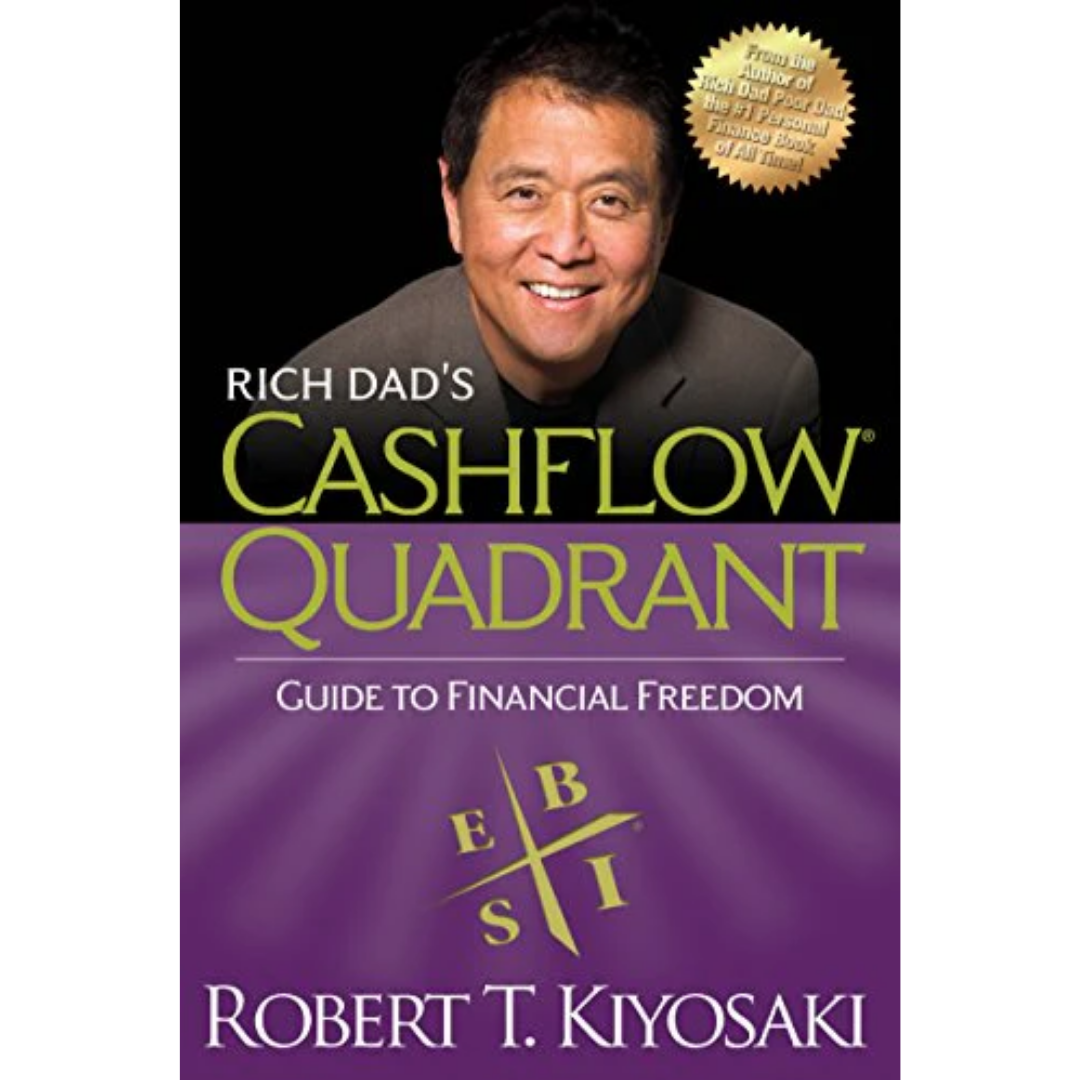
Most people were taught one path: go to school, get a job, work hard and retire someday. Rich Dad’s CASHFLOW Quadrant asks what happens if that path no longer leads to freedom. In this bestselling Rich Dad classic, Robert Kiyosaki explains why some people spend their lives trading time for money, while others build businesses and investments that generate income without them. The book’s organizing tool is the CASHFLOW Quadrant, a simple framework that shows the four ways people make money.
The book is positioned as the natural next step after Rich Dad Poor Dad. If that book changed how readers think about money, the CASHFLOW Quadrant shows them where to go next. It does not just teach how to earn more. It teaches readers to think differently about income, assets, business and freedom.
The Four Quadrants: E, S, B and I
The CASHFLOW Quadrant divides the world of earning into four quadrants, each marked by a letter:
- E, Employee: works for a company and receives income from an employer.
- S, Self-Employed: works for themselves, owning a job or a small business that depends on their personal effort.
- B, Business Owner: owns a system, usually staffed by others, that produces income without the owner doing the work.
- I, Investor: uses money to make money, earning income from assets rather than from labor.
The framework looks simple, but it carries a powerful insight. Two people can earn the same amount of money in different quadrants and live very different financial lives. An employee and a business owner might each earn a hundred thousand dollars in a year, but the way that income is generated, taxed and sustained is very different. One depends on continuing to show up. The other can continue even when the owner steps away.
Left Side and Right Side
The quadrant is divided down the middle. The left side contains E and S, the quadrants in which income depends on personal time and effort. The right side contains B and I, where income comes from systems and assets. Rich Dad’s argument is that most people spend their entire lives on the left side, because that is what schools and families prepare them for, while financial freedom is more often found on the right.
This does not mean that left-side work is bad. Employees and self-employed professionals provide essential services, and many find real satisfaction in their work. The point is about leverage and options. Income on the left side usually stops when you stop, and is typically taxed at higher rates. Income on the right side can continue without daily labor and may benefit from different tax treatment. The book encourages readers to understand these differences and to decide consciously where they want to build their lives.
Why Job Security Is Not Financial Security
One of the book’s most challenging lessons is that job security is not the same as financial security. A job can provide a steady paycheck, benefits and a sense of stability, but it also leaves a person dependent on one employer’s fortunes. Layoffs, restructuring, industry shifts and company failures can all remove a paycheck quickly. Financial security, in the Rich Dad sense, means owning assets that continue to produce income regardless of any one job.
Robert Kiyosaki is careful to acknowledge why security is attractive. Many people have responsibilities, families and obligations, and wanting stability is natural. The book’s point is that security-seeking can quietly crowd out the pursuit of freedom, and that readers benefit from knowing the difference.
Different Quadrants, Different Mindsets
A distinctive feature of the book is its treatment of mindset. People in each quadrant tend to think differently about work, risk and money. An employee may prize stability, benefits and clear expectations. A self-employed person may value independence and control, and often believes that doing the work personally is the best way to ensure quality. A business owner tends to think in terms of systems, teams and leverage. An investor thinks in terms of capital, return and risk.
These mindsets explain why changing quadrants is often harder than learning a new skill. Moving from E or S to B or I requires a shift in beliefs and habits as well as knowledge. The book describes the emotional challenges, including fear of failure, fear of losing security and fear of what other people will think, and it encourages readers to face them openly.
Building Systems That Make Money
The B quadrant is built on systems. Robert Kiyosaki explains how entrepreneurs create systems, teams and processes that earn money without constant personal effort. A system can be as simple as a repeatable way to deliver a service or as complex as a global operation, but the principle is the same: the business should be able to function when the owner is not doing every task.
This idea ties closely to Rich Dad’s Before You Quit Your Job, which explores the difference between building a business and buying yourself a job. Together, the two books give readers a map for moving from the S quadrant to B.
Using Money to Make Money
The I quadrant is where money works for you. Investors use capital to acquire assets such as real estate, businesses or paper assets that produce income. The book explains why investors can benefit from compounding returns and from the tax treatment that often applies to investment income. It also emphasizes that investing is a skill that requires education. Robert Kiyosaki warns against passive trust in others, encouraging readers to understand what they are investing in and how it produces cash flow.
This reinforces a core Rich Dad message: financial education is the foundation of every quadrant. Whether one is an employee, an entrepreneur or an investor, knowing how money works leads to better decisions.
Mindset Shifts for Moving Beyond Earned Income
The book identifies several mindset shifts needed to move beyond earned income:
- From trading time for money to building systems and assets
- From seeking security to seeking freedom, with eyes open to the risks
- From spending raises on lifestyle to directing them toward assets
- From waiting for permission to learning and acting
- From fear of mistakes to using mistakes as education
These shifts are described as practical changes in how a person approaches decisions, not as abstract ideas. Over time, each choice either strengthens a person’s position on the left side or builds toward the right.
Starting to Build Assets, Not Liabilities
The book returns to the asset and liability distinction from Rich Dad Poor Dad, applying it to the quadrants. An employee or self-employed person who spends everything they earn on liabilities remains on the left side indefinitely. One who directs part of their income into assets begins to build a bridge to the right. The book suggests starting where you are, with the income you have, and gradually accumulating assets that produce cash flow.
Why Schools Teach Employees
A final theme is that schools teach employees but rarely teach freedom. The traditional education system prepares students for careers in the E and S quadrants, and little time is devoted to the skills needed in B and I, such as leadership, sales, finance and investing. Robert Kiyosaki encourages readers to fill that gap through their own learning, with books, mentors, courses, games and real-world experience.
What Readers Will Learn
- Why job security is not the same as financial security
- How entrepreneurs build systems that make money
- Why investors use money to make more money
- The mindset shifts needed to move beyond earned income
- How to start building assets instead of liabilities
- Why schools teach employees but rarely teach freedom
A Self-Assessment to Try
Readers can apply the framework immediately with a short exercise. Write down every source of income from the past year and label each as E, S, B or I. Add up the percentages. Most people will find they are close to one hundred percent on the left side. Then set a direction for the next year: perhaps one small step toward B, such as documenting a business process, and one toward I, such as learning about a first investment. The goal is not to quit a job but to begin shifting the balance.
Where It Fits in the Rich Dad Library
The CASHFLOW Quadrant is one of the pillars of the Rich Dad philosophy, and the CASHFLOW board game takes its name from the same concept. It sits between Rich Dad Poor Dad, which lays the foundation, and Rich Dad’s Guide to Investing, which goes deeper into the I quadrant. Midas Touch and Before You Quit Your Job expand on the B quadrant.
Who Will Get the Most From It
- Employees who want more control over their future
- Entrepreneurs ready to grow beyond self-employment
- Investors seeking long-term wealth strategies
- Anyone ready to stop working only for money
Takeaway
Rich Dad’s CASHFLOW Quadrant offers a deceptively simple map of how people earn and why it matters. By understanding the four quadrants and the thinking that goes with each, readers can make deliberate choices about where to invest their time, energy and education. The book does not promise an easy path, but it gives a clear direction: toward income that works whether you do or not.
Product Reviews
Joseph Ciavarelli
Opened my mind / eyes..Educating myself and my family to reach for our financial freedom.
SJ
I've read this book and very inspiring and got lot of Great information. When I read this book I would lay it done and process all of the information in Each Chapter. It's Definitely worth Reading. Robert Kiyosaki won't disappoint. I'm Currently Reading RICH DAD POOR DAD RIGHT NOW. I plan getting more books written by RTK
Amy Ma
Haven’t opened yet but delivery was fast
LaSchelle Quarterman
I purchased CASHFLOW to play with my three grandchildren, ages 12, 12, and 11, and they absolutely LOVE it! What surprised me the most is that they were able to learn and enjoy the adult version of the game. One of my 12-year-old grandsons has already made it out of the Rat Race and onto the Fast Track!
Playing CASHFLOW has become part of our nightly routine. After the kids take their showers and get ready for bed, we sit down and play for about an hour. Believe it or not, this game has even made bedtime routines easier! They are so excited to play that they stay on task and get everything done without me having to constantly remind them.
Initially, I was concerned that the game might be too complicated for their ages. However, by the third night, they had caught on and were playing with confidence. I even ordered the children's version because I thought the adult version would be too difficult, but now I'm not sure we'll even need it!
Our CASHFLOW game has become a permanent fixture on the dining room table! We leave the board set up with everyone's pieces in their spaces, along with their financial sheets and money, so we can pick up right where we left off the following evening.
I also highly recommend watching the YouTube tutorial on how to play CASHFLOW. It was extremely informative and helped us understand the game much better.
As a grandmother, I love that my grandchildren are having fun while learning valuable lessons about money, investing, financial decisions, and building wealth. These are life skills that I believe children should be introduced to at an early age.
I highly recommend CASHFLOW to families with children! Don't underestimate what kids can learn when they're engaged and having fun. This has turned into much more than just a board game for our family. It's become quality time together, a learning experience, and something we all look forward to every evening!
Erik Navarro
I like very very much! go to my freedom