

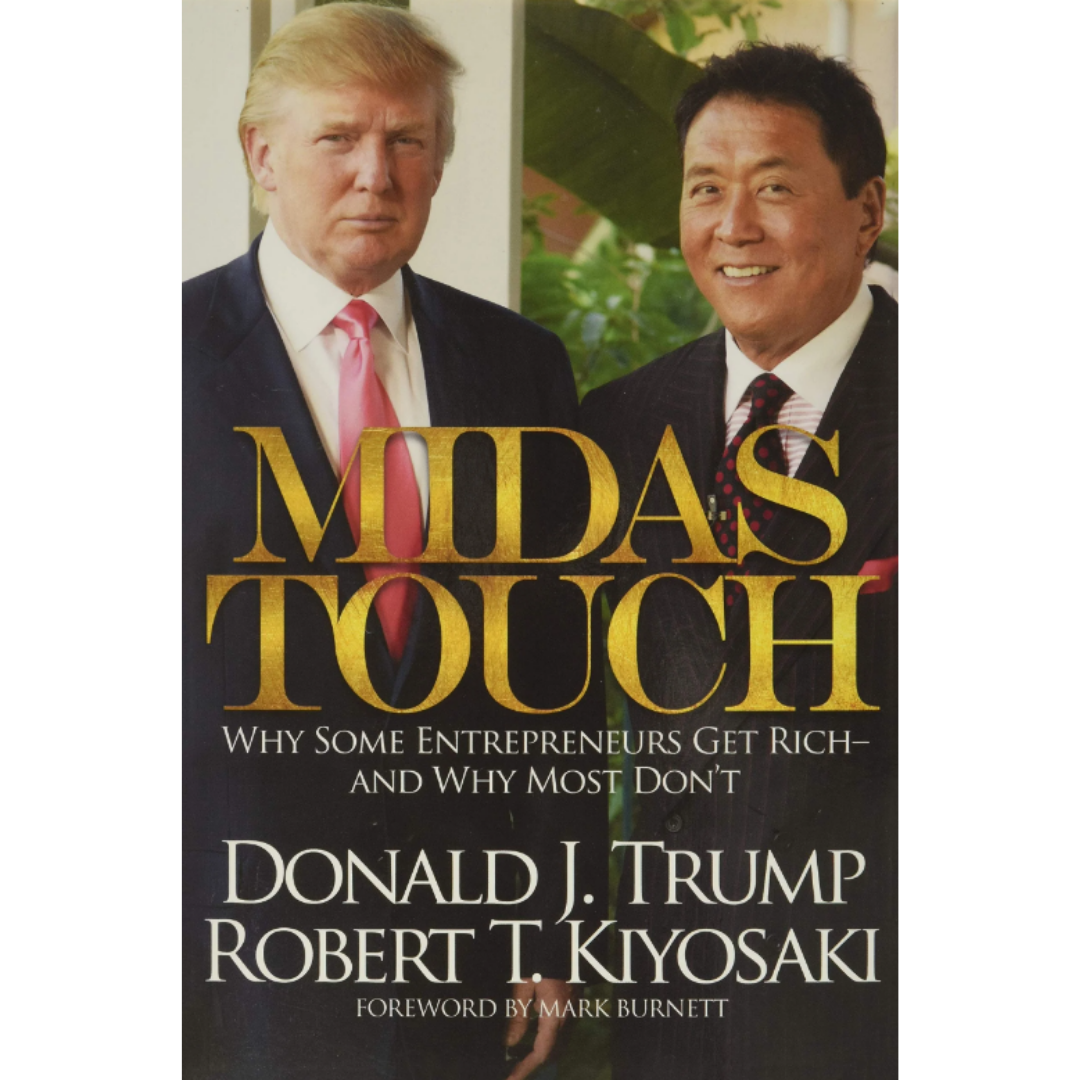
The Book in Brief
Most people dream about starting a business, and few build one that lasts. Midas Touch, written by Donald Trump and Robert Kiyosaki, sets out to explain the difference. The book is not a textbook filled with theory. It is presented as a practical guide from two entrepreneurs who describe having won, lost, rebuilt and built again, and who want readers to understand what it really takes to create opportunities, grow a brand, recover from setbacks and build businesses that generate wealth.
The central idea is that success is not luck. It is built one decision, one skill and one lesson at a time. Where many business books teach tactics, Midas Touch is about how entrepreneurs think, and it challenges the employee mindset that many readers have been trained to hold since childhood.
The Five Fingers of the Midas Touch
At the center of the book is a memorable framework called the Five Fingers of the Midas Touch. Each finger represents a core quality that every entrepreneur must develop: strength of character, focus, brand, relationships, and the little things that count. The hand image makes the framework easy to remember, and it reinforces the idea that these qualities work together. A weak finger weakens the grip.
Finger One: Strength of Character
The first quality is strength of character, the ability to handle failure, pressure and setbacks. The book treats emotional strength as a business skill, not a personality trait reserved for a lucky few. Entrepreneurs face rejection, financial stress and public mistakes, and those who cannot manage their emotions in those moments often quit or make decisions they regret. The authors argue that character shows up when conditions are worst.
This finger also covers a theme the book returns to repeatedly: turning bad luck into opportunity. Setbacks are unavoidable, but the way an entrepreneur interprets and responds to them shapes what happens next. In the Rich Dad tradition, failure is treated as education rather than a verdict. Each mistake teaches something, and the people who build lasting businesses are often those who keep learning while others stop.
Finger Two: Focus
The second quality is focus: directing energy where results happen. Entrepreneurs are constantly pulled in many directions by new ideas, urgent requests and tempting side projects. The book suggests that the ability to decide what matters, and to ignore what does not, is one of the most valuable skills a business owner can develop. Focus is not just about working hard. It is about concentrating effort on the activities that produce income and growth.
This connects to Robert Kiyosaki’s long-standing distinction between being busy and being productive. An employee is often paid for time, while an entrepreneur is rewarded for results. The book encourages readers to ask where their hours are going and whether those hours are building something that can grow.
Finger Three: Brand
The third quality is brand: standing for something people remember. The book frames a brand as more than a logo or a name. It is a promise about quality, trust and identity that customers carry in their minds. Strong brands make selling easier, support higher prices and create loyalty that competitors struggle to copy. The authors explain how successful brands are built and why entrepreneurs who ignore brand often compete only on price.
For small business owners and side hustlers, the lesson is practical. A brand can begin with a clear answer to a simple question: what do we want to be known for? Consistently delivering on that answer, over time, builds recognition and trust that no advertising budget can fully replace.
Finger Four: Relationships
The fourth quality is relationships: building partnerships and teams that grow success. The book emphasizes that entrepreneurs rarely succeed alone. Employees, advisors, partners, suppliers and customers all contribute to a business, and the quality of those relationships often determines how far the business can go. The authors explain why relationships can multiply results, allowing one person’s effort to be extended through the efforts of many.
This finger also reflects a Rich Dad principle: entrepreneurship is a team sport. A person who tries to do everything personally may build a good job but not a business that can operate without them. Learning to attract, lead and reward good people is part of the shift from self-employed to business owner.
Finger Five: Little Things That Count
The fifth quality is the little things that count: mastering details others ignore. Small improvements, repeated over time, can create big breakthroughs. The book argues that many successful entrepreneurs distinguish themselves not through one dramatic move but through consistent attention to details in service, quality, follow-up and presentation. These details signal professionalism and care, and customers notice them even when they cannot name them.
This finger rounds out the hand. Character, focus, brand and relationships set direction and build trust, while attention to detail turns plans into reliable results.
Employee Thinking vs. Entrepreneur Thinking
A major theme running through Midas Touch is the contrast between employee thinking and entrepreneur thinking. The book makes the point that job security is different from financial security. A job can provide a steady paycheck, but it can also be taken away, and it rarely builds assets. Entrepreneurs accept more uncertainty in exchange for the possibility of building something that grows beyond their own hours and efforts.
The authors also describe the sacrifices and rewards of building a meaningful business. Readers are offered a realistic look at the pressure, the long hours and the emotional ups and downs, along with the freedom, income and impact that can follow. The tone is encouraging but not naive.
What Readers Will Learn
- Why most entrepreneurs fail and how to avoid common traps
- How to turn bad luck into opportunity
- Why emotional strength matters in business
- How successful brands are built
- Why relationships can multiply results
- How small improvements create big breakthroughs
- Why job security differs from financial security
- What it takes to think and act like an entrepreneur
Putting the Five Fingers to Work
The framework lends itself to a simple self-assessment. Readers can rate themselves from one to ten on each finger and focus first on the weakest. For character, that might mean building habits that help manage stress. For focus, it might mean choosing three priorities for the quarter. For brand, it could mean writing a one-sentence description of what the business stands for. For relationships, it might involve contacting a mentor or potential partner. For little things, it could mean reviewing a customer’s experience from start to finish and fixing one detail.
Where It Fits in the Rich Dad Library
Midas Touch belongs with the entrepreneurship-focused titles, including Rich Dad’s Before You Quit Your Job and Rich Dad’s CASHFLOW Quadrant. Where CASHFLOW Quadrant explains the four ways people earn income and why the business owner and investor sides offer more freedom, Midas Touch focuses on the personal qualities needed to succeed on the business side. It is a natural next step for readers who finish Rich Dad Poor Dad and want to know what building a business actually demands.
Who Will Get the Most From It
- Aspiring entrepreneurs starting their first business
- Side hustlers ready to grow bigger
- Business owners who want to level up
- Readers of Rich Dad Poor Dad looking for entrepreneurship lessons
- Anyone who wants more freedom, income and impact
Pitfalls the Five Fingers Help Prevent
The framework is easiest to appreciate by looking at what happens when a finger is weak. These examples illustrate the framework and are not case studies from the book. An entrepreneur with little strength of character may quit after the first serious setback. One without focus may chase every new idea and finish none. A founder who neglects brand may find that customers cannot say what the business stands for. Someone who ignores relationships may try to do everything alone and burn out. And an owner who overlooks the little things may lose customers over avoidable errors in service or follow-up. Seen this way, the Five Fingers work as a diagnostic: when a business stalls, readers can ask which finger needs strengthening first.
Takeaway
Midas Touch offers a clear and memorable model for the qualities that separate lasting entrepreneurs from the rest. Its message is that success is built, not found, and that anyone willing to develop character, focus, brand, relationships and attention to detail can improve their odds. For readers deciding whether to take the leap, it provides both inspiration and a realistic checklist of what to work on first.
Product Reviews
Joseph Ciavarelli
Opened my mind / eyes..Educating myself and my family to reach for our financial freedom.
SJ
I've read this book and very inspiring and got lot of Great information. When I read this book I would lay it done and process all of the information in Each Chapter. It's Definitely worth Reading. Robert Kiyosaki won't disappoint. I'm Currently Reading RICH DAD POOR DAD RIGHT NOW. I plan getting more books written by RTK
Amy Ma
Haven’t opened yet but delivery was fast
LaSchelle Quarterman
I purchased CASHFLOW to play with my three grandchildren, ages 12, 12, and 11, and they absolutely LOVE it! What surprised me the most is that they were able to learn and enjoy the adult version of the game. One of my 12-year-old grandsons has already made it out of the Rat Race and onto the Fast Track!
Playing CASHFLOW has become part of our nightly routine. After the kids take their showers and get ready for bed, we sit down and play for about an hour. Believe it or not, this game has even made bedtime routines easier! They are so excited to play that they stay on task and get everything done without me having to constantly remind them.
Initially, I was concerned that the game might be too complicated for their ages. However, by the third night, they had caught on and were playing with confidence. I even ordered the children's version because I thought the adult version would be too difficult, but now I'm not sure we'll even need it!
Our CASHFLOW game has become a permanent fixture on the dining room table! We leave the board set up with everyone's pieces in their spaces, along with their financial sheets and money, so we can pick up right where we left off the following evening.
I also highly recommend watching the YouTube tutorial on how to play CASHFLOW. It was extremely informative and helped us understand the game much better.
As a grandmother, I love that my grandchildren are having fun while learning valuable lessons about money, investing, financial decisions, and building wealth. These are life skills that I believe children should be introduced to at an early age.
I highly recommend CASHFLOW to families with children! Don't underestimate what kids can learn when they're engaged and having fun. This has turned into much more than just a board game for our family. It's become quality time together, a learning experience, and something we all look forward to every evening!
Erik Navarro
I like very very much! go to my freedom