

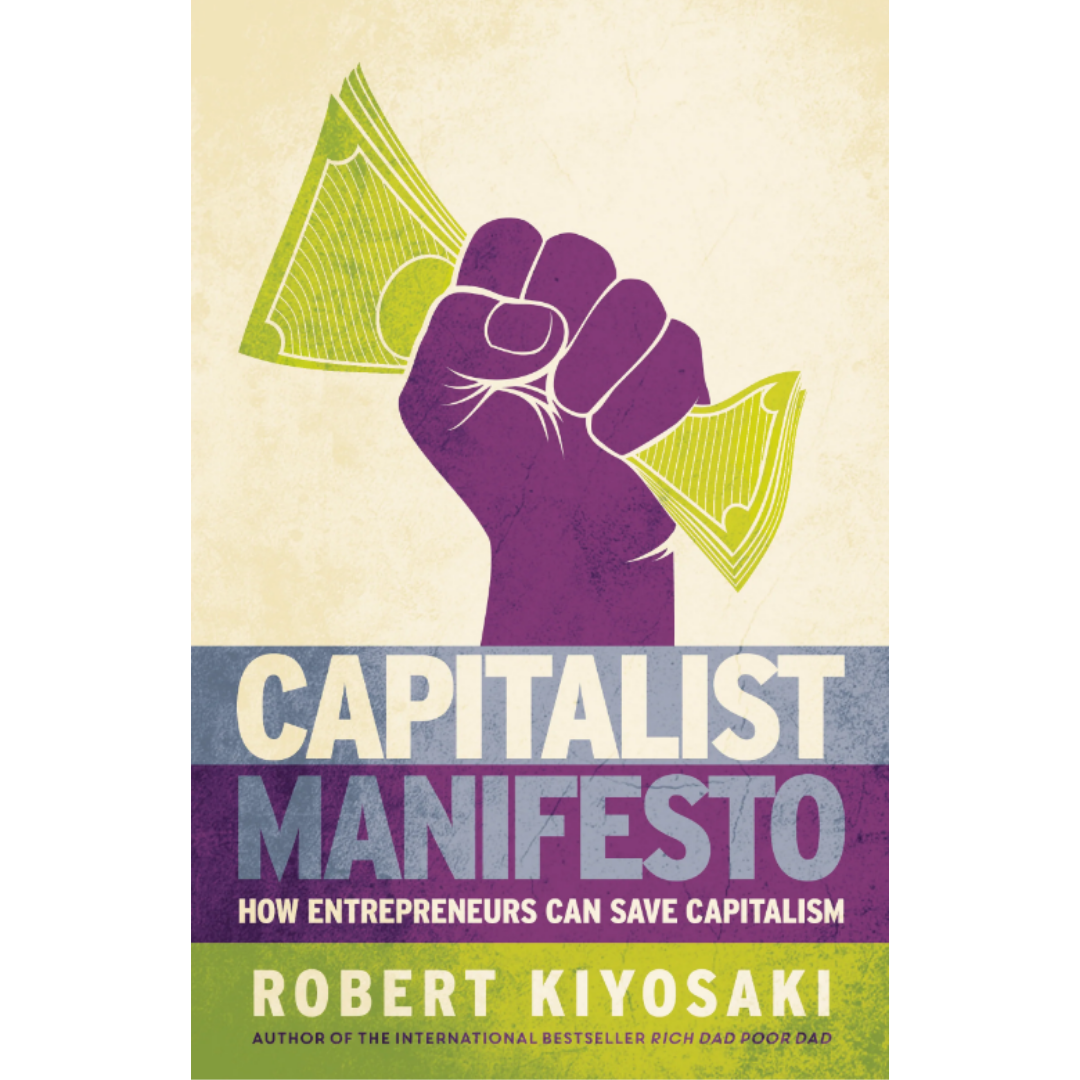
The Book in Brief
Capitalist Manifesto is the most openly political title in the Rich Dad library. Robert Kiyosaki writes it as both a warning and a call to action. His central claim is that principles from Karl Marx’s Communist Manifesto are being taught in schools today, and that the most effective response is not anger but education: teaching capitalism, and the money skills that make it work, in the home. The subtitle, How Entrepreneurs Can Save Capitalism, shows where he places the responsibility. In his view, a free-market system survives only when ordinary people understand it well enough to take part in it, and entrepreneurs and informed investors are the people who show that it works.
The book draws on more than fifty years of Robert Kiyosaki’s personal experience. That history includes service as a U.S. Marine Corps pilot during the Vietnam War, which he presents as the root of his lifelong opposition to communism. He uses those experiences to argue that warnings from the past have come true in today’s world, and he frames the book as an effort to hand those warnings to a new generation before the lessons are lost.
Why Robert Kiyosaki Wrote It
Robert Kiyosaki states his purpose plainly in the material that accompanies the book: he has been fighting communism for much of his life, and he wrote Capitalist Manifesto so that communist ideals taught in schools can be answered by teaching capitalism at home. That single idea explains the structure of the whole project. The book is not written as a policy paper for legislators. It is written for parents, grandparents, workers and would-be business owners who want to take responsibility for what the next generation learns about money, work and freedom.
This framing matters because it shifts the focus from institutions to individuals. Instead of asking readers to wait for a school system or a government to change, Robert Kiyosaki asks them to act within their own families. The practical message is that financial and economic education is something people can start giving each other tonight, at the kitchen table, without anyone’s permission.
Three Institutions Under the Microscope
According to the book’s description, Robert Kiyosaki turns his attention to three institutions: the National Education Association, the Internal Revenue Service, and the Federal Reserve Bank. Each represents a different piece of the system that shapes how people earn, spend and think about money. The education association stands for what is taught. The tax agency stands for how earned income is treated. The central bank stands for the money itself. His argument is that these three areas work together to shape financial lives, and that most people have never been taught to examine them.
Throughout the Rich Dad library, Robert Kiyosaki has argued that the tax code treats employees, business owners and investors very differently, and that the nature of money itself deserves more scrutiny than it usually gets. Capitalist Manifesto gathers those long-running themes under a single political banner. Readers who know his earlier work will recognize the concerns. Readers new to him will find a direct introduction to the way he connects personal finance to larger questions about power and freedom.
Education as the Battleground
The education system is the center of the book’s argument. Robert Kiyosaki contends that schools teach students to become employees rather than owners, and that the same classrooms now carry ideas he believes are hostile to the free-market system. This builds on a theme from the first Rich Dad book: that schools prepare people for jobs but rarely teach them how money works, how assets differ from liabilities, or how wealthy people use business and investing to build income that does not depend on a paycheck.
In Capitalist Manifesto the concern is broader than missing lessons. Robert Kiyosaki argues that what is taught, and what is left out, shapes how a generation thinks about wealth, risk and entrepreneurship. If young people are taught to distrust profit and ownership, he suggests, they will be less likely to build businesses or invest, and the economy that depends on them will suffer. He treats the home as the place where a different set of lessons can be taught.
The Home as the Classroom
The most practical thread in the book is the idea that capitalism has to be taught on purpose. Robert Kiyosaki offers what the product description calls practical alternatives for individuals and families. The underlying principle is consistent with everything Rich Dad has taught for decades: financial education is a skill, skills are learned through practice, and practice can begin early. Parents who play money games with their children, talk openly about assets and liabilities, and encourage small business projects are, in this view, doing more to protect capitalism than any political campaign could.
This connects the book to the wider Rich Dad education ecosystem, including the CASHFLOW board game, which was designed to teach the language of money through play. The Capitalist Manifesto adds a civic dimension to that mission. It argues that financial education is not only a route to personal freedom but also a way to preserve the system that allows personal freedom to exist.
Practical Alternatives for Individuals and Families
Without reproducing the book’s chapters, the themes it emphasizes can be summarized as a set of actions readers are encouraged to take:
- Treat financial education as a family responsibility rather than something to outsource to schools.
- Learn the difference between earning income as an employee and building income through businesses and investments.
- Question institutions and sources of information instead of accepting them automatically.
- Encourage entrepreneurship in children and in yourself, including the willingness to take small, educated risks.
- Defend the freedom to speak and learn the truth, even when it is uncomfortable.
Each of these actions reflects a long-standing Rich Dad conviction. Knowledge produces choices, and people who understand money and business have more options than people who do not.
Freedom of Truth
One phrase in the book’s description stands out: the call to preserve our freedoms, especially the freedom of truth. For Robert Kiyosaki, truth is not only a political value but a financial one. People who do not know how money, taxes and debt actually work make poorer decisions, and those decisions benefit others who understand the system better. His message is that independent thinking is the first asset any person should build. Reading widely, questioning assumptions and learning directly from experience are, in his view, forms of financial protection.
Where It Fits in the Rich Dad Library
Capitalist Manifesto sits alongside titles such as Unfair Advantage, Why the Rich Are Getting Richer and FAKE, all of which explore what Robert Kiyosaki sees as gaps in conventional education and financial advice. It differs from them in its explicit political framing. Where Rich Dad Poor Dad introduces the personal lessons of assets and liabilities, Capitalist Manifesto asks what happens to those lessons when a society stops teaching them. Readers who want the personal fundamentals first may prefer to start with Rich Dad Poor Dad or Rich Dad’s CASHFLOW Quadrant and come to this book afterward.
Who Will Get the Most From It
The book is aimed at readers who already share, or are open to, Robert Kiyosaki’s concern about the direction of education and economic thinking. It will be most useful to:
- Parents and grandparents who want a framework for teaching children about capitalism at home
- Entrepreneurs and aspiring business owners who see ownership as a path to freedom
- Long-time Rich Dad readers who want to see how the philosophy connects to current debates
- Readers who value Robert Kiyosaki’s first-person experiences, including his time as a Marine Corps pilot
A Note on Context
Capitalist Manifesto is a work of political and economic advocacy. Its claims about education, taxation and monetary policy reflect Robert Kiyosaki’s own conclusions, and they are disputed by many economists, educators and historians. Readers who want a full picture will benefit from reading opposing views alongside this one and from checking factual claims against primary sources. The book’s lasting practical contribution is likely to be its insistence that financial education should start at home and that every household can begin to teach it today.
Questions to Consider While Reading
Because the book is an argument as much as a collection of ideas, it rewards active reading. Readers may find it useful to pause on a few questions:
- How does the author define capitalism, and what would a fuller definition include, such as property rights, competition, risk and the role of rules?
- Which factual claims about institutions can be checked against primary sources, and what do those sources say?
- What financial or economic topics were never taught in my own education, and where could I learn them?
- What is one concrete way my family could begin teaching money and business skills this month?
Working through questions like these turns the book from a statement of opinion into a prompt for independent research, which is the habit Robert Kiyosaki says he most wants to encourage.
Product Reviews
Joseph Ciavarelli
Opened my mind / eyes..Educating myself and my family to reach for our financial freedom.
SJ
I've read this book and very inspiring and got lot of Great information. When I read this book I would lay it done and process all of the information in Each Chapter. It's Definitely worth Reading. Robert Kiyosaki won't disappoint. I'm Currently Reading RICH DAD POOR DAD RIGHT NOW. I plan getting more books written by RTK
Amy Ma
Haven’t opened yet but delivery was fast
LaSchelle Quarterman
I purchased CASHFLOW to play with my three grandchildren, ages 12, 12, and 11, and they absolutely LOVE it! What surprised me the most is that they were able to learn and enjoy the adult version of the game. One of my 12-year-old grandsons has already made it out of the Rat Race and onto the Fast Track!
Playing CASHFLOW has become part of our nightly routine. After the kids take their showers and get ready for bed, we sit down and play for about an hour. Believe it or not, this game has even made bedtime routines easier! They are so excited to play that they stay on task and get everything done without me having to constantly remind them.
Initially, I was concerned that the game might be too complicated for their ages. However, by the third night, they had caught on and were playing with confidence. I even ordered the children's version because I thought the adult version would be too difficult, but now I'm not sure we'll even need it!
Our CASHFLOW game has become a permanent fixture on the dining room table! We leave the board set up with everyone's pieces in their spaces, along with their financial sheets and money, so we can pick up right where we left off the following evening.
I also highly recommend watching the YouTube tutorial on how to play CASHFLOW. It was extremely informative and helped us understand the game much better.
As a grandmother, I love that my grandchildren are having fun while learning valuable lessons about money, investing, financial decisions, and building wealth. These are life skills that I believe children should be introduced to at an early age.
I highly recommend CASHFLOW to families with children! Don't underestimate what kids can learn when they're engaged and having fun. This has turned into much more than just a board game for our family. It's become quality time together, a learning experience, and something we all look forward to every evening!
Erik Navarro
I like very very much! go to my freedom