What You Really Need to Start a Business Without Money
Robert Kiyosaki’s rich dad taught him the B-I Triangle, a model of the eight integrities every business needs. Three form the frame: mission, team, and leadership. Five sit inside it: cash flow, communications, systems, legal, and product. Product is the smallest part of the triangle. Rich Dad’s look at better business systems shows how a company with a product people want can still fail when the other integrities are weak.
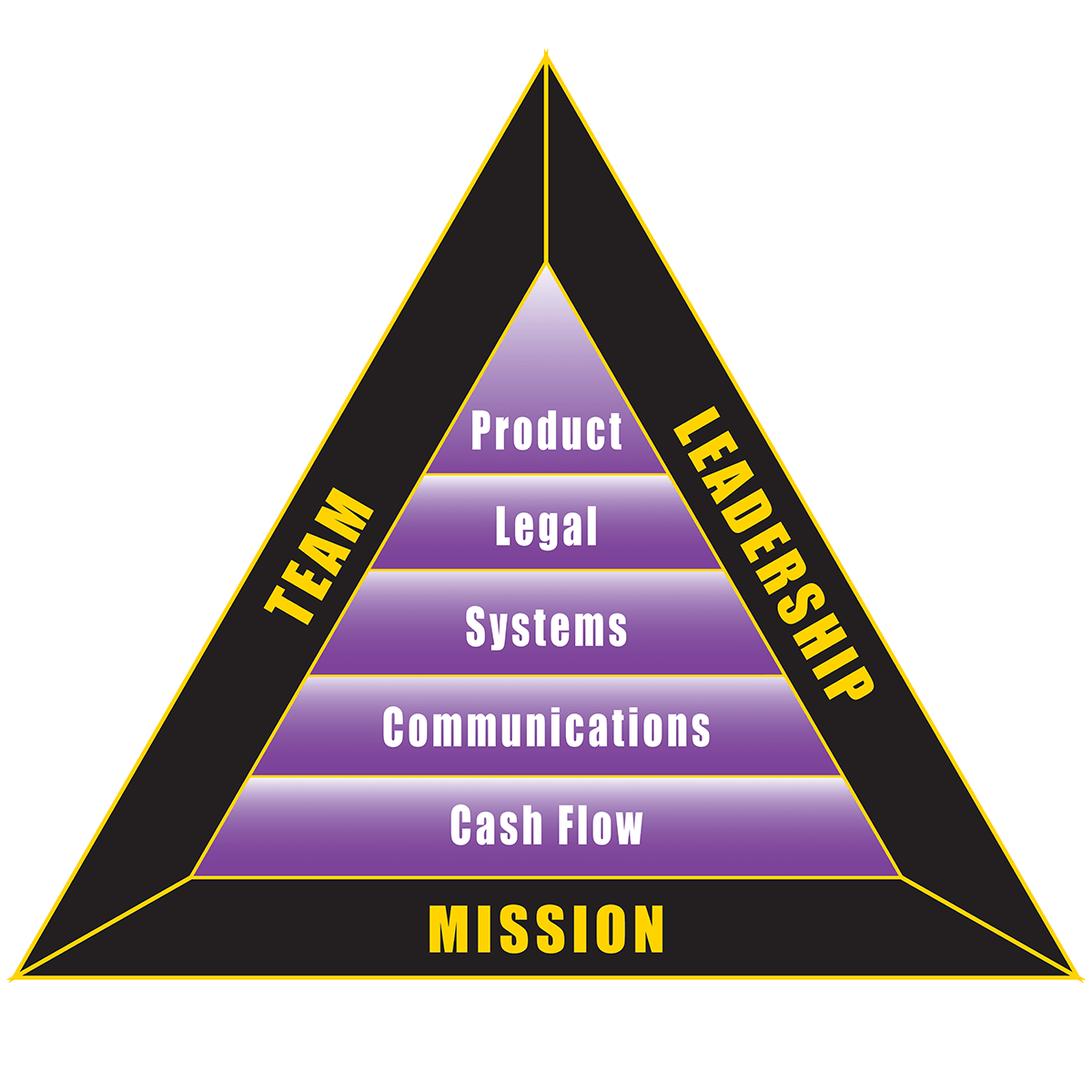
That is good news for anyone without capital. Most of the triangle runs on time, learning, and relationships, not cash. The 12 steps below follow it from the foundation up.
Steps 1–3: Lay the Foundation Before You Build Anything
Step 1: Define Your Mission
The foundation of the B-I Triangle is mission. A business without a mission is like a person without a soul, and starting with no money makes quitting tempting when the work gets hard. A business can’t be only about making money, because there are plenty of joyless ways to do that. Know your why before you spend a single hour on the idea. Rich Dad explains why every business needs a spiritual mission and how to write one.
Step 2: Keep Your Cash Flow Going
Cash flow is another of the eight integrities. Until the business covers your living costs, which can take months or years, a steady paycheck is the cheapest funding there is. If you are employed, don’t quit yet. Save as much as you can, and leave only when your savings can carry the venture. Rich Dad also explains seven ways to start a business without quitting your job and why paying yourself first works differently for entrepreneurs.

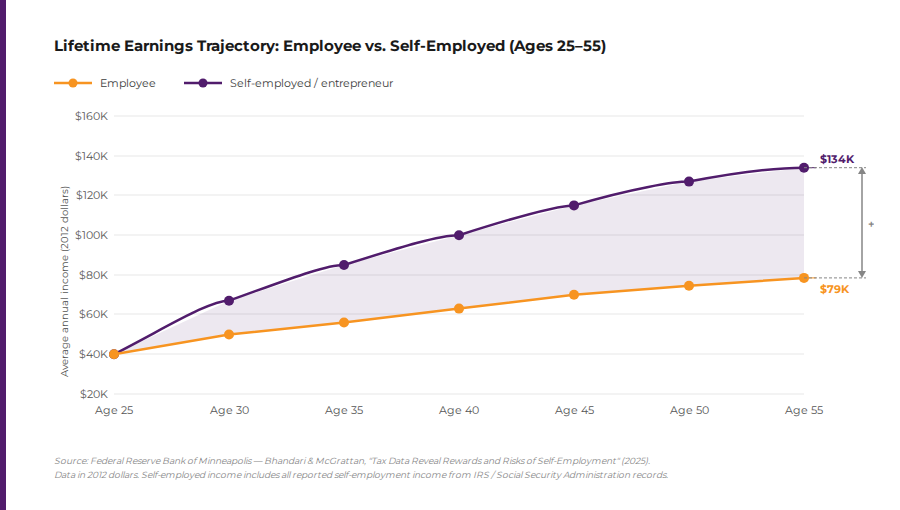
The payoff for making the leap can be large, but it is uneven. A Federal Reserve Bank of Minneapolis analysis of tax data found that by age 55, workers who tried self-employment averaged $134,000 a year versus $79,000 for paid employees, in 2012 dollars. The same research found that, once education and skills are held constant, most self-employed people earn less than comparable employees, and 80% of self-employment income goes to people earning over $100,000. A higher ceiling and higher risk come together, which is why education and a day-job cushion matter.
Step 3: Choose a Product or Service Business
When Robert Kiyosaki began his journey into entrepreneurship in the 1980s, a business needed a lot of startup capital, and a product could fail before it reached the market. The internet changed that. Access to vendors, customers, and results is now nearly instant, and a business can be running within a day.
Once your mission is clear, decide what kind of business to own. A product business sells a good that can be sold without trading your own time, the way Nordstrom sells clothes. A service business sells time, the way a business coach sells consulting. Many businesses grow into a mix of both. The Rich Dad Company is primarily a product company selling education products, with services such as coaching alongside. In the CASHFLOW Quadrant, the B stands for business owner, and the goal is a business whose systems work without you.
Steps 4–7: Research Your Market and Build Your Presence for Free
Step 4: Research the Market and Run a SWOT Analysis
The most expensive mistake costs nothing to make: building something no one wants. Before you build anything, ask three questions. Is the idea unlike anything on the market, or similar to what is already there? If similar, how will you make it better, cheaper, or aimed at a different market? Can you pursue it for the long haul?
Free searches can answer the first two in a couple of hours. Read reviews of competing products on Amazon and Yelp to hear improvement ideas straight from customers. Then run a SWOT analysis of strengths, weaknesses, opportunities, and threats. With no money, a weakness may be the inability to buy advertising, so competing for the same ad slots makes no sense. A strength may be speed and a willingness to take risks, which points to guerrilla marketing.
Step 5: Become an Industry Expert
Position yourself as a subject matter expert. The quickest way is to join online communities in your industry, such as Reddit forums and Facebook groups, many of them free. You often don’t even need to join. Scroll through the discussions looking for problems people keep asking about. Look for gaps: digital products with weak reviews, or physical products that lack a personal touch only you can supply. Then answer those problems in your own voice.
Step 6: Own Some Digital Real Estate
Communication and systems are two of the eight integrities, so you need a place where people can learn about what you offer: a website. Free and free-trial platforms suit beginners, and low-cost monthly plans add features. From there, build in this order:
- Create content. Publish simple text and images that solve the problems you found in Step 4. A blog is the most common format.
- Offer something for an email address. This is called a lead capture. Rich Dad Poor Dad began as the manual for the CASHFLOW board game. Robert Kiyosaki and his team cut the 700-page manual to under 300 pages and self-published it. You don’t need a book. A short guide built from your research can do the same job.
- Be findable. People discover a business by searching for what it offers or through paid ads. With no budget, helpful content that ranks in search is the better path.
- Email regularly. Send emails that give real value so subscribers look forward to your offer.
Step 7: Build a Community on Social Media
Social platforms such as Facebook, Instagram, Pinterest, and X give you access to huge audiences and a chance to learn their likes and dislikes. Post consistently and mix value, your expert content, with product-related content such as offers and how-tos. Constant hard selling turns people off. Reply when people comment. They are the people you will sell to, and people buy from people and brands they like.
Steps 8–9: Launch a Digital Product First, Then Listen
Step 8: Make a Digital Product
Before investing time and energy in physical products, use the speed of digital ones. The posts you have been publishing may be your first product. Say you want to work in the home garden industry and have written about growing flowers in different soils. Combine your 10 or 12 best posts into an eBook. A free tool such as Google Docs can merge them into one document you export as a PDF. If you can’t decide what to make, browse Amazon or Barnes & Noble and ask what catches your eye and whether you could do it better.
Step 9: Listen to Feedback
A digital product gets you fast feedback. Releasing a minimum viable product, or MVP, shows how close or far you are from the target, so treat the first one as a test. An idea that looks attractive on paper may not be profitable in the market, and the market decides the value of your product. Entrepreneurs who can adjust their model, product, and customer policies will pass those who are rigid about the original plan.
Steps 10–12: Build a Team, Make It Official, and Raise Capital
Step 10: Grow Your Team and Handle the Legal Basics
Rich dad said business and life are team sports. Team and leadership are two of the three foundations of the B-I Triangle, and you provide the leadership as owner and expert. At a minimum, add a good lawyer and a good accountant, and ask people in your circle for recommendations. Then hire people who are better than you. Rich Dad explains how to choose a business partner and the basics of legal and asset protection.
Making a business official costs less than many people expect. The IRS says you never have to pay a fee for an Employer Identification Number, which businesses use to manage their taxes and which many need to hire employees or operate as a partnership or corporation. Whether you need one, and which entity fits, depends on your situation, so confirm with your attorney and accountant.
Step 11: Expand into Physical Products
Once the digital product sells, keep communicating with your community and adding content. Then consider going physical. Every industry has physical products that can support the digital one, and the reverse. A gardening eBook can lead to seeds, pots, soil, tools, hoses, and gloves, and each of those can send buyers back to the eBook.
Step 12: Raise Capital When the Business Has Earned It
Look for outside money when you are sure the business will thrive. Options include loans, angel investors, venture capital, crowdfunding, and partners, and the type of business shapes the path. Government-backed help exists too. The SBA Microloan program funds nonprofit intermediary lenders that make loans up to $50,000, averaging about $13,000. Proceeds can go to working capital, inventory, supplies, furniture, fixtures, machinery, and equipment, but not to repay existing debt or buy real estate.

Tom Wheelwright, a Rich Dad Advisor, teaches that a smart tax strategy can supply startup capital, which is why the accountant on your team matters. Rich Dad’s business taxes resources explain the strategies the wealthy use. For the mindset behind using other people’s money, read how smart entrepreneurs use OPM and the entrepreneur’s guide to raising capital.
Why Businesses Fail, and How to Beat the Odds
Starting small does not remove risk. Bureau of Labor Statistics data that tracks private-sector establishments from the year they opened shows 79.6% still operating after one year, 49.6% after five, and 33.6% after ten, for the March 1994 cohort. BLS notes that survival follows a similar path regardless of birth year.
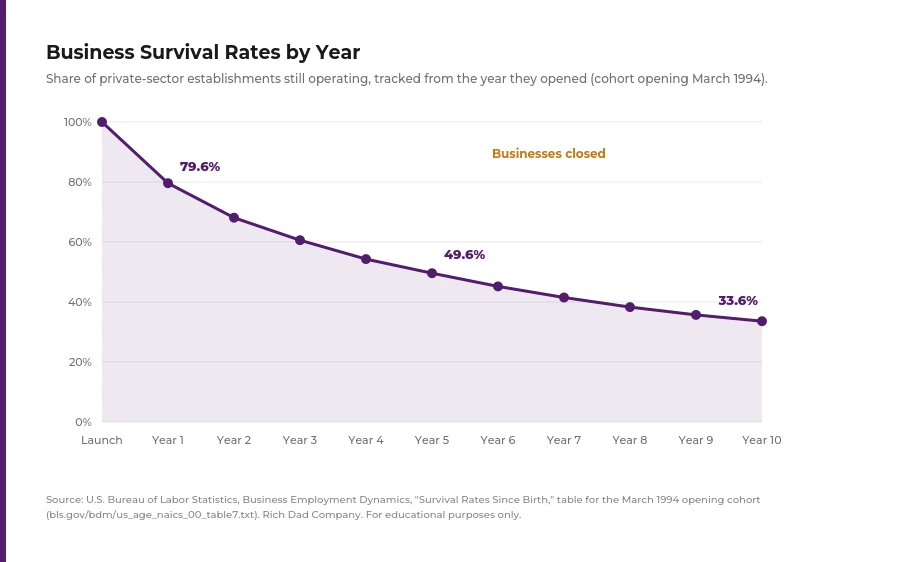
Rich Dad’s view is that most of those failures trace back to the integrities in the B-I Triangle, not to the product itself. Market research in Step 4, feedback in Step 9, and a capable team in Step 10 each address a common cause. Education is the cheapest insurance a founder can buy.
Common Mistakes When Starting a Business Without Money
- Quitting too soon. A paycheck funds the experiment. Leave only when savings can carry you.
- Building the product first. Product is the smallest part of the triangle. Mission, systems, and communication come first.
- Going it alone. No one succeeds without a team, and the smartest person in the room rarely goes far.
- Ignoring feedback. The market sets the value. Listen and adjust.
Your First 30 Days
Use this sequence to turn the plan into action:
- Write your mission in one sentence.
- Spend a few hours on market research and a SWOT analysis.
- Launch a free website and publish three posts that solve real problems.
- Create a lead capture offer and start your email list.
- Pick one social channel, post consistently, and reply to every comment.
- Outline your first digital product from your best posts.
Conclusion: Start Before You Feel Ready
Now is as good a time to start as any. The sooner you begin, the sooner you make mistakes, and mistakes are how entrepreneurs learn. Don’t let a fear of going broke keep you from the business and lifestyle you want. To go deeper, read how Robert Kiyosaki started his first business, browse the Rich Dad Start a Business library, or pick up Rich Dad’s Before You Quit Your Job.
FAQs
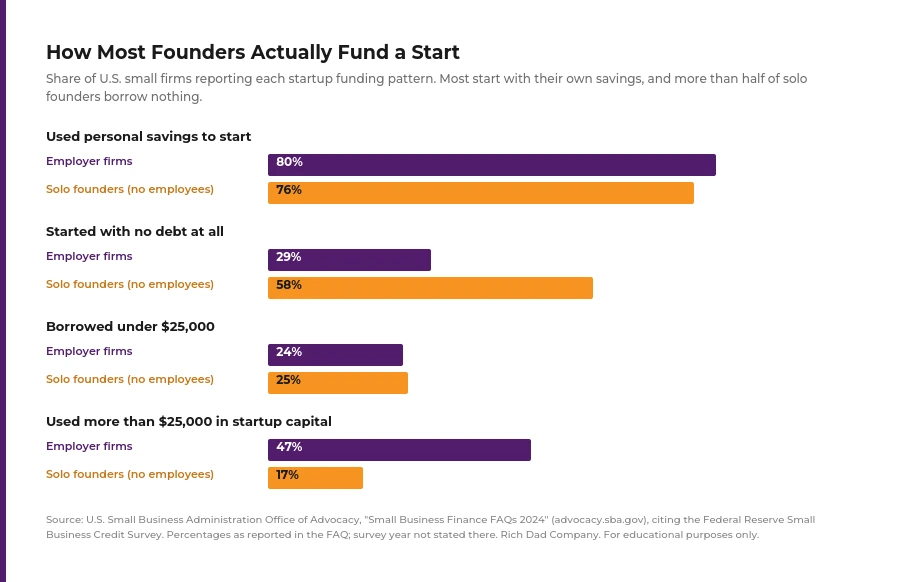
Yes, though it takes time, effort, and a plan. Many founders begin with only their own savings. The SBA data above shows 58% of solo founders borrowed nothing. The 12 steps here rely on free tools, content, and relationships before any outside capital.
The best fit is one that uses a skill or knowledge you already have. A service business can start fastest but sells your time. A digital product, such as an eBook built from your best content, can sell without your time and costs little to make.
Keep your job and start part-time. Use revenue from a first digital product to fund the next step. When the business has proven itself, consider a loan, an SBA microloan through a nonprofit lender, partners, or investors. Your accountant can also show tax strategies that free up capital.
No. Rich Dad advises against quitting until your savings can carry the venture. Building the business part-time protects your cash flow while you test the idea.
It depends on your business and situation. An EIN is free from the IRS, but your attorney and accountant should advise you on the right entity and when to register.
Start with Steps 4 and 5. Read customer reviews, join online communities in a field you know, and note the problems people keep raising. A good idea is usually a good answer to a problem someone already has.