Are rich people greedy? It depends on which rich people you mean. Robert Kiyosaki’s rich dad saw two very different kinds of high earners: those who built businesses and gave generously to the people who worked for them, and those who kept asking for more from the businesses that paid them. The difference wasn’t income. It was mindset.
That is the heart of the employee mindset vs. entrepreneur mindset divide. Below, we define each, compare them side by side, and walk through three contrasts that show up everywhere from small businesses to the NFL.
What is the entrepreneurial mindset?
An entrepreneurial mindset is a way of thinking that takes responsibility for outcomes, sees problems as opportunities, and measures success by results instead of effort. At its core, it is a belief about who is responsible for your financial future: you are.
The employee mindset is the mirror image. It looks to an employer for pay, security, and advancement, and it tends to measure success by effort, loyalty, and time served.

A mindset is not a job title. Plenty of employees think like owners, and plenty of business owners still think like employees. Researchers at Lehigh University’s Nasdaq Center note that the entrepreneurial mindset is no longer limited to founders, and that about half of all job ads now ask applicants to show it.
Employee mindset vs. entrepreneur mindset: The short version
Robert Kiyosaki’s rich dad drew the line in three places: ownership, stability, and results. Here is how the two mindsets compare.
| Employee mindset | Entrepreneur (business owner) mindset | |
|---|---|---|
| Ownership | Takes from the business. Asks what the business owes me. | Takes ownership of the business. Asks what the business needs from me. |
| Stability | Demands stability through pay, benefits, and contracts. | Creates stability by building a business other people can depend on. |
| Results | Expects effort and tenure to be rewarded. | Rewards results, and accepts the blame when results fall short. |
Entrepreneur mindset vs. high-paid employee mindset: Generosity vs. entitlement
The entrepreneur mindset: generosity first
Many entrepreneurs give generously of their time and money, and they build products and businesses that improve other people’s lives. One well-known example is a Seattle CEO who cut his own pay so that every employee could earn $70,000 a year. The company reported that employee childbearing rose, more than 10% of workers bought their first homes, over 70% of indebted workers paid down debt, and individual 401(k) contributions more than doubled.
Not every owner can do that, and not every owner should. The point is that entrepreneurs tend to see themselves as responsible for the people who depend on the business.
The high-paid employee mindset: “I deserve a raise, no matter what”
High pay doesn’t make someone an owner. A high-paid employee can be generous in private and still push for more from an organization no matter how it is performing. That is an employee mindset, even at the top of the org chart.
CEOs are the clearest example, because they are employees too. Median reported CEO pay at S&P 500 companies reached $17.5 million in 2026 proxy filings, up 6% from a year earlier, according to The Conference Board. Meanwhile, the median employee at S&P 500 companies earned $89,744, and at half the companies in an Associated Press survey, a worker at the middle of the pay scale would need 200 years to earn what the CEO earned in one.
Pay and results don’t always move together, either. In ISS-Corporate’s analysis of 2026 proxy filings, median CEO pay at Media & Entertainment companies rose 117.4% while their median shareholder return was negative 28.6%. Across the full sample of 318 S&P 500 companies, median pay rose 10.6% against a median shareholder return of 7.5%.
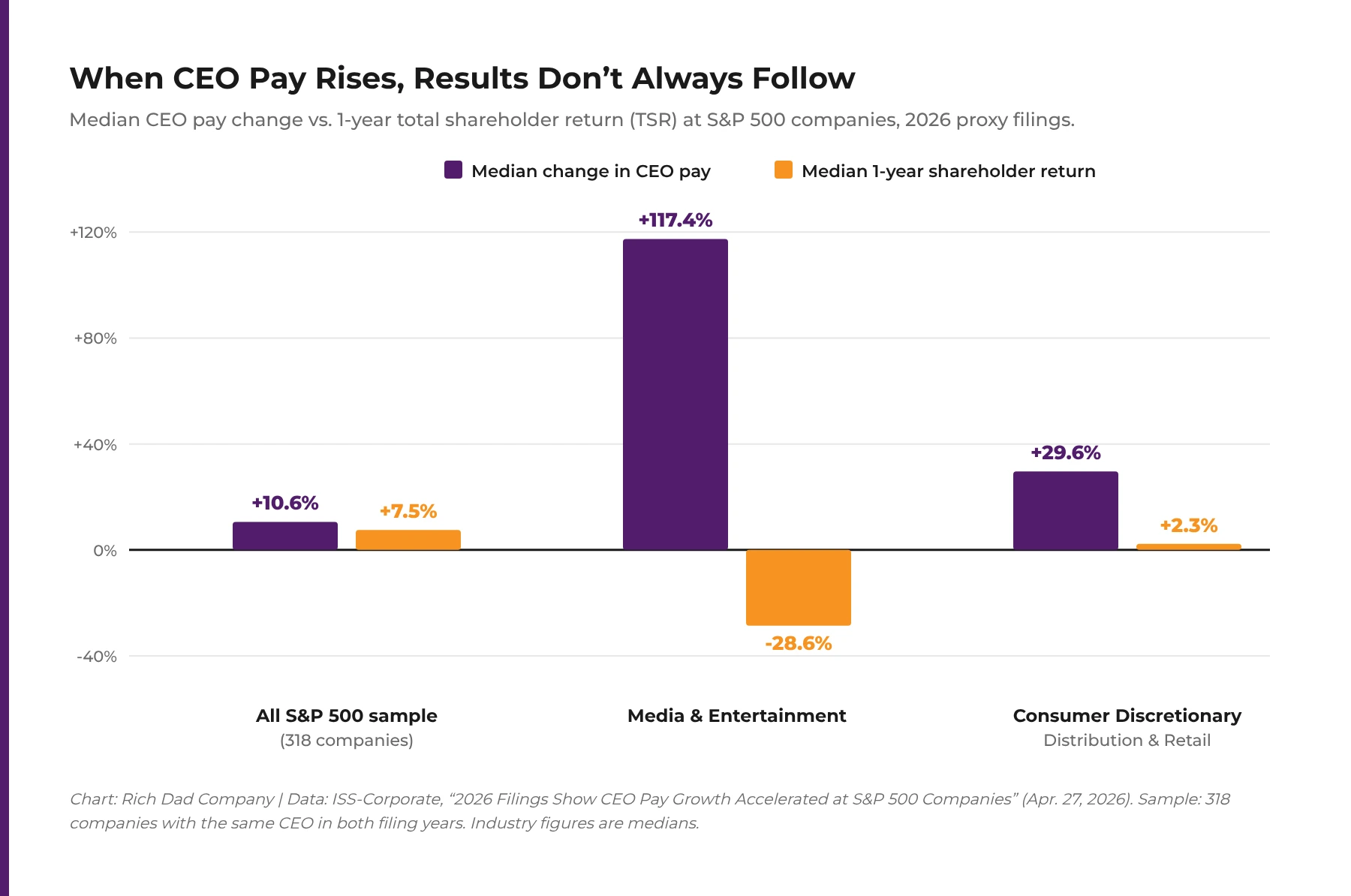
To be fair, shareholder return isn’t the only measure of results, and boards weigh many factors. But the pattern illustrates a mindset: the expectation that compensation climbs whether or not the business does.
The 3 key contrasts between the entrepreneur mindset and the employee mindset
1. Ownership: Taking ownership vs. taking from ownership
Successful owners put the business first. When it struggles, they take responsibility, and they often pay themselves last. One friend of Robert Kiyosaki’s skipped his own paycheck in the early days to make sure his staff got paid, even with a young family to support. That is what taking ownership looks like in practice.

The employee mindset runs the other way, and honestly, it makes sense. The employee didn’t sign up to carry the business’s risk. When the raise doesn’t come, the employee looks for a better offer. That is a reasonable choice. It is also exactly why employees and owners can look at the same company and see two different things.
2. Stability: Creating stability vs. demanding stability
Entrepreneurs turn uncertain ventures into stable jobs for other people, usually without those people ever seeing the sacrifices involved. Employees, understandably, ask for stability in the form of higher pay, better benefits, and longer contracts. But a bigger paycheck is not the same as security.
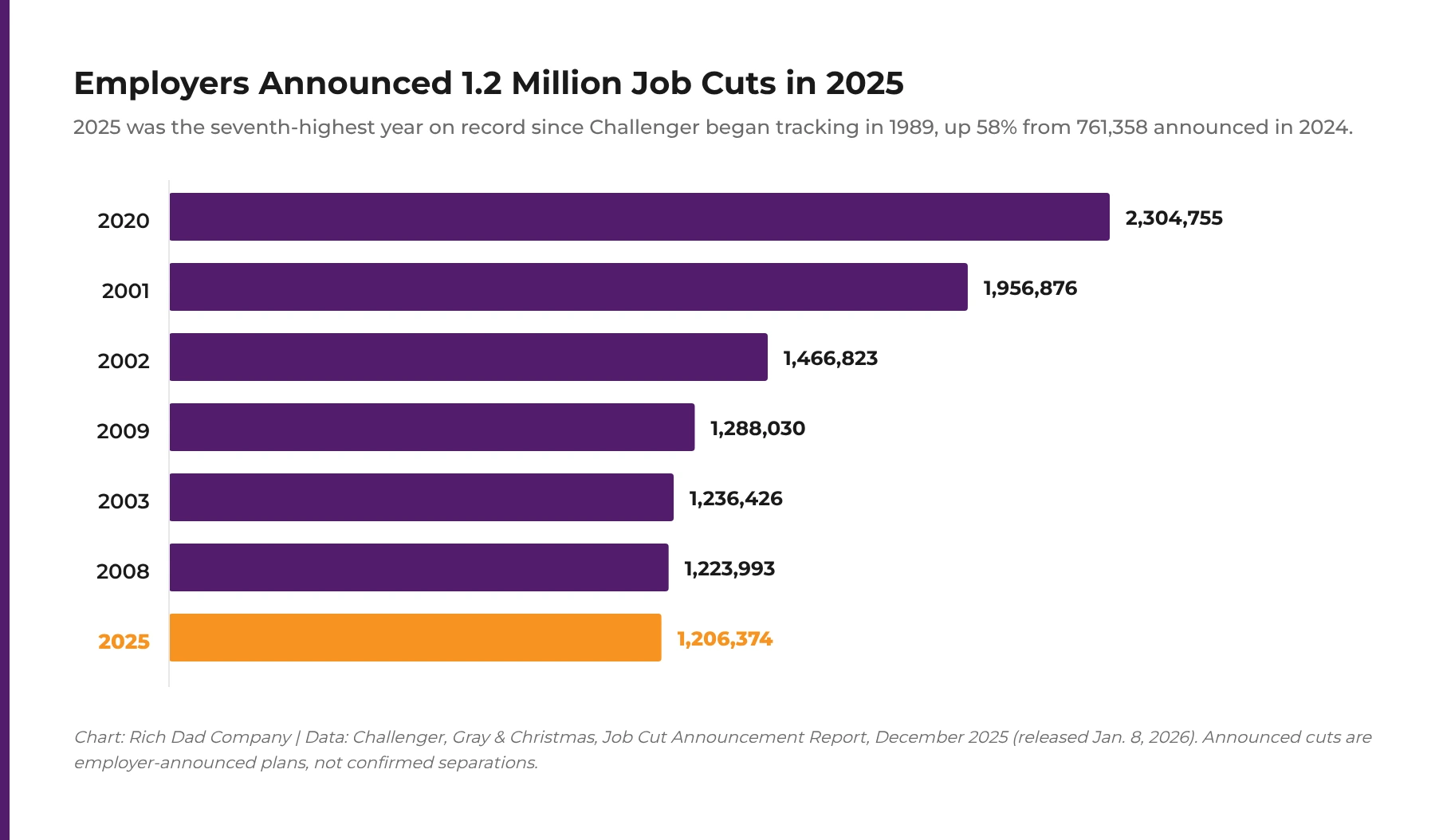
Employers announced 1,206,374 job cuts in 2025, up 58% from 2024 and the seventh-highest annual total since 1989, according to Challenger, Gray & Christmas. Announced cuts aren’t the same as completed layoffs, and many employees keep the same job for decades. But the numbers show who carries the risk when a business is under pressure: the owner decides where to cut, and the employee waits to hear. For rich dad, that made being an employee the riskier path, which is why Rich Dad calls the advice to “get a good job” one of its “Rich Dad scams.”
3. Results: Looking at results vs. looking at tenure
Entrepreneurs live and die by results. When things go wrong, they accept the blame, and they reward what moves the business forward rather than how long someone has been around or how hard they worked. The market works the same way. Customers and investors can’t be satisfied by effort alone, and when results fall short, businesses close.
Even the NFL’s owners show this mindset when it comes to pay. In September 2026, owners agreed to a four-year contract extension for Commissioner Roger Goodell that runs through the 2030 season. The chairman of the owners’ compensation committee told teams the deal is “heavily performance based,” with more than 95% of total compensation tied to Goodell’s and the league’s performance, at the committee’s discretion. The financial terms weren’t disclosed. That is the owner’s view of pay in a sentence: results first, tenure second.
Can an employee develop an entrepreneurial mindset?
Yes, and that is the good news. Mindset is learned, not inherited. In the Lehigh study, educators viewed the traits of an entrepreneurial mindset as competencies that can be developed through training and education.
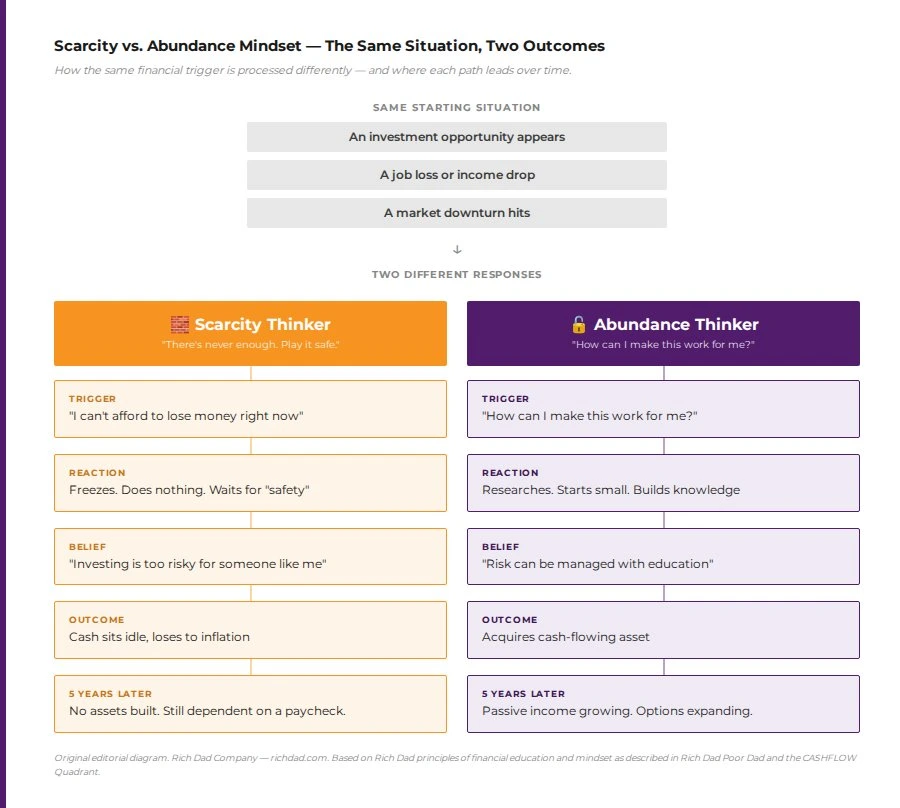
Rich Dad’s approach starts with financial education, because the two mindsets respond differently to the same situation. Faced with an investment opportunity, a job loss, or a market downturn, the scarcity thinker freezes and waits for “safety.” The abundance thinker researches, starts small, and builds knowledge. Five years later, one is still dependent on a paycheck, and the other is building assets that pay.
A few ways to start thinking like an owner today:
- Swap “I can’t afford that” for “How can I afford that?” The question forces creative thinking.
- Treat your job as tuition. Ask what skills a role will teach you, not just what it pays.
- Keep your day job and start a small business on the side. Robert Kiyosaki recommends this over holding down a second job, because a thriving side business builds an asset instead of just adding hours.
Which mindset do you want?
This is not a knock on employees. It is a recognition that the two mindsets are different, and that the right mindset belongs in the right role. Employees who adopt an entrepreneurial mindset are often the most valuable people on any team, and they frequently go on to start ventures of their own.
If that’s you, go in with eyes open. Researchers at the Minneapolis Fed analyzed IRS and Social Security records and found that entrepreneurs earn substantially more on average and see much faster earnings growth than paid employees, but that those averages mask wide inequality skewed toward top earners. In fact, 80% of self-employment income came from people earning $100,000 or more a year. Owners earn the upside by carrying real risk, and by learning how to manage it.
If you’re ready to make the move, start with how to transition from employee to business owner. Whichever path you choose, choose it on purpose. Which mindset do you want?
FAQs
The employee mindset takes from ownership, demands stability, and values tenure. The entrepreneur mindset takes ownership, creates stability, and values results. The difference is about who feels responsible for outcomes, not about job titles or income.
An entrepreneurial mindset is a way of thinking that takes responsibility for results, sees problems as opportunities, and focuses on creating value. It can be learned, and it isn’t limited to people who own businesses.
Yes. Employees with an entrepreneurial mindset take initiative, own their results, and think about what the business needs. Many employers now ask for these traits in job ads, and employees who show them are often the most valuable people on a team.
A business owner carries the risk and keeps what is left after the business pays its bills, so income can be higher but is not guaranteed. An employee trades time and skills for a wage and relies on the employer for stability. Owner income can scale beyond hours worked, while wage income is usually tied to them.
Neither is better in every situation. The entrepreneur mindset fits ownership and risk-taking, while the employee mindset fits roles where someone else carries the risk. The goal is to match the mindset to the role, and to learn the owner’s mindset if you want to become one.
Start with financial education and small steps. Ask how you can afford something instead of saying you can’t, treat your job as a place to learn skills, and consider building a side business while you keep your paycheck.