

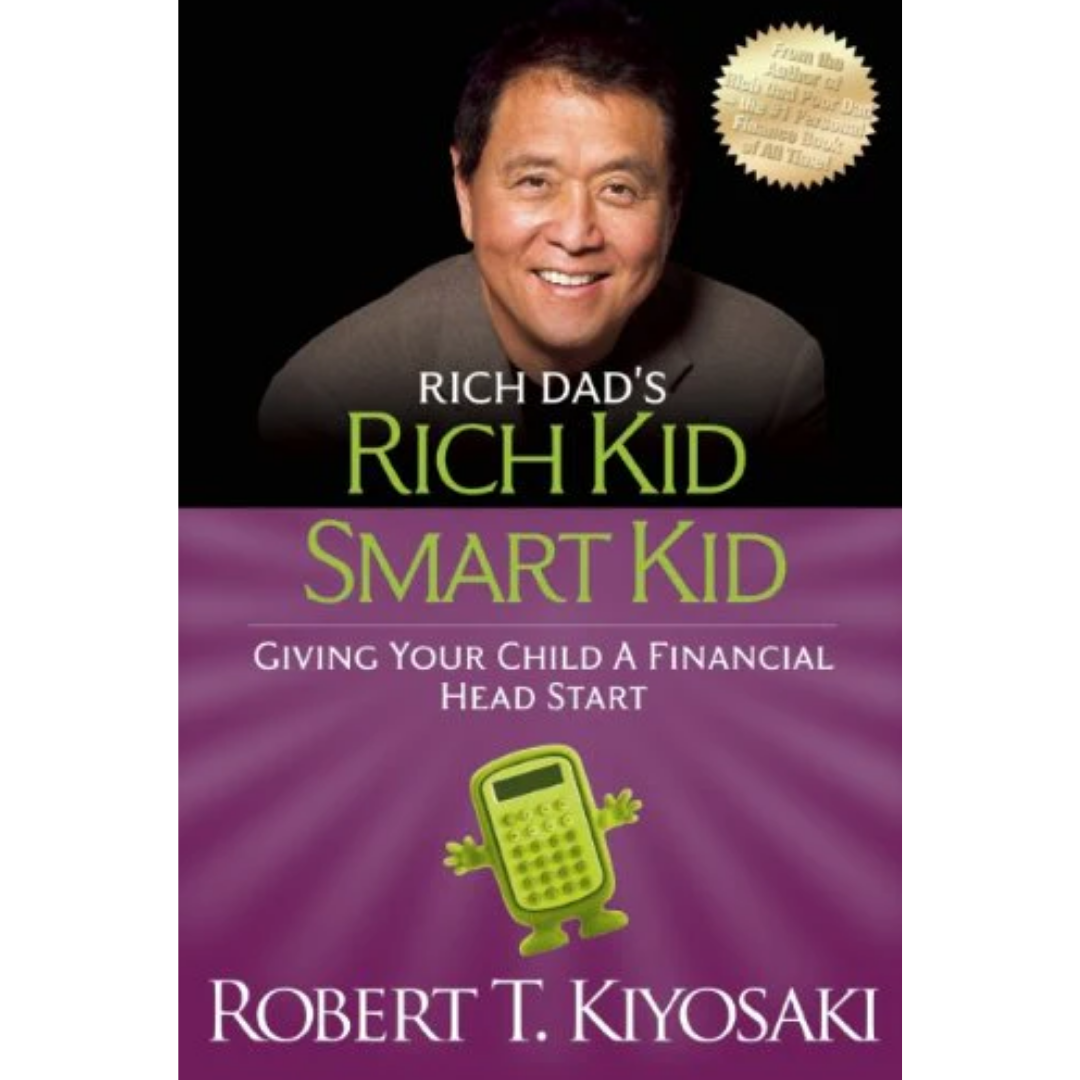
The Book in Brief
Schools teach reading, writing and math. But do they teach children how money works, how to think independently or how to succeed in the real world? Rich Kid Smart Kid starts with that question. In it, Robert Kiyosaki explains why many children are naturally smart, yet traditional education can suppress their creativity, confidence and financial intelligence. The book helps parents take a more active role in preparing kids for life beyond the classroom.
Rather than focusing only on grades, Robert Kiyosaki shows how to help children discover their natural strengths, build financial confidence and learn skills that support lifelong success. It is described as more than a parenting book: a roadmap for helping children succeed in a world where financial intelligence matters more than ever. The book is written for parents of kids ages five to fifteen who want to teach confidence, money skills and real-world success early.
Every Child Is Born Rich and Smart
The book begins with an optimistic premise: every child is born rich and smart. In Robert Kiyosaki’s view, children arrive curious, creative and eager to learn. They ask questions, experiment and explore without fear of embarrassment. What happens next, he argues, is that formal education and social pressure often narrow that natural energy, rewarding certain behaviors and discouraging others. Children learn that mistakes are bad, that there is one right answer and that being different is risky.
The parent’s job, in this framework, is to protect and develop the natural intelligence a child already has. That involves noticing strengths, supporting curiosity and providing experiences that let a child test ideas in the real world. The book presents this as both a financial and an emotional project, since confidence is the foundation on which later success is built.
How Schools Reward One Type of Intelligence
A major theme is that schools tend to reward one kind of intelligence, primarily the ability to memorize, follow instructions and perform well on tests. That ability is valuable, but it is not the only kind. Children who excel at building, selling, leading, drawing, storytelling or solving practical problems may not stand out in a traditional classroom, and they can come to believe they are not smart.
Robert Kiyosaki has described himself as a student who struggled in school, and this theme runs through his work. The book encourages parents to look beyond report cards and to recognize that grades measure only part of a child’s potential. It also reminds them that many successful entrepreneurs and innovators did not follow a conventional academic path. The aim is not to dismiss school but to put it in perspective.
Why Financial Education Should Start Early
The book makes the case that financial education should start early. The habits and beliefs children form about money in their first years can last a lifetime. A child who learns to think of money as a tool, to save with a purpose and to create value for others begins adulthood with an advantage. By contrast, a child who learns nothing about money until the first credit card arrives may be learning through costly mistakes.
The book’s approach is practical and age-appropriate. It does not ask parents to turn a five-year-old into an investor. It asks them to introduce simple ideas through conversation, play and everyday experiences, and to build complexity as the child grows.
Learning Through Play and Experience
Children learn best through play and experience, and the book organizes many of its suggestions around that principle. Games, role-playing, small businesses and real purchases give children a safe place to test ideas. A child who runs a pretend store learns about pricing and customers. One who earns money by doing a job for a neighbor learns about value and effort. The CASHFLOW games developed by Rich Dad grew from the same idea: that people absorb financial concepts more deeply when they act them out.
Play also reduces fear. When money lessons are fun, children associate learning with curiosity rather than anxiety, and they are more willing to try, fail and try again.
Discovering Your Child’s Natural Genius
The book encourages parents to identify their child’s natural genius, the unique combination of interests and talents that sets them apart. A parent who notices that a child loves organizing, negotiating, drawing, building or caring for animals can look for ways to connect those strengths with real-world opportunities. This builds confidence and opens a path toward work that feels meaningful.
This also fits Rich Dad’s belief that entrepreneurship begins with noticing what you do well and finding a way to provide value. For a child, that might be as simple as turning a hobby into a small project that earns a little money.
Confidence and Decision-Making
The book gives special attention to confidence and decision-making skills. Children who are never allowed to decide anything may become adults who are afraid to act. Rich Kid Smart Kid encourages parents to give children age-appropriate choices, let them live with the results and talk through what they learned. Over time, this builds the judgment and self-trust that financial success requires.
Good Debt, Bad Debt and Savers Who Lose
Two financial concepts that the book introduces for families are the difference between good debt and bad debt and the idea that savers can lose in inflationary economies. In the Rich Dad framework, good debt helps acquire assets that produce income, while bad debt finances things that take money out of your pocket. Teaching the distinction early can prevent the common trap of treating all borrowing the same way.
The lesson about savers reflects a long-standing Rich Dad position: that money held in cash can lose purchasing power when prices rise. The book presents this as a reason to teach children about earning, investing and ownership as well as saving. These are Robert Kiyosaki’s views, and parents may want to discuss them with the child in a balanced way that includes the value of saving for specific goals.
Core Lessons Readers Remember
The book highlights several core lessons that parents are encouraged to carry with them:
- Money is an idea. Money is a concept people agree to use, and understanding that idea gives a child power to think about it creatively.
- Children learn more by example than instruction. What parents do with money teaches more than what they say.
- Grades do not equal future success. Academic performance matters, but it is not the only predictor of a good life.
- Financial intelligence creates more choices. The more a child understands money, the more options they will have as an adult.
- Confidence and curiosity matter as much as academics. These qualities drive learning at every age.
Parents as the Most Important Teachers
The book returns to the point that parents are a child’s most important teachers. This is both encouraging and demanding. It means that parents have more influence than any school program, and it means that their own attitudes toward money are being watched and absorbed. The book invites parents to examine their beliefs, learn alongside their children and model the behavior they want to see.
Age-by-Age Ideas
Because the book is aimed at ages five to fifteen, it can help to think of a progression. These are applications of its themes rather than a chapter list:
- Ages 5 to 8: play store, simple earning and saving goals, and conversations about where money comes from.
- Ages 9 to 11: small business projects, assets versus liabilities, and introductory games such as CASHFLOW for Kids.
- Ages 12 to 15: deeper discussions about income types, debt, investing basics and entrepreneurship, with room for real-world experiments.
What Parents Will Learn
- Why every child is born rich and smart
- How schools often reward one type of intelligence
- Why financial education should start early
- How to build confidence and decision-making skills
- Why kids learn best through play and experience
- How to identify a child’s natural genius
- The difference between good debt and bad debt
- Why savers can lose in inflationary economies
- How to teach children about money responsibly
- Why parents are a child’s most important teachers
Where It Fits in the Rich Dad Library
Rich Kid Smart Kid is a core family title. It pairs with Rich Family Smart Family, which offers practical tools for the whole household, and with Why “A” Students Work for “C” Students, which takes a deeper look at education. Children who outgrow it can graduate to Escape the Rat Race and Rich Dad Poor Dad for Teens.
Who Will Get the Most From It
- Parents who want to teach kids about money
- Families seeking real-world life skills
- Homeschool and alternative education families
- Parents of creative or non-traditional learners
- Fans of Rich Dad teachings
- Anyone who wants to raise confident, capable children
Takeaway
Rich Kid Smart Kid argues that raising financially capable children means looking beyond report cards and giving them the confidence, curiosity and money skills schools often leave out. Its message is hopeful: every child has natural gifts, and parents who nurture them while teaching financial basics can give their children a real head start in a world where financial intelligence matters more than ever.
Product Reviews
Erik Navarro
I like very very much! go to my freedom
Richard
Me llegaron ambos productos, de muy buena calidad, me gustó mucho q volvieron a los billetes en sus 12 denominaciones, lo q si vi q cambio bastante fue el cashflow for kids, ahora es mas sencillo ya que las cantidades solo son por multiplos de 100 entiendo q lo hacen para hacilidad en el calculo con los niños, sin embargo an la antigua version habian triangulos azules q representaban los ingresos ganados cosa q extrañe mucho ya q con ello podia ver la diferencia con los ingresos pasivos….gracias
Angelo Galante
Greatest game for children. I love teaching them all this good stuff
Johnny Midas
This is not some cheap off-brand board game. It’s as high quality as anything you’d buy from Parker Brothers, and after a few games my 13 year old is understanding financial statements better than I did in college! This should be a required purchase for all parents. Hint: play the kids version first. It is fast, fun, and just as educational.
Logan Manzanares
Love the trilogy