
The real entrepreneur failure rate: What the data actually says
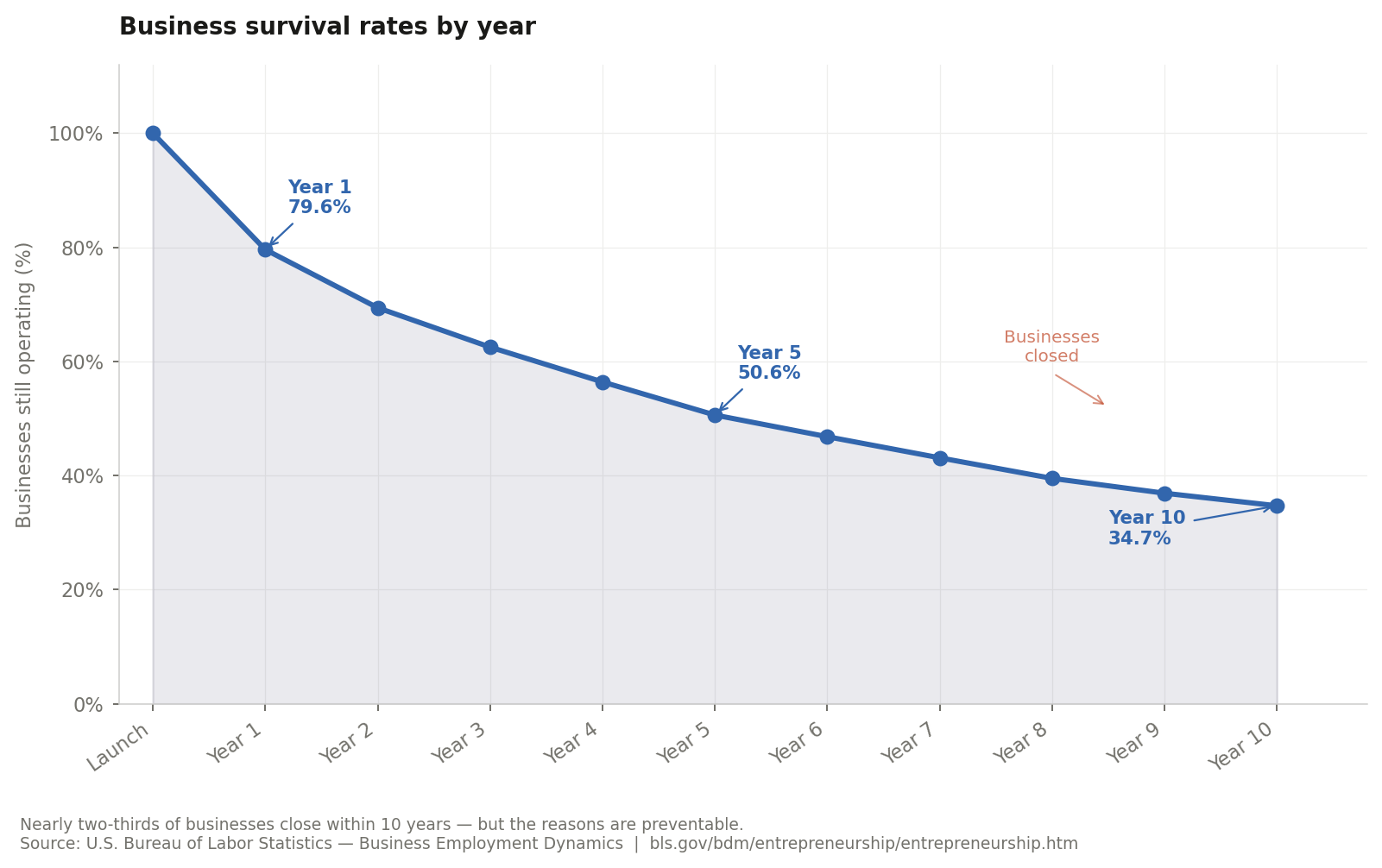
Before diagnosing why entrepreneurs fail, it’s worth grounding the conversation in reality. The commonly repeated claim that “90% of businesses fail in the first year” is a myth. According to 2024 data from the U.S. Bureau of Labor Statistics, approximately 20.4% of new businesses close in their first year, 49.4% close within five years, and 65.3% close within ten years. That means roughly one in three businesses is still standing after a decade — a sobering but not hopeless picture.
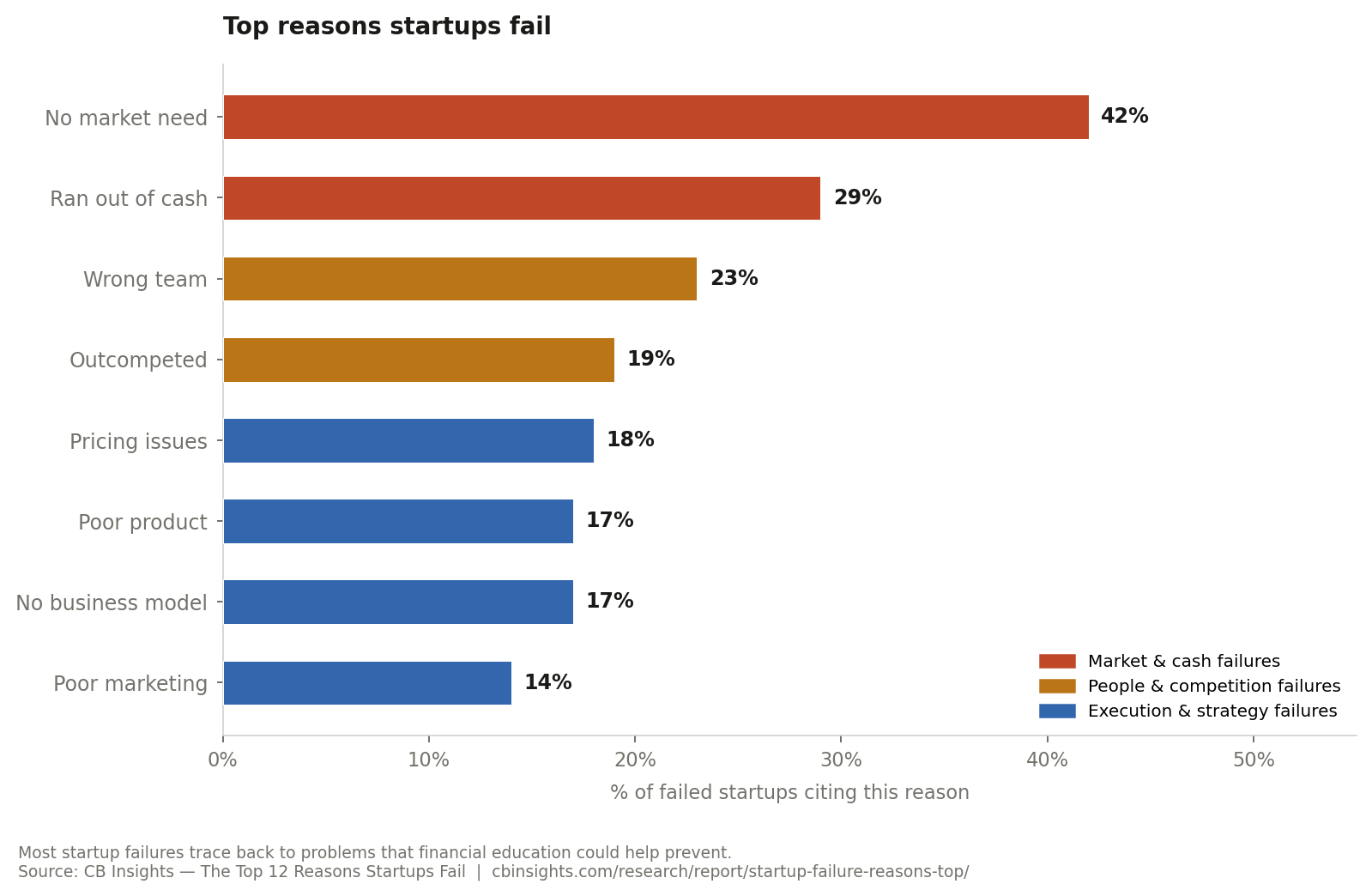
Research firm CB Insights analyzed more than 100 startup post-mortems and identified the most common self-reported reasons for failure: 42% cited no market need, 29% ran out of cash, 23% had the wrong team, 19% were outcompeted, and 18% struggled with pricing and cost issues. What is striking about this list is that every single one of these failures involves something that could have been anticipated with better financial education and planning — the exact tools that the Rich Dad financial education platform was built to provide.
Why most businesses fail: The predictable patterns
1. Confusing self-employment with entrepreneurship
One of the most important distinctions Robert Kiyosaki draws in his CASHFLOW Quadrant framework is the difference between being Self-Employed (the S quadrant) and being a true Business Owner (the B quadrant). Most people who “start a business” actually create a job for themselves. They are the product, the service, the salesperson, and the accountant. When they stop working, the income stops too.

True entrepreneurship means building a system — a business that works without you. Getting stuck in self-employment is one of the primary reasons entrepreneurs fail to scale. They become the bottleneck in their own companies, unable to trust others, delegate effectively, or think strategically. The trap is comfortable at first: control feels like competence. But a business that depends entirely on its founder is fragile, not resilient.
2. Poor cash flow management
The number one operational killer of small businesses is not a bad product — it is running out of cash. A U.S. Bank study cited by SCORE found that 82% of small businesses that fail do so because of cash flow problems. Entrepreneurs often confuse revenue with profit, and profit with cash. A business can be “profitable” on paper and still go bankrupt if its receivables lag behind its payables.
Financial literacy is not optional for entrepreneurs — it is survival-critical. Understanding the difference between assets and liabilities, knowing how to read a cash flow statement, and building systems to manage working capital are the underestimated but essential skills that separate lasting businesses from early closures. Rich Dad’s teaching is direct on this point: the financially uneducated entrepreneur is always one bad quarter away from collapse.
3. No market need–building what nobody wants
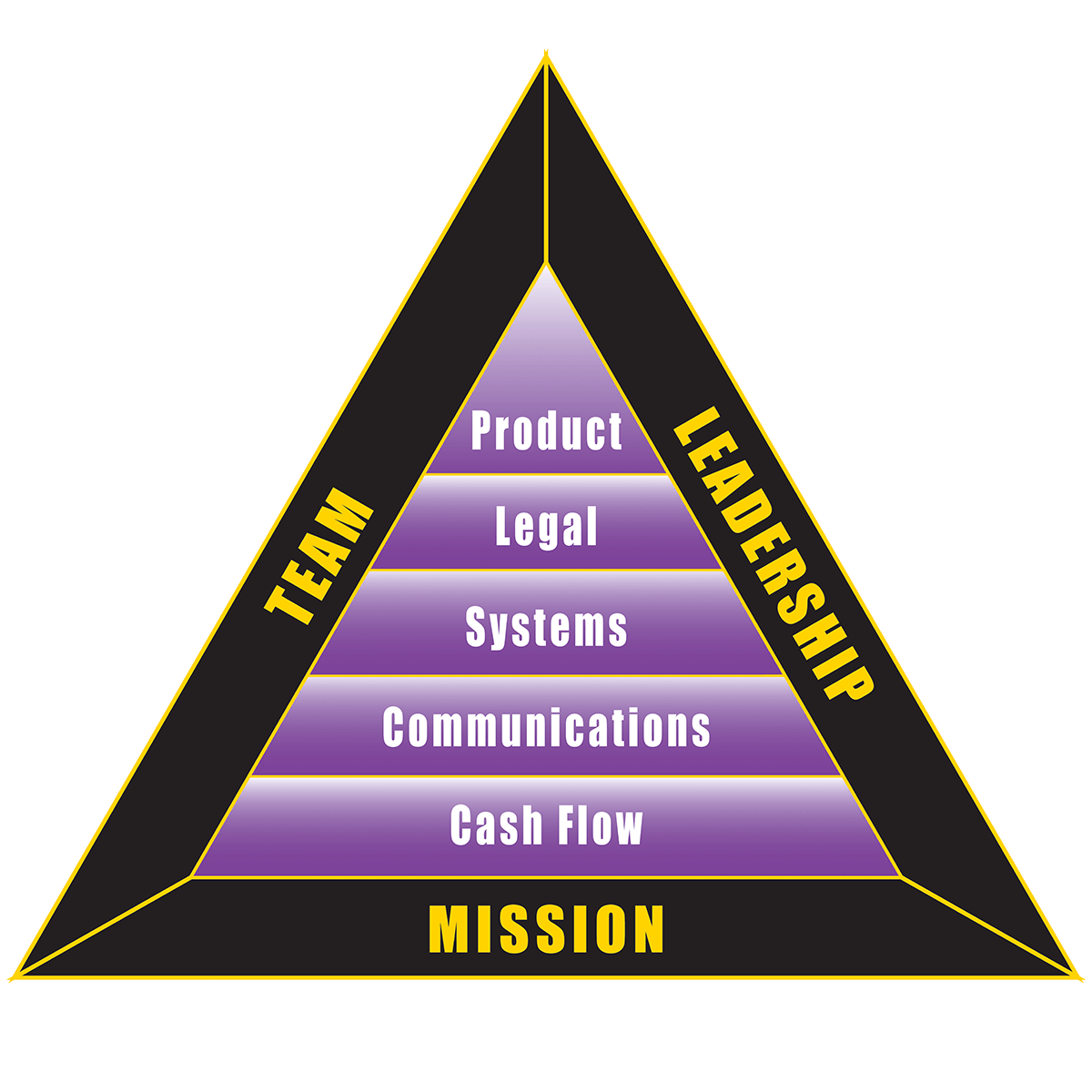
The leading cause of startup failure, according to CB Insights, is that the business was solving a problem nobody actually had. Entrepreneurs often fall in love with their own ideas and build products before validating whether a market exists. This is the inverse of sound business strategy. Rich Dad’s B-I Triangle framework makes this point clearly: a business must be built around a mission that serves a genuine market need. Without that foundation, every other effort — marketing, product development, fundraising — is wasted energy.
4. The wrong team (or no team at all)
Twenty-three percent of failed startups cite their team as a primary factor, and the failure is almost never about intelligence — it is about fit, culture, and complementary skills. Robert Kiyosaki’s rich dad told him early on: “Business and investing are team sports.”

The entrepreneur who insists on doing everything alone, or who hires people who think exactly the way they do, is building a house with one kind of brick.
The most dangerous myth in entrepreneurship is the lone genius. In practice, every successful business is built by a team with diverse, complementary capabilities. A founder who is strong in vision and weak in operations needs to hire for operations — not surround themselves with more visionaries. Kiyosaki made a deliberate investment in his own deficiencies early in his career, including taking a sales job at Xerox specifically to develop the skills he lacked. That kind of self-awareness is rare, and it is a direct antidote to one of the most common reasons entrepreneurs fail.
5. Fear masquerading as caution
Many entrepreneurs never actually fail — because they never fully commit. They keep one foot in the E (employee) quadrant and one foot in entrepreneurship, hedging their bets and wondering why neither path is working.
Fear is the primary barrier between most people and financial freedom. Not stupidity. Not bad timing. Fear.
This manifests in several ways: failing to make a critical hire because payroll feels risky, avoiding a new marketing channel because past efforts underperformed, or holding back on investment in infrastructure because it feels irresponsible. The paradox is that excessive caution in business is itself a form of recklessness. A stagnant business in a dynamic market is a business in slow decline.
The three skills every entrepreneur must develop
The skill of selling
Robert has been transparent about taking a job with Xerox not because he needed the money or wanted a career in sales, but because he needed to learn how to sell. He understood that revenue is the engine of every business, and revenue requires selling. The entrepreneur who cannot sell — who cannot communicate value, handle objections, and close — is permanently dependent on others for the lifeblood of their business.
Sales education is financial education. Understanding how to connect a product or service to a genuine customer need, and how to do so at scale, is one of the highest-leverage skills a founder can develop. Many entrepreneurs dismiss sales as beneath them or delegate it too early, before they have proven the model themselves. This is a critical mistake that contributes significantly to the business failure rate.
The skill of leadership
Scaling a business means multiplying yourself — replacing your personal effort with systems and people who can execute in your absence. The transition from self-employed operator to business leader is one of the most difficult passages in entrepreneurship, and it is where many high-potential ventures stall or collapse entirely.
The entrepreneur who cannot lead cannot scale. Leadership means trusting people with responsibility, creating accountability structures, and inspiring others to be bought into the mission.
Learning how to build and manage a team is not a soft skill — it is an economic necessity. The businesses that survive and grow are led by people who understand how to multiply the efforts of others, not just their own.
The skill of self-mastery
Of all the reasons entrepreneurs fail, the most underappreciated is the failure to master themselves. Emotional reactivity, poor impulse control, fear-driven decision-making, and an inability to sustain discipline during difficult periods are business killers that never appear in a post-mortem report but are behind nearly every one.
Robert is frank about his own struggles with self-mastery. Every time he let fear dictate his decisions when cash flow was tight, he made things worse. Every time he reacted with frustration to an employee problem instead of responding with strategy, he damaged his culture. Self-mastery is the precondition for every other entrepreneurial skill. It cannot be outsourced or delegated. It must be developed deliberately, through the kind of honest self-examination that most people avoid and that financial education at the Rich Dad level actively encourages.
Why financial education is the real competitive advantage
The conventional education system teaches people how to be employees — how to follow instructions, pass tests, and earn a salary. It does not teach how to read a financial statement, structure a business entity, leverage tax strategies, or build systems that generate cash flow. This is not an accident, in Rich Dad’s view — it is a design. An education system built to produce employees will not naturally produce entrepreneurs.
This is why Robert Kiyosaki’s central argument has always been that financial education is not supplemental — it is foundational. The entrepreneur who understands the difference between good debt and bad debt, who knows how to structure business income to minimize taxes through legal means, and who can read a balance sheet as fluently as a sales report, has a structural advantage over every competitor who cannot. That advantage compounds over time.
The CASHFLOW game was designed specifically to build this kind of financial intelligence in an experiential format — because Kiyosaki understood that financial literacy is a skill acquired through practice, not lecture. The entrepreneurs who invest in their own financial education before, during, and after launching a business dramatically improve their odds of being among the one-third still standing at the ten-year mark.
How the most successful entrepreneurs use failure
There is a reason that every serious study of entrepreneurship eventually arrives at the same counterintuitive finding: the entrepreneurs with the highest long-term success rates are also the ones with the most failures on their record. Failure, when engaged honestly and strategically, is the most efficient teacher available to a business builder.
Robert has talked openly about going bankrupt, losing businesses, and making costly mistakes. So has every other Rich Dad advisor. The lesson is not that failure is inevitable or acceptable — it is that failure, treated as data, accelerates growth in a way that no amount of theoretical preparation can replicate. The entrepreneur who is too afraid to fail is the entrepreneur who is too afraid to learn. And the entrepreneur who refuses to learn is the one the statistics are waiting for.
The Rich Dad entrepreneurship hub exists to give aspiring and current business owners the financial education, frameworks, and practical tools to shorten that learning curve — and to fail smarter, faster, and more profitably on the path to building something that lasts.
The bottom line: Entrepreneurship is a skill, not a lottery
The high business failure rate is not a verdict on the worthiness of entrepreneurial ambition — it is a reflection of how underprepared most people are when they start. The gap between a business that fails and one that thrives is rarely about the idea. It is almost always about the education, the team, the systems, and the self-awareness of the person running it.
Robert’s entire life’s work is built on one premise: that the financial education most people never received is available to anyone willing to seek it out. The Rich Dad entrepreneurship resources — including guidance on starting a business, managing business taxes, and understanding legal and asset protection — exist to equip entrepreneurs with what the school system never taught them. The question is not whether entrepreneurship is risky. It is. The question is whether that risk is taken with education or without it.For those ready to build their financial intelligence and reduce their odds of becoming a statistic, the Rich Dad financial education community is the right starting point.