

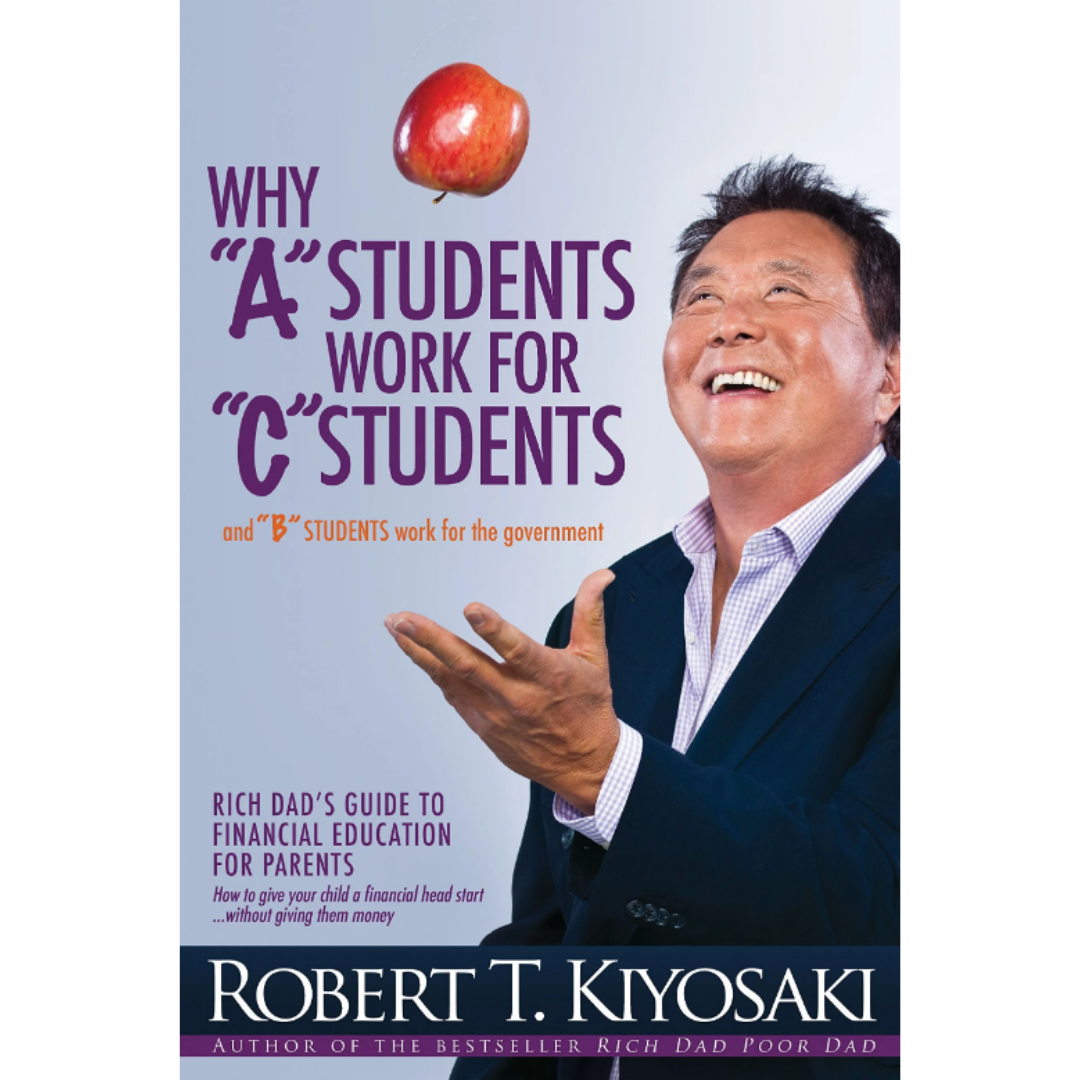
The Book in Brief
In this bold book, Robert Kiyosaki challenges one of the most deeply rooted beliefs in the education system: that academic success equals life success. His argument is that the traditional school model was designed to produce employees, not entrepreneurs, and that so-called “A students” are often trained to memorize, follow rules and fit into a system rather than question it or change it. By contrast, he says, it is often the “C students” who grow up to become the visionaries, risk-takers and outside-the-box thinkers who start businesses, disrupt industries and hire the A students as employees.
Subtitled Rich Dad’s Guide to Financial Education for Parents, the book is written for the adults who are shaping children’s futures. It urges parents to look beyond report cards and standardized tests and, instead of obsessing over grades, to nurture creativity, passion and an entrepreneurial mindset. The book is described as packed with personal insights, real-world examples and powerful reframes on intelligence and success.
The Core Claim: School Was Built to Produce Employees
The heart of the book is a claim about purpose. Robert Kiyosaki argues that the modern school system was designed during an industrial era to prepare large numbers of people to work in factories, offices and government agencies. Students were taught to show up on time, follow instructions, complete assigned tasks and be evaluated by a standard measure. Those habits made sense for an economy that needed reliable employees.
The problem, he suggests, is that the world has changed while the model has not. In an economy where information moves quickly and entrepreneurs, investors and creators drive growth, a system that prizes obedience and memorization may leave students unprepared for the roles with the most freedom and income potential. This is a theme that runs throughout the Rich Dad library, from Rich Dad Poor Dad to Rich Kid Smart Kid.
What the A Student Learns
The A student, in the book’s portrait, succeeds within the rules. They learn how to master what is taught, how to meet expectations and how to earn approval. These are real strengths, and the book does not suggest that diligence or intelligence are bad. In fact, it acknowledges that A students are often highly capable and hard-working.
The risk is that success in school can encourage a dependence on structure. An A student may seek a safe, well-defined path with a clear ladder to climb, and may be less comfortable with uncertainty, failure and ambiguity. The book argues that these are exactly the conditions in which entrepreneurs operate, and that the A student’s strengths can be channeled into a business setting if they are paired with entrepreneurial skills.
What the C Student Learns
The C student, as Robert Kiyosaki describes the type, is often a dreamer who does not fit the mold. Perhaps they are bored by lectures, restless in class or more interested in building, selling or creating than in memorizing. They may receive lower grades, and they may begin to see themselves as less intelligent. But the book argues that many of these students possess the creativity, resilience and independence that entrepreneurship demands.
Because they have often been told they are not good at the traditional game, C students may learn to look for other ways to win. They are more likely to take risks, ask unconventional questions and try ideas that others dismiss. The book suggests that when these traits are developed and supported, they can lead to businesses and innovations that employ the very A students who excelled in school.
Why B Students Work for the Government
The second half of the title adds another category. B students, in the book’s framing, tend to gravitate toward stability and security, and many end up in secure positions, including government work. The title is provocative by design, and it should be read as a rhetorical device that makes a point about the types of roles that different educational paths often lead to, not as a statement about any individual’s worth or the value of public service. Public servants play essential roles, and the book’s argument is about mindset and options.
The broader point is that school tends to channel students into predictable career tracks. Parents who recognize this can help children think more broadly about what is possible and avoid assuming that a conventional path is the only safe one.
Looking Beyond Report Cards
A main piece of advice for parents is to look beyond report cards. Grades measure how well a child performs within a particular system, but they do not capture creativity, curiosity, leadership, resilience or entrepreneurial instinct. A parent who focuses exclusively on grades may unintentionally discourage the qualities that will matter most later. The book encourages families to value effort and learning, to notice a child’s strengths and to talk about interests beyond the classroom.
This does not mean ignoring school or dismissing education. The book makes clear that learning matters. It argues that grades should be one measure among many, and that financial education, creativity and real-world experience deserve equal attention.
Nurturing Creativity, Passion and an Entrepreneurial Mindset
The positive program of the book is to nurture creativity, passion and an entrepreneurial mindset. Creativity means giving children room to invent, experiment and make things. Passion means taking seriously the subjects and activities that excite them. An entrepreneurial mindset means helping them see problems as opportunities, practice selling ideas, handle rejection and learn from mistakes.
For parents, this can start with small steps. Encourage a child to design a product, run a small service or organize an event. Ask questions that stimulate thinking, such as “What problem could you solve?” and “Who would pay for that?” Treat failures as lessons. Over time, these experiences build skills and confidence that no classroom can fully provide.
Reframing Intelligence and Success
The book offers what it calls powerful reframes on intelligence and success. The central reframe is that intelligence is not one thing and that the traditional measure of academic performance captures only a slice. Other forms of intelligence, including social, creative, practical and financial, are equally important. Success, similarly, is not limited to high grades and a good job. It can include building something, creating freedom and contributing in ways that do not fit a standard resume.
This reframing is meant to free both parents and children from narrow definitions. A child who is labeled average in school may be exceptionally talented in other ways, and the book encourages families to find and develop those talents.
Financial Education at the Center
Because the book is subtitled as a guide to financial education for parents, it ties these ideas back to money. Schools rarely teach how money works, how to build assets or how to run a business. Robert Kiyosaki encourages parents to fill that gap, using games, conversations and real-life projects. The book suggests that financial education is one of the most useful complements to formal schooling and that it can give any student, regardless of grades, a practical advantage.
What Readers Will Learn
- Why the traditional school model was designed to produce employees
- How A students, B students and C students are often shaped by the system
- Why grades do not reliably predict financial or entrepreneurial success
- How to nurture creativity, passion and an entrepreneurial mindset
- How to reframe intelligence and success for children
- Why financial education belongs alongside academic education
Ideas for Parents
The themes of the book point to practical actions that parents can adapt:
- Ask children what they are curious about, and help them explore it outside of school.
- Praise effort, creativity and problem-solving, not only grades.
- Support small entrepreneurial projects and discuss the results.
- Introduce financial concepts early through games and real purchases.
- Share your own experiences with mistakes and learning.
These ideas apply the book’s spirit and are not direct quotations. They can be tailored to a child’s age and personality.
A Balanced Reading
The book’s categories are deliberately simplified. Real students do not fit neatly into A, B or C types, and many people combine strong academic performance with entrepreneurial ability. Education offers many benefits, including knowledge, discipline and opportunity, and many successful entrepreneurs have strong academic backgrounds. The most constructive way to read the book is as a challenge to the assumption that grades alone determine success, and as encouragement to broaden the goals of parenting and education.
Where It Fits in the Rich Dad Library
This title sits with the family and education books, alongside Rich Kid Smart Kid, Rich Family Smart Family and Rich Dad Poor Dad for Teens. It also connects to Unfair Advantage, which explores the role of financial education in more depth.
Who Will Get the Most From It
- Parents who want to look beyond report cards
- Educators and mentors interested in entrepreneurial education
- Students who feel they do not fit the traditional mold
- Anyone seeking a better path for the next generation
Takeaway
Why “A” Students Work for “C” Students argues that academic success is not the same as life success and that children need more than grades to thrive. By encouraging parents to nurture creativity, curiosity and financial education, it offers a more flexible view of intelligence and a practical path for raising capable, confident young people.
Product Reviews
SJ
I've read this book and very inspiring and got lot of Great information. When I read this book I would lay it done and process all of the information in Each Chapter. It's Definitely worth Reading. Robert Kiyosaki won't disappoint. I'm Currently Reading RICH DAD POOR DAD RIGHT NOW. I plan getting more books written by RTK
Amy Ma
Haven’t opened yet but delivery was fast
LaSchelle Quarterman
I purchased CASHFLOW to play with my three grandchildren, ages 12, 12, and 11, and they absolutely LOVE it! What surprised me the most is that they were able to learn and enjoy the adult version of the game. One of my 12-year-old grandsons has already made it out of the Rat Race and onto the Fast Track!
Playing CASHFLOW has become part of our nightly routine. After the kids take their showers and get ready for bed, we sit down and play for about an hour. Believe it or not, this game has even made bedtime routines easier! They are so excited to play that they stay on task and get everything done without me having to constantly remind them.
Initially, I was concerned that the game might be too complicated for their ages. However, by the third night, they had caught on and were playing with confidence. I even ordered the children's version because I thought the adult version would be too difficult, but now I'm not sure we'll even need it!
Our CASHFLOW game has become a permanent fixture on the dining room table! We leave the board set up with everyone's pieces in their spaces, along with their financial sheets and money, so we can pick up right where we left off the following evening.
I also highly recommend watching the YouTube tutorial on how to play CASHFLOW. It was extremely informative and helped us understand the game much better.
As a grandmother, I love that my grandchildren are having fun while learning valuable lessons about money, investing, financial decisions, and building wealth. These are life skills that I believe children should be introduced to at an early age.
I highly recommend CASHFLOW to families with children! Don't underestimate what kids can learn when they're engaged and having fun. This has turned into much more than just a board game for our family. It's become quality time together, a learning experience, and something we all look forward to every evening!
Erik Navarro
I like very very much! go to my freedom
Richard
Me llegaron ambos productos, de muy buena calidad, me gustó mucho q volvieron a los billetes en sus 12 denominaciones, lo q si vi q cambio bastante fue el cashflow for kids, ahora es mas sencillo ya que las cantidades solo son por multiplos de 100 entiendo q lo hacen para hacilidad en el calculo con los niños, sin embargo an la antigua version habian triangulos azules q representaban los ingresos ganados cosa q extrañe mucho ya q con ello podia ver la diferencia con los ingresos pasivos….gracias